After hitting 3300 in July last year, it fell 34.37%... Back to pre-COVID-19 levels
Concerns over fiscal strain due to UK's large-scale tax cuts... Economic downturn seen over national financial crisis
PBR at 0.84 fuels bargain buying... KOSPI surprises with over 1% rebound
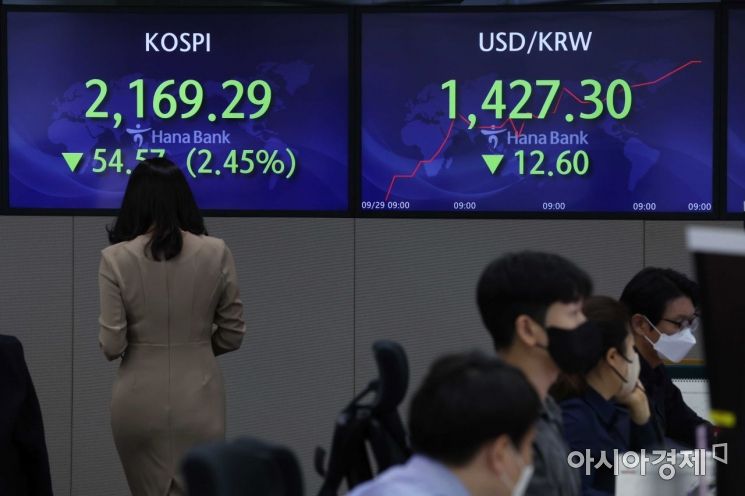 On the 29th, dealers were working in the dealing room of Hana Bank in Euljiro, Seoul. On this day, the KOSPI index opened at 2197.75, up 28.46 points (1.31%) from the previous trading day. The won-dollar exchange rate opened at 1424.5, down 15.4 won. Photo by Moon Honam munonam@
[Asia Economy Reporters Ji Yeon-jin and Kwon Jae-hee] Where is the ‘real’ bottom of the domestic stock market? Amid recession concerns originating from the UK and forecasts of China’s economic slowdown, the KOSPI has fallen to the 2100 level. The index, which reached the 3300 mark in July last year, has dropped by 34.37% in just over a year, retreating to pre-COVID-19 levels. The market expects that, when conservatively assessing the financial strength of domestic listed companies, the index could fall further to the 2050 level.
According to the Korea Exchange on the 29th, the KOSPI started the day with a rebound of over 1%. As of the previous day, the price-to-book ratio (PBR) of the KOSPI index stood at 0.84, encouraging retail investors to buy at low prices. A PBR below 1 means that selling all companies listed on the stock market at their book value would still yield a profit. This level is close to the 0.81 recorded during the 2008 global financial crisis triggered by the Lehman Brothers collapse in the US.
The sharp drop the previous day was due to concerns that the UK government’s large-scale tax cut plan would worsen fiscal difficulties, combined with the World Bank’s forecast of a recession in China. Additionally, Apple’s cancellation of its iPhone production increase plan due to weak sales in China further fueled investors’ risk-averse sentiment. The British pound, Chinese yuan, and Japanese yen all plummeted, and the won-dollar exchange rate exceeded 1440 won during the session.
However, analyses suggest that the possibility of a financial crisis in these countries is low. In fact, following the Bank of England’s (BOE) announcement of bond purchases and the US stock market’s rise the previous day, the domestic stock market also showed a strong rebound on this day. Kim Young-hwan, a researcher at NH Investment & Securities, explained, "The countries currently facing highlighted risks, such as Japan, China, and the UK, are unlikely to actually fall into crisis or cause turmoil in global financial markets. Structurally, these countries have a low risk of foreign exchange crises: Japan and China have large foreign exchange reserves and low external debt ratios, and the UK has a standing currency swap agreement with the US."
◆Not a Financial Crisis but a Recession= Recent pressure on the stock market from the sharp rise in the dollar should be interpreted as a recession rather than a financial crisis in specific countries. NH Investment & Securities applied the average KOSPI price-to-earnings ratio (PER) of 8.2 times during past recessions in 2012, 2013, and 2019 to the current 12-month forward earnings per share (EPS) of the KOSPI, indicating a bottom index level of 2050. However, there is a possibility of a further decline. Researcher Kim said, "The index is calculated based on past recession cases. It shows that the domestic stock market is undervalued, but since financial markets always have uncertainties, additional declines are possible." He added that even if the KOSPI temporarily undershoots past low valuations, the duration of such a period would not be long.
Meritz Securities, considering the current high interest rates and ongoing cost increases, calculated the KOSPI index assuming a minimum return on equity (ROE) of 7% for domestic companies experiencing profitability deterioration, which also resulted in a level of 2054. Currently, the capital of KOSPI-listed companies is 1887 trillion won, meaning that with a 7% ROE, they earn about 132 trillion won annually. Lee Jin-woo, a researcher at Meritz Securities, said, "Compared to last year’s nearly 180 trillion won in profits (excluding one-time gains), this is a conservative scenario with about a 50 trillion won earnings impairment. Unless there is a debt crisis, further sharp declines from the current level would be considered oversold."
Although there are only negative factors and no momentum for a rebound, some opinions suggest that since the KOSPI has hit new yearly lows, it will likely trade sideways in a box range near the bottom rather than falling further. Na Jung-hwan, a researcher at Cape Investment & Securities, analyzed, "Some express concerns that the KOSPI could fall below 2000, but considering that the low during the financial crisis was around 2050, this is an excessive worry." Korea Investment & Securities, Hana Securities, and DB Financial Investment also set the KOSPI’s lower bound for October at around 2100.
◆Must Also Consider a Collapse Below 2000= Given the difficult times, advice has been given to approach the market conservatively. Kim Dae-jun, a researcher at Korea Investment & Securities, said, "Estimates for corporate net profits in Q3 and Q4 may continue to be revised downward, so now is a time to wait a bit longer. Since the environment is unfavorable for investment, it is necessary to adjust portfolios focusing on sectors like automobiles and transportation, where earnings estimates are steadily increasing."
On the other hand, some pessimistic forecasts suggest that the KOSPI could fall below 2000 during this downturn. Heo Jae-hwan, a researcher at Eugene Investment & Securities, said, "Assuming that next year’s profits of Korean listed companies decrease by at least 5-10% compared to this year, the appropriate KOSPI level would be between 1920 and 2020. We should keep open the possibility that the KOSPI index could fall below 2000."
Kim Hyung-ryul, head of the Kyobo Securities Research Center, described next month’s market outlook as a ‘journey to the underworld.’ Kim said, "Fundamental indicators to be announced from next month may suggest a relaxation in the degree of monetary policy tightening, but this cannot be a logical basis for viewing the index as bottomed and buying stocks at the low point." Lee Kyung-min, head of investment strategy at Daishin Securities, also said, "The medium- to long-term downtrend of global stock markets, including the KOSPI, is becoming more solid. Premature bottom calls should be avoided."
© The Asia Business Daily(www.asiae.co.kr). All rights reserved.
![Clutching a Stolen Dior Bag, Saying "I Hate Being Poor but Real"... The Grotesque Con of a "Human Knockoff" [Slate]](https://cwcontent.asiae.co.kr/asiaresize/183/2026021902243444107_1771435474.jpg)















