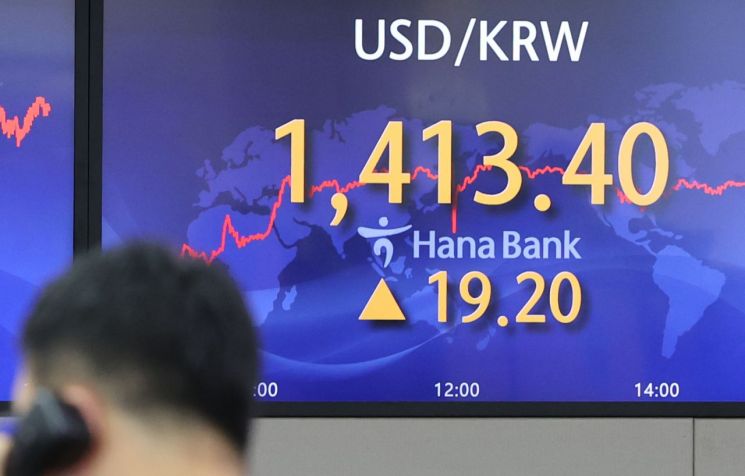
[Asia Economy Reporter Kwon Jae-hee] The Korean won to US dollar exchange rate (won-dollar exchange rate) has broken through the psychological support level of 1,400 won, and there are expectations that the 'strong dollar' trend will continue for the time being. The securities industry forecasts that the strong dollar trend will last at least until the end of the year, highlighting the need to pay attention to sectors that benefit from the strong dollar era.
On the 26th, in the Seoul foreign exchange market, the won-dollar exchange rate was trading at 1,421 won, down 0.14% from the previous trading day. The won-dollar exchange rate broke through 1,400 won for the first time in 13 years and 6 months since the global financial crisis on the 22nd and has been moving in the 1,400 range since then. The won-dollar exchange rate, which was 1,191.8 won on the first trading day of this year (January 3), entered the 1,200 range, known as the 'psychological resistance level,' in February, and in September, it surpassed 1,400 won, considered the 'financial crisis red line.'
There are also views that if domestic and international negative factors worsen, such as the prolonged Ukraine war leading to a worsening European energy crisis, concerns over China's economic recession, and an expanding trade deficit, the exchange rate could surge to the 1,500 level.
Park Sang-hyun, a researcher at Hi Investment & Securities, said, "The Federal Open Market Committee (FOMC) meeting in September reaffirmed the Federal Reserve's aggressive interest rate hike stance, further strengthening the dollar's bullish trend," adding, "The king dollar phenomenon is expected to intensify at least until the end of the year, acting as a factor that increases uncertainty in the global financial market."
As the won-dollar exchange rate soars, attention is focusing on high exchange rate beneficiaries such as finished car manufacturers with a high export ratio. Representative examples include finished car companies. Labor Gil, a researcher at Shinhan Financial Investment, said, "When the exchange rate rises by 10%, the operating profit margin of companies such as automobiles and auto parts has increased by 3.3 percentage points."
In fact, foreigners have been steadily buying Hyundai Motor and Kia, with Hyundai Motor's foreign ownership ratio at 29.01%, the highest level this year. Kia's foreign ownership ratio is also at its highest this year at 37.07%.
Recently, earnings estimates for Hyundai Motor and Kia have also been revised upward due to the rise in the won-dollar exchange rate. Hyundai Motor's operating profit consensus for this year is 10.232 trillion won, up from 10.1447 trillion won one month ago and 8.2857 trillion won three months ago.
Secondary battery and parts-related stocks that supply finished car manufacturers are also classified as beneficiaries. The auto parts industry's export ratio to the US was 27.4% over the past five years but jumped to 34.7% this year. Secondary batteries also nearly doubled from 18.9% to 38% during the same period.
Recently, clothing OEM (Original Equipment Manufacturer) companies have also emerged as beneficiaries of the exchange rate. The combined dollar sales of the three OEM companies (Youngone Trading, Hwaseung Enterprise, Hansae Co., Ltd.) in the first half increased by 38%, but in won terms, it rose by as much as 52% due to the exchange rate effect. OEM companies price raw material costs, which depend on sales and imports, in dollars, but most costs, including wages, are paid in local currencies of Southeast Asia where the factories are located. Park Ha-kyung, a researcher at Korea Investment & Securities, analyzed, "Clothing OEMs are expected to exceed operating profit expectations in the third quarter due to the added variable of exchange rate increases during the peak season."
Kim Dae-jun, a researcher at Korea Investment & Securities, advised, "It is worth considering investing in stocks that foreigners are steadily net buying and whose profit forecasts are rising."
© The Asia Business Daily(www.asiae.co.kr). All rights reserved.
![Clutching a Stolen Dior Bag, Saying "I Hate Being Poor but Real"... The Grotesque Con of a "Human Knockoff" [Slate]](https://cwcontent.asiae.co.kr/asiaresize/183/2026021902243444107_1771435474.jpg)















