Foreigners and Institutions Sell Together
"Concerns Over Economic Recession Are a Negative Factor for Korea's Export-Dependent Stock Market"
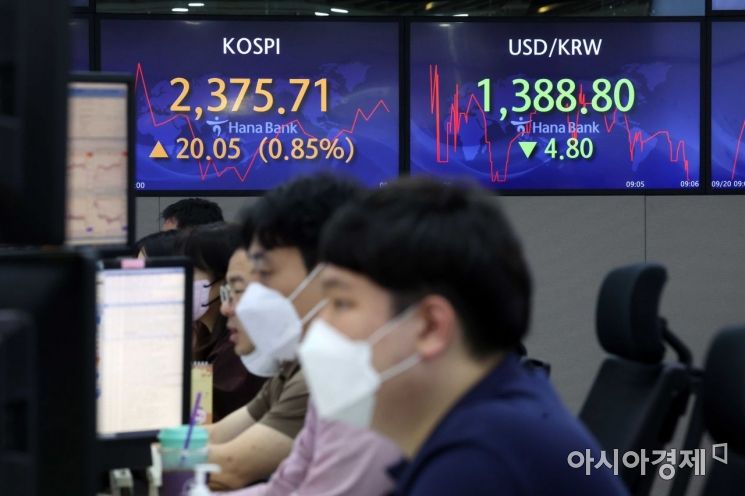 On the 20th, dealers are working in the dealing room of Hana Bank in Euljiro, Seoul. On this day, the KOSPI index opened at 2,373.64, up 17.98 points (0.76%) from the previous trading day. The won-dollar exchange rate opened at 1,390.0, down 3.6 won. Photo by Moon Honam munonam@
[Asia Economy Reporter Ji Yeon-jin] The KOSPI index is slightly widening its intraday losses on the 21st. This comes as concerns over an economic recession spread ahead of the U.S. Federal Open Market Committee (FOMC) interest rate decision, leading to simultaneous selling by foreign and institutional investors.
As of 10:30 a.m. on the day, the KOSPI index was trading at 2,344.23, down 23.61 points (1.00%) from the previous day. Foreign investors sold a net 147.5 billion KRW worth of shares, and institutions also sold about 63.9 billion KRW. On the other hand, individual investors bought a net 210.9 billion KRW, supporting the downside of the index.
The decline in the index was largely due to the U.S. stock market shrinking sharply the previous day amid recession fears, which dampened investor sentiment, as well as the rebound of the exchange rate that had paused the day before. On this day, the won-dollar exchange rate rose 4.1 points (0.30%) from the previous day, breaking through 1,390 KRW again.
Won-Dollar Exchange Rate Breaks Through 1,390 KRW Again
Earlier, Germany's August Producer Price Index surged 45.8% year-on-year, marking a historic high, while U.S. automaker Ford's expected poor performance due to supply shortages reignited recession concerns. Additionally, with the Federal Reserve's rate hike looming, U.S. Treasury yields soared, further fueling recession fears.
Seosangyoung, a researcher at Mirae Asset Securities, explained, "The ongoing recession issue has continuously impacted and dampened risk asset preference, which negatively affected the Korean stock market that is highly dependent on exports. The dollar's strength against other currencies, driven by expectations of continued Fed rate hikes and increased safe-haven demand amid global recession concerns, also burdened foreign investor flows."
Among the top market cap stocks in KOSPI, Samsung SDI recorded the largest intraday drop, falling nearly 3%. Samsung Electronics slid to 55,100 KRW early in the session, rewriting its 52-week high, while LG Energy Solution, SK Hynix, Samsung Biologics, and Hyundai Motor also posted losses exceeding 1%. NAVER and Kakao also fell nearly 2%, hitting new 52-week lows.
The KOSDAQ index fell 4.78 points (0.63%) to 755.57. However, with 606 stocks rising and 773 falling, the atmosphere is more favorable compared to the KOSPI market. Foreign investors are net sellers of 61.5 billion KRW and institutions of 6.3 billion KRW, while individuals are net buyers of about 73.3 billion KRW.
Among the top market cap stocks in KOSDAQ, EcoPro BM is rising nearly 2%, and Pearl Abyss is also up more than 1%, supported by foreign buying. Pearl Abyss has seen foreign investors buying net for eight consecutive trading days. Additionally, HLB, Kakao Games, and EcoPro are showing firm gains. Conversely, Celltrion Healthcare and Celltrion Pharm are down 2.22% and 1.76%, respectively.
The decline in biopharmaceutical stocks is due to concerns about the efficacy of a new drug that Hanmi Pharmaceutical licensed out to the U.S. On this day, Hanmi Pharmaceutical and Hanmi Science fell more than 10%, and new drug developers such as Engchem Life Sciences and Appclon also showed sharp declines.
On the other hand, YTN continued its two-day limit-up streak amid privatization expectations, and Korea Economic TV, a likely acquirer of YTN, also surged. Semiconductor inspection equipment maker WI also rose to the price limit again following its sharp rise the previous day.
© The Asia Business Daily(www.asiae.co.kr). All rights reserved.
![Clutching a Stolen Dior Bag, Saying "I Hate Being Poor but Real"... The Grotesque Con of a "Human Knockoff" [Slate]](https://cwcontent.asiae.co.kr/asiaresize/183/2026021902243444107_1771435474.jpg)
















