Democratic Party Pushes 400,000 Won Increase in Basic Pension
Focus on Expanding Scope Including Abolishing Couple Reduction in Many Pending Bills
Calls to Discuss Alongside National Pension in Pension Special Committee
[Asia Economy Reporter Naju-seok] Following Lee Jae-myung, leader of the Democratic Party of Korea, expressing his intention to push for a "400,000 KRW increase in the Basic Pension," related legislation has also been submitted to the National Assembly, bringing Basic Pension reform to the forefront. The proposed bills specify an increase in the Basic Pension amount and an expansion of eligibility, which is expected to significantly increase the financial burden.
According to the National Assembly's legislative information system on the 19th, a total of 18 bills, including the Basic Pension Act proposed by Democratic Party lawmaker Wi Seong-gon, which centers on raising the Basic Pension to 400,000 KRW, are currently pending. Wi's bill includes revising the Basic Pension from the 2021 base amount of 300,000 KRW to 400,000 KRW in 2023. The government has already set the Basic Pension at 322,000 KRW next year, linked to inflation and other factors, based on the 300,000 KRW amount in 2021. The Democratic Party's proposal aims to accelerate the pace of the Basic Pension increase. Other bills include provisions to relax eligibility criteria and various reduction standards, making related discussions inevitable.
Kim Seong-hwan, chairman of the Democratic Party's Policy Committee, said in a call, "The increase in the Basic Pension has the character of a party consensus," adding, "The Democratic Party's position has been decided to raise the Basic Pension from 300,000 KRW to 400,000 KRW as promised during the presidential election and to expand its scope." Earlier, it was reported that Lee, through a closed Democratic Party Supreme Council meeting, presented the expansion of the Basic Pension to 400,000 KRW as a key livelihood task.
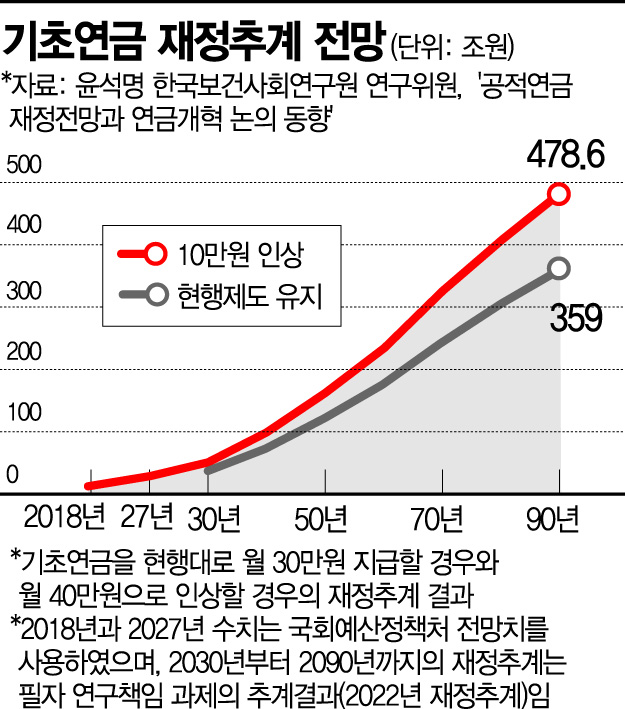
The issue is funding. According to "Public Pension Financial Outlook and Pension Reform Discussion Trends," submitted by Yoon Seok-myung, a research fellow at the Korea Institute for Health and Social Affairs, to the National Assembly Budget Office, the current 300,000 KRW Basic Pension requires 37 trillion KRW in funding by 2030, but if raised to 400,000 KRW, it will increase to 49.3 trillion KRW.
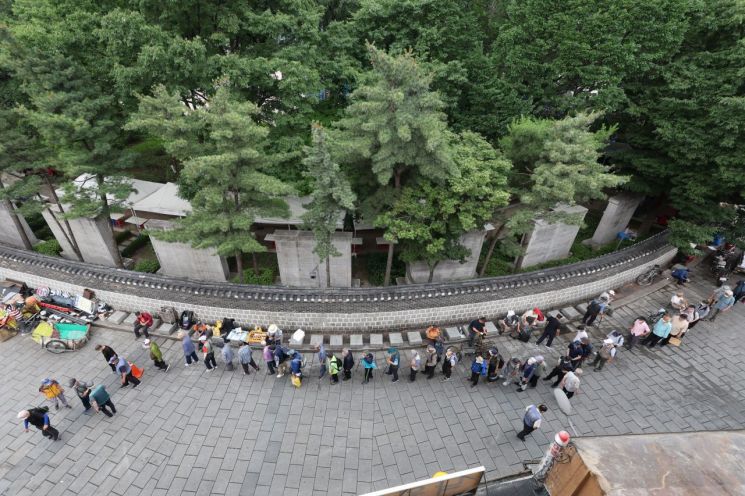
The financial burden also increases during adjustments to eligibility and reduction criteria. Currently, the Basic Pension is paid only to the bottom 70% income group, and reductions apply if couples receive it together or if recipients receive a certain amount or more from the National Pension. The Democratic Party has already declared the abolition of the couple reduction. Furthermore, if the pension is paid to all elderly aged 65 and over or if the linkage with the National Pension is abolished, the financial burden will increase.
Depending on the scenario, if all restrictions on Basic Pension eligibility are lifted (as proposed by Democratic Party lawmaker Ko Young-in), an additional annual cost of 1.46421 trillion KRW will be required. According to the Budget Office's cost estimates, the Basic Pension will cost an average of 2.43514 trillion KRW annually over the next five years starting in 2023, but if all reduction systems are removed and the pension is paid to all elderly aged 65 and over, the annual cost will rise to 3.89935 trillion KRW. The Democratic Party has only set the direction for increasing the Basic Pension cost to 400,000 KRW and is reportedly still estimating the detailed methods.
Within the National Assembly, there is a consensus that the Basic Pension issue cannot be dealt with independently, as pension reform committees have agreed to adjust other pillars of old-age income security such as the National Pension. Kang Hoon-sik, the Democratic Party's welfare committee whip, said, "Increasing the Basic Pension alone cannot solve the old-age income problem, so it has to be discussed together with pension reform," adding, "(This issue) should be discussed jointly by the Pension Reform Special Committee and the Welfare Committee."
© The Asia Business Daily(www.asiae.co.kr). All rights reserved.
![Clutching a Stolen Dior Bag, Saying "I Hate Being Poor but Real"... The Grotesque Con of a "Human Knockoff" [Slate]](https://cwcontent.asiae.co.kr/asiaresize/183/2026021902243444107_1771435474.jpg)
















