Samsung Challenges '2050 Carbon Neutrality'
Top 4 Korean Groups Join RE100
Korea's Renewable Energy Share One-Quarter of OECD Average
"Serious Cost Issues... Government Support Needed"
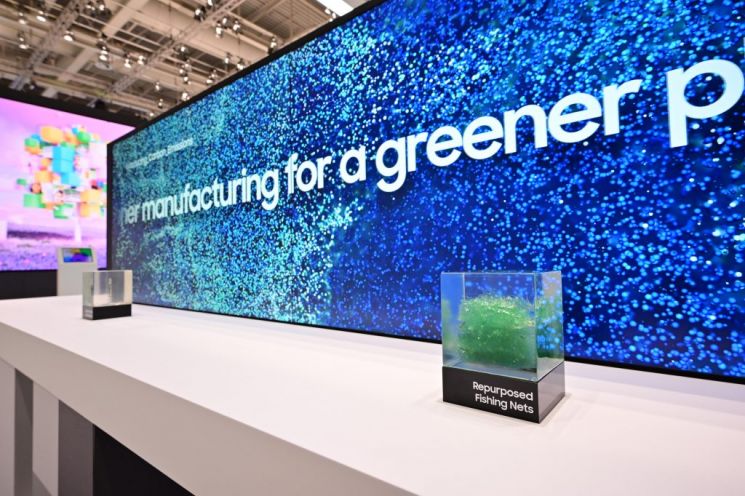
[Asia Economy Reporter Han Ye-ju] Samsung Electronics has decided to join the private campaign 'RE100,' which aims to switch 100% of its electricity consumption to renewable energy by 2050. With this, the four major domestic conglomerates?Samsung, Hyundai Motor, SK, and LG?have all joined RE100. However, it remains a challenge whether electricity demand and costs can be managed solely with eco-friendly energy sources excluding nuclear power.
According to industry sources on the 18th, Samsung Electronics recently announced its 'New Environmental Management Strategy' and revealed its decision to join RE100.
RE100 is a campaign where companies commit to switching 100% of their electricity consumption to renewable energy. It was launched in 2014 through a collaboration between the UK non-profit The Climate Group and the global carbon disclosure initiative, the Carbon Disclosure Project (CDP). When a company submits an application, membership is confirmed after approval by The Climate Group. Following global companies such as Apple and Google joining RE100, the campaign has become a significant issue in the international economy as it also encourages partner companies to participate.
This has had a considerable impact on South Korean companies, which are highly dependent on exports. According to a survey conducted by the Korea Chamber of Commerce and Industry targeting 300 domestic manufacturing companies, about 29% of large enterprises and 10% of mid-sized companies have been required by global demand companies to use renewable energy.
As a result, domestic companies are also joining the initiative. Since SK Group affiliates such as SK Hynix first declared their participation in 2020, 22 companies including Hyundai Motor and LG Energy Solution have joined.
However, the problem is that there is not enough renewable energy in South Korea to meet corporate demand. As of last year, the share of renewable energy generation in the country was 7.5%, only a quarter of the OECD average of 30%.
According to the '2021 Electricity Consumption Ranking of High-Usage Companies' submitted by Korea Electric Power Corporation (KEPCO) to Rep. Gu Ja-geun of the People Power Party, Samsung Electronics used 18.41 TWh (terawatt-hours) and SK Hynix used 9.21 TWh last year. However, the renewable energy secured domestically by Samsung Electronics during the same period was only 500 GWh, less than one-thirtieth of its electricity consumption.
There are also forecasts that the domestic renewable energy power trading market will be shaken by Samsung Electronics' declaration to participate in RE100. Since Samsung Electronics consumes massive amounts of electricity, its participation could lead to a shortage in the supply of electricity generated from renewable energy.
In the industry, price is considered the most important factor when procuring renewable energy, and many agree that it is too expensive. While renewable energy costs are relatively low at overseas business sites, domestic renewable energy costs are nearly 1.5 to 2 times higher than those abroad.
Experts advise that the government should introduce active support measures, such as reducing ancillary costs in the renewable energy supply chain, to assist companies facing urgent challenges.
© The Asia Business Daily(www.asiae.co.kr). All rights reserved.
![Clutching a Stolen Dior Bag, Saying "I Hate Being Poor but Real"... The Grotesque Con of a "Human Knockoff" [Slate]](https://cwcontent.asiae.co.kr/asiaresize/183/2026021902243444107_1771435474.jpg)















