Cabbage Prices Soar... Up 87.3% in One Year
Prices of Packaged Kimchi from Bibigo, Jonggajib Also Rise
"Major Agricultural Product Prices Expected to Increase Significantly in September"
"Thought Prices Would Stabilize After Chuseok," Consumers Sigh
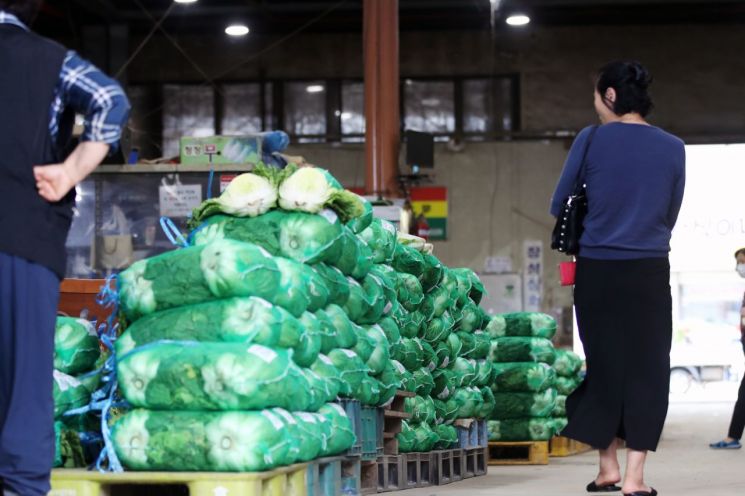 On the afternoon of the 13th, a citizen is seen leaving after asking about the price of napa cabbage at Gakhwa Agricultural Market in Buk-gu, Gwangju. This summer, with the combination of heatwaves and heavy rain, and Typhoon Hinnamnor (No. 11) making landfall on the Korean Peninsula, the wholesale price of napa cabbage has doubled in just one month.
 [Image source=Yonhap News]
[Asia Economy Reporter Kim Jung-wan] #. Shim (60s), who runs a restaurant in Eunpyeong-gu, Seoul, has been deeply troubled by the sharply rising cabbage prices this year. Shim said that not only has he given up on making kimchi for the winter kimjang season, but he also finds it burdensome to prepare kimchi as a side dish. He lamented, "Even in difficult times, I always prepared kimchi and vegetable side dishes, but with prices continuously rising, even this has become a burden."
As the burden of 'grocery basket prices' continues day by day, recent vegetable prices have nearly doubled in a year, deepening concerns among ordinary people. With high prices for vegetables such as cabbage and radish, some consumers have already given up on winter kimjang, while the food industry has announced plans to raise the prices of packaged kimchi.
According to the Agricultural Products Distribution Information (KAMIS) of the Korea Agro-Fisheries & Food Trade Corporation (aT) on the 16th, the average price of one head of cabbage as of the previous day was 10,204 won, up 53.2% from 6,660 won a month ago. Compared to 5,448 won at the same time last year, this is an 87.3% increase. On the same day, the price of one radish was 3,940 won, up 25.2% from last month (3,146 won) and 92.3% from the same period last year (2,048 won).
Prices of other agricultural products have also risen significantly compared to a year ago. As of the 14th, 20 kg of radish cost 27,580 won, 2.5 times higher than 11,020 won a year ago, and 15 kg of onions cost 22,760 won, 1.6 times higher than 14,415 won. In addition, rising energy and logistics costs have increased production cost burdens for food companies.
There are also forecasts that vegetable prices will rise further this month. According to the Korea Rural Economic Institute (KREI) and others, prices of major agricultural products in September are expected to rise significantly compared to last year. The institute forecasts that the wholesale price of Cheongyang green chili peppers will be 48,000 won per 10 kg this month, an 89% increase from 25,400 won in the same month last year. Wholesale prices of other vegetables such as cucumber chili peppers, Baekdadagi cucumbers, Chwichung cucumbers, red paprika, and zucchini are also expected to rise by up to 80%.
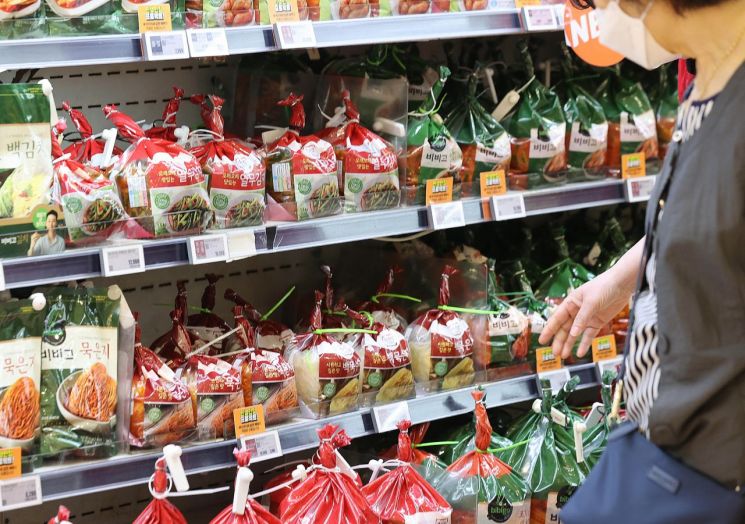 Due to poor crop yields, the prices of napa cabbage and radish have increased by 2.3 times and 2.5 times respectively compared to a year ago, intensifying the production cost burden on food companies, leading to a rise in packaged kimchi prices as well. Daesang will raise the price of its "Jongga Jip" kimchi by an average of 9.8% starting from the 1st of next month. CJ CheilJedang began a phased price increase of its "Bibigo" kimchi by an average of 11.0% across different channels starting from the 15th. The photo shows the kimchi display at a large supermarket in downtown Seoul on the 16th. [Image source=Yonhap News]
Due to the rise in vegetable prices such as cabbage, the price of packaged kimchi has also increased. According to the related industry, CJ CheilJedang raised the price of kimchi, including the 'Bibigo' brand, by an average of 11% starting from the 15th. As a result, the price of Bibigo whole cabbage kimchi (3.3 kg) sold at large supermarkets increased from 30,800 won to 34,800 won. Daesang will also raise the price of kimchi, including 'Jongga Jip,' by an average of 9.8% starting from the 1st of next month. Earlier this year, CJ CheilJedang and Daesang had already raised kimchi prices once between February and March.
Because of this situation, citizens’ sighs have deepened. Ahn (53), who felt the price increase while shopping for Chuseok, said, "I thought prices would stabilize after Chuseok, but seeing them continue to rise, I gave up on kimjang early this year. Preparing for the Chuseok table was more burdensome than last year, so now I really have to save."
Meanwhile, the Bank of Korea expects the inflation trend to continue for the time being. In the 'Monetary and Credit Policy Report' submitted to the National Assembly on the 8th, the Bank of Korea stated regarding the recent price situation, "Considering oil price forecasts and base effects, the inflation rate is expected to peak during the second half of this year, but there are considerable upside risks, so the peak may be delayed or the high inflation situation may persist." It added, "Since inflation is expected to continue at a high rate significantly exceeding the target level, it is necessary to maintain the current policy of raising interest rates."
© The Asia Business Daily(www.asiae.co.kr). All rights reserved.
![Clutching a Stolen Dior Bag, Saying "I Hate Being Poor but Real"... The Grotesque Con of a "Human Knockoff" [Slate]](https://cwcontent.asiae.co.kr/asiaresize/183/2026021902243444107_1771435474.jpg)
















