KOSPI Led by Institutional 'Selling'
Morning Decline Starts on US Economic Data
Strong Employment and Consumption, US High-Intensity Tightening Continues
Afternoon Impacted by Weak Yuan
Stock Market Sentiment Falls Due to Won Synchronization Effect
[Asia Economy Reporter Hwang Yoon-joo] The KOSPI and KOSDAQ closed down over 1%. The two major indices started lower due to the reaffirmation of a high-intensity tightening stance following the previous day’s strong U.S. employment and consumption data. In the afternoon, continued weakness in the yuan further dampened investor sentiment.
On the 16th, the KOSPI closed at 2,382.78, down 0.79% (-19.05 points) from the previous day. It opened at 2,387.56, down 0.59% (-14.27 points), but the decline widened to over 1% at one point in the afternoon.
◆ Investor sentiment weakens due to yuan depreciation... KOSPI decline led by institutional selling = Factors influencing the domestic stock market that day included the previous day’s U.S. economic indicators and the yuan’s movement. Despite improvements in China’s three major economic indicators exceeding expectations, the yuan’s weakness had a greater impact.
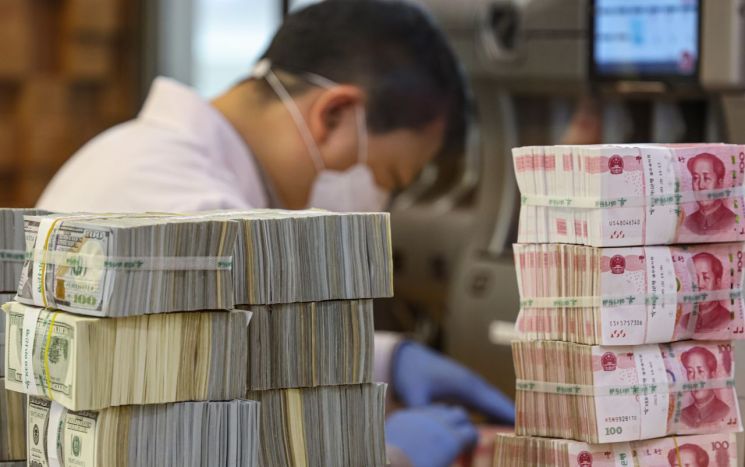
At around 6:30 p.m. the previous evening in the Hong Kong offshore market, the Chinese yuan traded at 7.0187 yuan per dollar. Breaking the 7-yuan mark was the first time in over two years. It shows synchronization with Korea’s foreign exchange market. If a 'Po-chi' (破七, breaking 7 yuan per dollar) occurs, there is a high possibility of a sharp drop in the won exchange rate as well.
Foreigners and institutions showed selling pressure throughout the trading session. In particular, institutions increased their selling volume as time passed, leading the KOSPI’s decline. Individuals and institutions net sold 47.2 billion KRW and 409.3 billion KRW, respectively. In the futures market, foreigners sold 92.6 billion KRW and institutions 42.7 billion KRW. Although individuals alone bought 446.1 billion KRW, it was insufficient to defend the index.

◆ Strong U.S. employment and consumption... Fed’s high-intensity tightening justified = U.S. employment and consumption data also influenced the domestic stock market that day.
Initial jobless claims in the U.S. were recorded at 213,000, lower than the forecast (228,000) and the previous week’s figure (218,000). August retail sales increased by 0.3% month-on-month, improving from last month’s reported -0.4%, and August industrial production fell by 0.2% month-on-month, underperforming last month’s reported 0.5% increase.
The strong employment data provided the Federal Reserve (Fed) with grounds to continue its rate hike policy. This increased concerns about economic slowdown, leading to a significant drop in petrochemical stocks in the KOSPI market.
Among the top market capitalization stocks, automobiles stood out that day. Hyundai Motor and Kia closed up 1.77% and 1.50% at 201,500 KRW and 81,200 KRW, respectively.
Researcher Kim Seok-hwan of Mirae Asset Securities explained, "The expectation of improved export performance as beneficiaries of the strong dollar was reflected, and also the news that Kia Motors plans to launch the first electric vehicle model year change, 'The 2023 EV6,' influenced the market."
Samsung Electronics touched a 52-week low of 55,500 KRW during the session but closed up 0.36% at 56,200 KRW near the end of trading. Meanwhile, LG Chem (-3.50%) had the largest decline, followed by Naver (-2.44%) and Samsung SDI (-2.11%).
Refining stocks S-Oil and SK Innovation fell 5.84% and 4.05%, respectively, amid forecasts of reduced oil demand due to economic slowdown.

◆ KOSDAQ led by foreign selling... SM surges throughout the session = The KOSDAQ closed at 771.64, down % (-p) from the previous day. It opened at 776.49, down 0.63% (-4.89 points), but the decline widened in the afternoon.
Foreign and institutional selling pressured the index downward. Foreigners led the selling with net sales of 140.6 billion KRW, and institutions net sold 92.1 billion KRW. Meanwhile, individuals alone net bought 42.7 billion KRW.
Among the top market capitalization stocks, JYP Entertainment rose 0.16% from the previous day, ranking 10th.
All others declined. EcoPro BM and EcoPro fell 3.76% and 3.09%, respectively, ranking among the top decliners. They were followed by Pearl Abyss (-2.35%), Celltrion Healthcare (-2.04%), and Alteogen (-2.14%).
The most notable KOSDAQ stock that day was SM, which showed a commitment to improving corporate governance. SM closed at 76,500 KRW, up 18.60% (12,000 KRW) from the previous day. After rising over 10% shortly after the opening, it maintained a sharp increase into the afternoon.
The previous day, SM announced it would terminate its contract with Lee Soo-man’s personal company, Like Planning. Although not yet finalized, the contract is expected to be terminated within the year. The previously backward corporate governance had weighed down SM’s stock price.
Contentree JoongAng, the producer of the drama "Suriname," fell for two consecutive trading days. After the Netflix original drama was released and the stock entered the rising popularity list, surpassing 40,000 KRW, investor sentiment sharply cooled as the Suriname government expressed intentions to consider legal action. The stock gave back all its gains.
Meanwhile, the won-dollar exchange rate opened at 1,399.0 KRW, up 5.3 KRW from the previous day, approaching 1,400 KRW. It later fell, closing down 5.7 KRW at 1,388.00 KRW.
© The Asia Business Daily(www.asiae.co.kr). All rights reserved.
![Clutching a Stolen Dior Bag, Saying "I Hate Being Poor but Real"... The Grotesque Con of a "Human Knockoff" [Slate]](https://cwcontent.asiae.co.kr/asiaresize/183/2026021902243444107_1771435474.jpg)
















