'Sindang Station Incident' Perpetrator Stalked Fellow Station Workers for Over 2 Years
Victim Filed Complaints Twice, but Police Took Passive Measures
Expert Says, "Active Consideration of Detention in Stalking Crimes Is Needed"
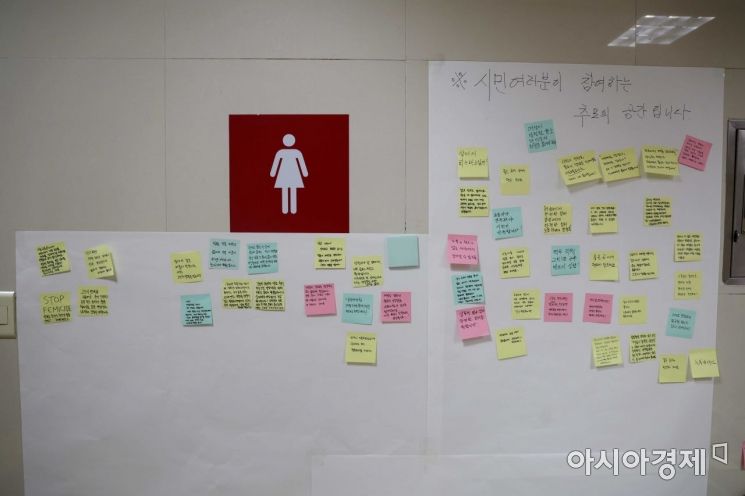 At the entrance of the women's restroom at Sindang Station on Seoul Subway Line 2, where a female attendant was killed by a coworker who had been stalking her, citizens continue to visit to pay their respects. Photo by Mun Ho-nam munonam@
[Asia Economy Reporter Kang Juhee] A 20-year-old female subway employee was murdered by a 30-year-old male coworker in the women's restroom at Sindang Station on Seoul Subway Line 2. The man had been obsessively stalking the victim for over three years. On the day of the incident, he meticulously prepared by bringing a weapon in advance and waited for more than an hour until the victim appeared. Although the victim had filed complaints twice against the man for illegal filming and stalking, signaling danger, she was unable to prevent the perpetrator who approached with the intent to kill.
According to the police and Seoul Metro, the incident occurred around 9 p.m. on the 14th at Sindang Station. The perpetrator, identified as Mr. A, followed the victim, Ms. B, who was patrolling the women's restroom, and killed her with a weapon. The stabbed victim used the emergency bell in the restroom to call for help, and station staff, social service workers, and citizens apprehended the perpetrator at the scene. Ms. B was transported to the hospital in cardiac arrest and passed away about two and a half hours later.
The police believe Mr. A harbored resentment against Ms. B and committed a 'planned crime.' Mr. A had prepared the weapon in advance on the day of the incident and was wearing a disposable sanitary cap during the crime. Both Mr. A and Ms. B joined Seoul Metro in 2018 as 'cohorts' and met during new employee training. However, stalking began after Mr. A forced meetings with Ms. B.
After nearly three years of stalking, Ms. B filed a complaint against Mr. A in October last year for violating the Special Act on the Punishment of Sexual Crimes (illegal filming using cameras, threats using filmed materials). During the police investigation, Mr. A was suspended from his position at Seoul Metro on the 13th of the same month. Nevertheless, Mr. A continued stalking by contacting Ms. B multiple times, demanding settlements, and sending threatening messages. Ultimately, Ms. B filed a second complaint against Mr. A in January for violating the Stalking Crime Punishment Act.
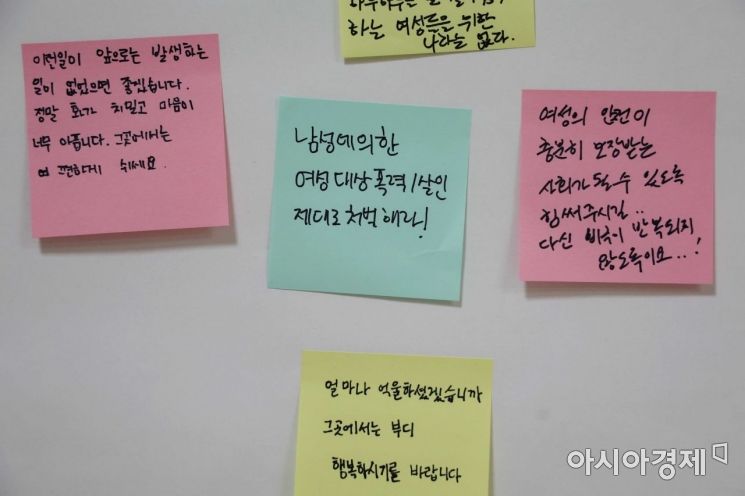 At the entrance of the women's restroom at Sindang Station on Seoul Subway Line 2, where a female attendant was killed by a coworker who had been stalking her, citizens continue to visit to pay their respects. Photo by Moon Honam munonam@
Despite Ms. B filing complaints twice to the police about stalking, proper victim protection was not provided. When Ms. B first filed a complaint, the police requested an arrest warrant for Mr. A, but the court dismissed it, stating there was no risk of evidence tampering or flight. After the first complaint, 'crime victim safety measures (personal protection)' were implemented for Ms. B but ended after one month. When Ms. B filed the second complaint, the police did not request an arrest warrant, nor were additional protection measures taken.
Mr. A was indicted and brought to trial in February and June this year. The prosecution demanded a nine-year prison sentence for Mr. A on the 18th of last month. The court was scheduled to deliver a first-instance verdict on the 15th after consolidating the two cases. However, Mr. A brutally murdered Ms. B one day before the verdict.
Experts point out that leniency toward perpetrators and passive responses that do not provide protection unless requested by the victim cannot prevent crimes. Attorney Lee Eun-ui, who specializes in sexual crimes (Lee Eun-ui Law Office), said, "It has been pointed out repeatedly that the problem is that perpetrators are not detained even in similar past cases. Simply doing something for the victim does not provide proper protection." She emphasized, "Due to the nature of stalking crimes, the perpetrator contacting the victim alone should be considered a dangerous situation. Active consideration of detention for perpetrators of dating violence and stalking crimes is necessary."
Attorney Lee also noted that the fact that settlements with victims have an absolute influence on sentencing is a cause of repeated crimes. He said, "The judiciary views the presence or absence of settlements between victims and perpetrators as absolute," and "in the case of the Stalking Act, it is a semi-conditional offense (a crime that cannot be punished if the victim does not want it), which leads perpetrators to coerce settlements and threaten victims, causing secondary harm. As a result, perpetrators do not repent and, in extreme cases, this leads to retaliatory crimes."
© The Asia Business Daily(www.asiae.co.kr). All rights reserved.
![Clutching a Stolen Dior Bag, Saying "I Hate Being Poor but Real"... The Grotesque Con of a "Human Knockoff" [Slate]](https://cwcontent.asiae.co.kr/asiaresize/183/2026021902243444107_1771435474.jpg)
















