Why Is the Autumn Sky Especially Clear? ... The Effect of 'Light Scattering'
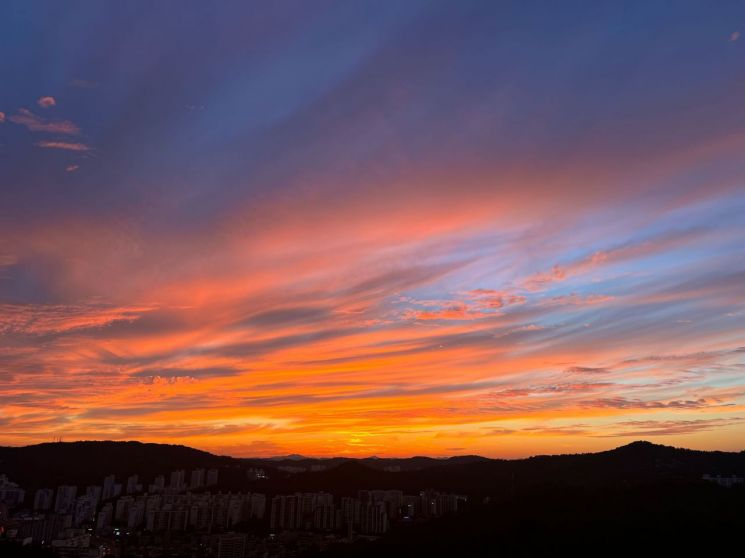 Recently, posts with hashtags such as 'sunrise', 'sunset', and 'sky' have been uploaded mainly on Instagram. Photo by Reader.
"33 years ago, in 1975, I taught English at Yesan Middle School in Chungnam as a member of the Peace Corps. The autumn sky in Korea I saw then was so beautiful. I will never forget the first autumn in Korea I saw."
[Asia Economy, Reporter Heo Midam] This was said by Kathleen Stephens, who served as the U.S. Ambassador to South Korea from 2008 to 2011, when she was first assigned to Korea.
As autumn arrives, unusually clear blue skies continue. Especially during sunrise and sunset, the sky turns particularly red. Why is the autumn sky uniquely blue and red?
Recently, posts tagged with hashtags like 'sunrise', 'sunset', and 'sky' have been continuously uploaded on social networking services (SNS). Netizens mainly post photos of skies dyed red by the dawn sunrise or the sunset glow. One netizen who posted a sunset photo said, "Just looking at the sunset fills my heart with emotion. It's a magnificent sight," adding, "The sky has been so beautiful lately that just quietly gazing at it lifts my mood."
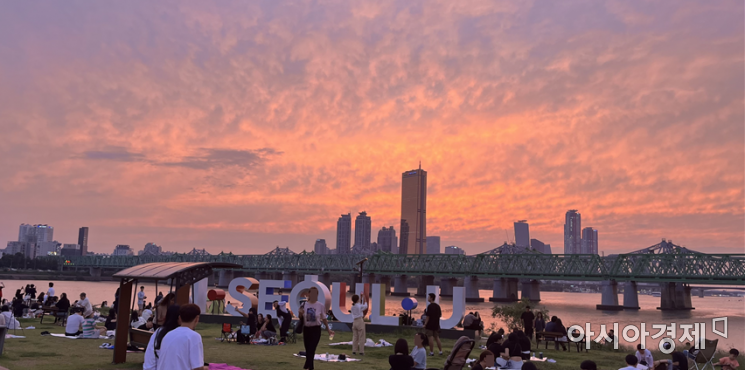
Why is the red sky more frequently observed in autumn? This is related to the phenomenon of 'light scattering.' Light scattering refers to the phenomenon where sunlight hits particles in the atmosphere (molecules, atoms, dust, etc.) and scatters irregularly in all directions. In particular, we can only see the visible light, which is the rainbow-colored part of sunlight. Visible light has colors ranging from red to violet depending on the wavelength. The closer the light is to red and orange, the longer the wavelength; the closer it is to blue and violet, the shorter the wavelength.
During sunset and sunrise, the sun's altitude is low, so the wavelength becomes longer. As a result, only the long-wavelength red light can pass through the atmosphere, allowing us to see the red-colored sunset. Especially in autumn, there is less dust in the atmosphere, and the amount of water vapor or droplets is relatively less compared to summer, so the light scattering process is less disturbed. Professor Lee Hyunho of the Department of Atmospheric Science at Kongju National University said, "In summer, humidity is often high. When the amount of water vapor exceeds a certain level, 'haze' (smoke and fog) forms, causing the sky not to appear red but rather dim."
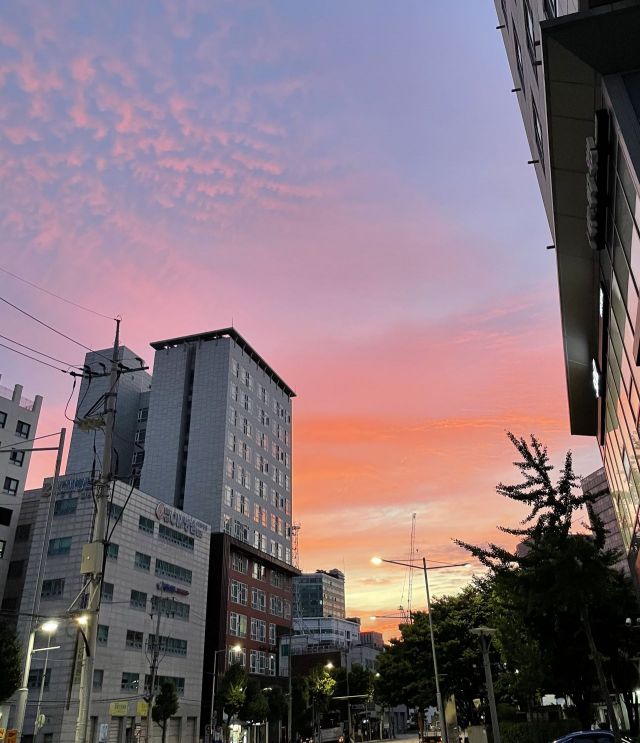
On the other hand, when the sun is high in the sky, sunlight passes through a shorter distance in the atmosphere. At this time, scattering of short-wavelength violet and blue light occurs, but since our eyes are not very sensitive to violet light, the sky appears blue. The reason why the autumn sky is particularly clear is also related to dry weather. In humid atmospheres like in summer, many water vapor particles in the air absorb sunlight and interfere with light scattering, making the sky appear hazy.
An official from the Korea Meteorological Administration said, "Due to the sun's altitude angle, the sky appears reddish during sunrise and sunset. When there are high-altitude clouds rather than low clouds, the combination of those clouds and the red color makes the sky appear even redder," adding, "Recently, there have been many high-altitude clouds, so red skies have been frequently observed." The official also said, "There is a saying that sunsets are redder before and after typhoons, but there are no related statistics or studies."
© The Asia Business Daily(www.asiae.co.kr). All rights reserved.
![Clutching a Stolen Dior Bag, Saying "I Hate Being Poor but Real"... The Grotesque Con of a "Human Knockoff" [Slate]](https://cwcontent.asiae.co.kr/asiaresize/183/2026021902243444107_1771435474.jpg)


















