Starting August 28 This Year, Mandatory Pallet Loading for Corn Shipment at Garak Market... Heat-Sensitive Corn Can Be Stably Palletized Without Quality Damage Using Net Covers
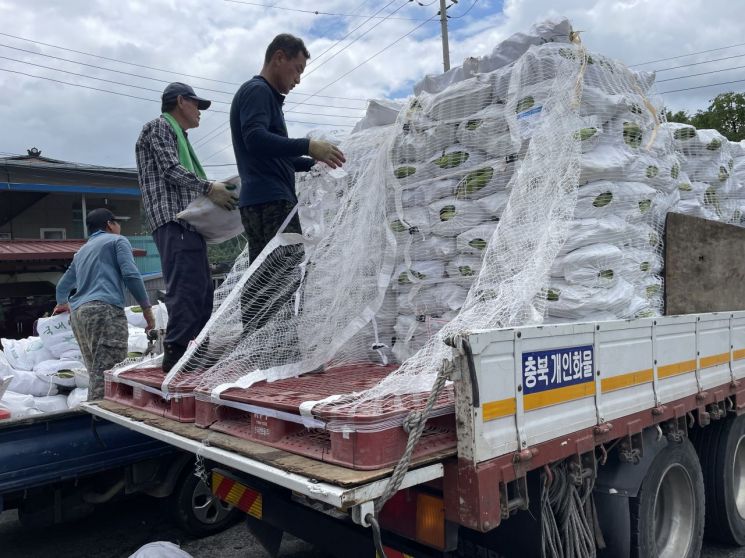
[Asia Economy Reporter Jongil Park] Seoul Agro-Fisheries & Food Corporation (President Youngpyo Moon) announced that the ‘Garak Market Corn Pallet Loading and Shipping Mandatory System,’ which began on the 28th of last month, has been stably implemented and is now fully established.
From the 28th of last month to the 12th of this month, the total corn shipment volume at Garak Market was 284 tons, all shipped on pallets.
Garak Market is currently undergoing a facility modernization project, and among them, Vegetable Building 2, where the corn category is housed, is scheduled for completion in the second half of next year. All shipment volumes are designed to be loaded and brought in on pallets.
Vegetable Building 2 is a controlled environment facility (6℃ in winter to 26℃ in summer), where cargo vehicle entry is prohibited, and only pallet-loaded goods are allowed for entry.
Accordingly, the corporation has been continuously communicating with distributors and shippers since 2020 to establish pallet shipments for the corn category. Especially this year, through distributor consultations (about 10 times), production area shipper consultations (5 times), and pilot projects (2 times), the mandatory pallet shipment system was successfully implemented.
The corporation closely communicated with distributors and shippers to discuss the timing of pallet introduction and the scope of subsidies, conducting a pilot period for pallet-loaded shipments from July 1st and implementing mandatory pallet shipments from August 28th.
Additionally, to ensure stable pallet loading and improve efficiency, the corporation conducted two pilot projects at production sites using net covers together with professional packaging companies. Through this, it was demonstrated that corn, which is sensitive to heat, can be safely shipped without product damage during the process of loading on pallets and unloading at the market.
With the establishment of pallet shipments, manual unloading has been replaced by mechanical unloading using forklifts, resulting in reduced unloading costs, resolution of heatstroke safety issues for unloading workers during hot seasons, reduced unloading waiting times, and improved traffic flow, among other positive effects.
Based on a pallet loading capacity of 80 bags (sacks), manual unloading costs 186 KRW per bag, totaling 14,880 KRW, whereas pallet unloading costs range from 6,000 to 7,000 KRW, resulting in up to approximately 60% reduction in unloading costs.
Corn is mainly traded in the summer season, and the outdoor parking lot is used as a temporary auction site. During hot seasons, manual unloading often causes safety issues such as heatstroke among unloading workers, which are resolved by mechanical unloading.
The unloading time, which took 2 hours manually, has been reduced to 15 minutes, significantly decreasing waiting times for truck drivers and greatly improving working conditions. As vehicle circulation speeds up, traffic flow inside and outside the market is also smoothly improved.
Kang Seongsu, Logistics Innovation Team Leader, said, “We deeply thank the distributors and shippers who cooperated in establishing corn pallet shipments,” and promised, “We will continue to communicate with shippers to devise ways to improve the efficiency of pallet loading.”
© The Asia Business Daily(www.asiae.co.kr). All rights reserved.
![Clutching a Stolen Dior Bag, Saying "I Hate Being Poor but Real"... The Grotesque Con of a "Human Knockoff" [Slate]](https://cwcontent.asiae.co.kr/asiaresize/183/2026021902243444107_1771435474.jpg)
















