Intentional Perpetrator Colleague Cannot Be Subrogation Target
Clarifying the Meaning of 'Third Party' in Article 87(1) of the Industrial Accident Compensation Insurance Act
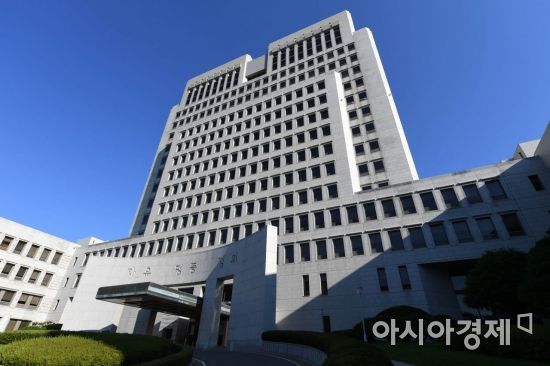
[Asia Economy Reporter Choi Seok-jin, Legal Affairs Specialist] The Supreme Court has ruled that the Korea Workers' Compensation and Welfare Service (hereinafter referred to as the Service) cannot exercise subrogation rights against a perpetrator who sexually harassed a colleague at work, leading to the colleague's extreme choice.
The ruling clearly states that the Supreme Court precedent, which holds that a fellow worker employed by the same employer cannot be the subject of subrogation under the Industrial Accident Compensation Insurance Act because they share an industrial accident compensation insurance relationship with the injured worker, also applies to fellow workers who commit intentional criminal acts.
The Supreme Court's Third Division (then presided over by Justice Kim Jae-hyung) announced on the 14th that it overturned the lower court's partial ruling in favor of the plaintiff in the appeal trial of the Service's subrogation claim lawsuit against Yoon, the perpetrator who sexually harassed and molested a colleague, and remanded the case to the Seoul Central District Court.
The court stated, "The lower court judged that the defendant falls under the 'third party' as defined in Article 87, Paragraph 1 of the Industrial Accident Compensation Insurance Act, reasoning that in cases where the perpetrator's conduct is highly socially condemnable, it is socially just for the fellow worker to bear ultimate responsibility," and added, "The lower court misinterpreted the legal principles regarding 'third parties' under Article 87, Paragraph 1 of the Industrial Accident Compensation Insurance Act, which affected the judgment," explaining the reason for reversal and remand.
Yoon, who worked as a senior researcher at a certain center, continuously made sexually harassing remarks and committed sexual molestation against a female subordinate in her 20s, A, who worked with him for over two years starting from June 2013, leading to A's extreme choice in September 2017.
After A's death, Yoon was prosecuted for forced molestation and sentenced to eight months in prison with a two-year probation in the first trial in January 2019. In October of the same year, the appellate court reduced the sentence to a fine of 10 million won, and the sentence was finalized as Yoon did not appeal further. The criminal trial recognized two counts of guilt: forcibly hugging A in a resort room in Muju, Jeonbuk, in June 2015, and touching A's buttocks in the company office in September of the same year.
Meanwhile, A's bereaved family claimed that A's death was a work-related injury and filed for survivor benefits with the Service. The Service paid the bereaved family approximately 144.9 million won in survivor benefits and about 13.3 million won in funeral expenses, totaling around 158 million won, and then filed a lawsuit against Yoon, the perpetrator, seeking subrogation.
In court, the Service argued that it could exercise subrogation rights on behalf of A for the damages claim against Yoon, who caused the injury resulting in death by subjecting A to continuous sexual harassment and molestation for about two years and three months.
Article 87, Paragraph 1 of the Industrial Accident Compensation Insurance Act (Subrogation Rights Against Third Parties) states, "When the Service pays insurance benefits due to an injury caused by the act of a third party, it shall be subrogated to the injured person's claim for damages against the third party up to the amount of the benefits paid."
On the other hand, Yoon countered that only two counts of sexual molestation recognized in the criminal trial were committed against A, denying continuous sexual harassment and molestation, and argued that there was no substantial causal relationship between his acts and A's extreme choice, which occurred two years after the forced molestation, thus no liability for illegal acts could be established.
However, the first and second trial courts recognized, based on evidence such as KakaoTalk conversations and recorded phone calls exchanged between the two, that Yoon continuously made sexually harassing remarks and committed sexual molestation against A.
In particular, a recording of a phone call between A and Yoon on September 16, 2015, contained A expressing that Yoon's words and actions felt like sexual harassment, causing her shame and disgust, and Yoon admitting to these facts and apologizing.
According to the facts recognized by the court, Yoon made several inappropriate remarks about A's sex life, such as "How far did you go with your boyfriend?", "Have you had your first experience?", "If I ask you to sleep with me, will you?", and "I have the technique of a married man you don't know," and made sexual advances and unnecessary physical contact.
However, the court judged that Yoon did not intend to cause A's death through such sexual harassment and molestation, and that A's personality and other personal factors also influenced her extreme choice to some extent, limiting Yoon's responsibility to 50%. Consequently, the first and second trials recognized Yoon's liability to compensate for half of A's lost future income (approximately 540 million won) and half of the funeral expenses (5 million won), totaling about 270 million won.
The Supreme Court agreed with the conclusion that Yoon's illegal acts against A were established.
The issue was whether the Service, which paid insurance benefits when a fellow employee suffered an industrial accident, could exercise subrogation rights against the fellow perpetrator.
The first and second trial courts ruled that the Service could exercise subrogation rights.
Previously, the Supreme Court clarified in 1986 that the "third party" stipulated in Article 87, Paragraph 1 of the Industrial Accident Compensation Insurance Act refers to a person who has no industrial accident compensation insurance relationship with the injured worker but is liable for damages due to illegal acts against the injured worker.
In 2004, the Supreme Court ruled that when a fellow worker causes injury to another worker, and the injury is recognized as a work-related injury, such conduct can be considered a risk inherent in the workplace. Therefore, the Service should bear ultimate compensation responsibility for work-related injuries arising from such risks, consistent with the social insurance or liability insurance nature of industrial accident compensation insurance. Considering this, when a worker suffers a work-related injury due to the act of a fellow worker employed by the same employer, that fellow worker is regarded as having an industrial accident compensation insurance relationship with the injured worker, directly or indirectly, along with the insured employer, and thus is excluded from the "third party" under Article 87, Paragraph 1 of the Industrial Accident Compensation Insurance Act.
According to this Supreme Court stance, the Service's subrogation claim against Yoon, a fellow worker like A, should have been denied. However, the first and second trial courts held that in cases where a fellow worker commits intentional criminal acts, such as criminal offenses, the fellow worker cannot be considered to have an industrial accident compensation insurance relationship with the victim, directly or indirectly, and thus falls under the "third party" defined in Article 87, Paragraph 1 of the Industrial Accident Compensation Insurance Act, allowing the Service to exercise subrogation rights.
The previous Supreme Court case involved a fellow employee working as a waiter at the same bar who, while cleaning a bathroom floor stained with paint using thinner, accidentally set fire to the floor with a lighter, causing burns to a fellow worker. The court held that the legal principles applied to negligence-based illegal acts could not be extended to intentional criminal acts committed by fellow workers.
The first trial court reasoned that although A's extreme choice could be considered a work-related injury as it was a realization of risks inherent in workplace human relations, Yoon's acts were criminal offenses such as forced molestation with little connection to work and were highly socially condemnable. If subrogation rights were restricted by uniformly excluding fellow workers from being third parties in cases of work-related injuries caused by their acts, perpetrators of intentional criminal acts or their heirs would bear no economic responsibility, while the Service and insured employers would unfairly share the economic burden. In cases like this, where the perpetrator's acts have little relation to work but cause severe consequences and are highly socially condemnable, it is socially just and equitable for the perpetrator to bear ultimate economic responsibility.
Meanwhile, Yoon also claimed that the 130 million won criminal settlement money he paid to A's bereaved family should be deducted from the subrogation claim.
However, the first trial court rejected Yoon's claim, stating that since the Service had already paid survivor benefits and established subrogation rights before the settlement, the settlement money paid based on the agreement could not limit the scope of subrogation.
The Supreme Court overturned the lower courts' judgment regarding the "third party" under Article 87, Paragraph 1 of the Industrial Accident Compensation Insurance Act.
The court stated, "When a fellow worker's act causes injury to another worker, and the injury is recognized as a work-related injury, such conduct can be considered a risk inherent in the workplace. Therefore, the Service should bear ultimate compensation responsibility for work-related injuries arising from such risks, consistent with the social insurance or liability insurance nature of industrial accident compensation insurance."
It continued, "Considering this, when a worker suffers a work-related injury due to the act of a fellow worker employed by the same employer, that fellow worker is regarded as having an industrial accident compensation insurance relationship with the injured worker, directly or indirectly, along with the insured employer, and thus is excluded from the 'third party' under Article 87, Paragraph 1 of the Industrial Accident Compensation Insurance Act," maintaining the existing Supreme Court stance.
Finally, the court concluded, "The defendant (Yoon) and A were fellow workers employed by the same employer. Due to the defendant's illegal acts such as sexual harassment and molestation at work, A made an extreme choice. The plaintiff (Service) recognized this as a work-related injury and paid insurance benefits to A's bereaved family under the Industrial Accident Compensation Insurance Act. Considering these facts in light of the legal principles above, the defendant is regarded as a person who has an industrial accident compensation insurance relationship with the injured worker A, directly or indirectly, along with the insured employer, and is excluded from the 'third party' under Article 87, Paragraph 1 of the Industrial Accident Compensation Insurance Act. Therefore, the plaintiff cannot exercise subrogation rights against the defendant's claim for damages."
© The Asia Business Daily(www.asiae.co.kr). All rights reserved.
![Clutching a Stolen Dior Bag, Saying "I Hate Being Poor but Real"... The Grotesque Con of a "Human Knockoff" [Slate]](https://cwcontent.asiae.co.kr/asiaresize/183/2026021902243444107_1771435474.jpg)















