Korea University Raises Prices by 6,000 Won, Hankuk University of Foreign Studies Increases Lunch and Dinner by 500 Won
Price Hike Inevitable Due to Rising Production Costs and Labor Expenses
Jeondaenet "Government Must Step In to Stabilize Student Cafeteria Prices"
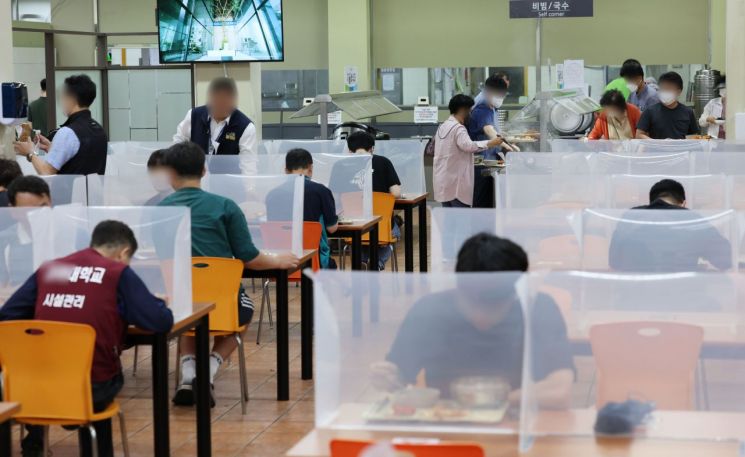
[Asia Economy Intern Reporter Kim Gun-chan] Recently, the price increase at university cafeterias, which started with the second semester, has become a reality. Universities claim that the price hike is inevitable due to high inflation, but students are upset as the 'cost-effective school meals' disappear.
According to university districts on the 11th, Korea University and Hankuk University of Foreign Studies decided to raise cafeteria prices starting this month. Korea University will increase the existing meal price at the student union cafeteria from 5,000 KRW to 6,000 KRW starting the 19th. Hankuk University of Foreign Studies raised cafeteria menu prices on the 1st. Lunch and dinner prices increased by 500 KRW, and snack items like ramen and kimbap rose by 300 KRW. The university stated in an internal notice, "Due to the recent sharp rise in food ingredient prices and labor costs, we have decided to increase prices."
Students are upset by the cafeteria price hikes. As even the affordable school meal prices rise, complaints grow that the burden increases in this high-inflation era. Lee, a senior at a private university in Seoul, said, "Now the cafeteria prices are similar to those of restaurants around the school, so it won't be easy to visit frequently for lunch without burden as before." Another senior, Kim, attending a different university, said, "In this high-inflation era, I am trying to reduce expenses, but if school meals also increase, the choices I can make become fewer."
Negative public opinion about the cafeteria price increase is also prevalent within universities. According to a survey conducted by Korea University Student Council on the 10th of last month, 61% of respondents said cafeteria prices should be frozen. Hankuk University of Foreign Studies showed similar results. In a survey conducted on the 24th of last month, 48.6% of respondents favored price freezing, and 32.9% said the price increase should be postponed for one semester and then reconsidered.
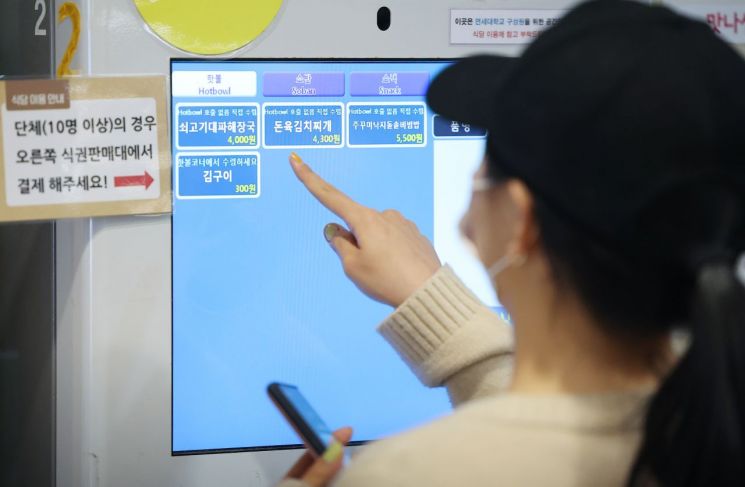 A university student is purchasing a meal ticket at a university cafeteria in Seoul city last May. [Image source=Yonhap News]
However, universities maintain that the cafeteria price increase is unavoidable. These universities reportedly pushed for price hikes due to rising manufacturing costs, increased labor costs, and deficits caused by price freezes.
According to Statistics Korea, the consumer price inflation rate in August was 5.7%, showing a slowdown compared to the 6% range in June and July. However, prices for agricultural products and dining out continue to soar. Vegetables such as cabbage and cucumber rose 27.9% year-on-year, marking the highest increase since September 2020. Dining out prices increased by 8.8%, the highest in 30 years since October 1992.
Major private universities in Seoul, including Yonsei University, Chung-Ang University, and Sookmyung Women's University, have already raised cafeteria prices in the first half of the year. At Seoul National University, a controversy over poor-quality meals arose after the price increase.
The National University Student Council Network (Jeondaenet), composed of student councils from 26 universities nationwide, demanded that the government intervene to stabilize cafeteria prices. On the 7th, Jeondaenet held a press conference in front of the Yongsan Presidential Office, opposing the cafeteria price hikes and urging the expansion of the "1,000 KRW Breakfast" program.
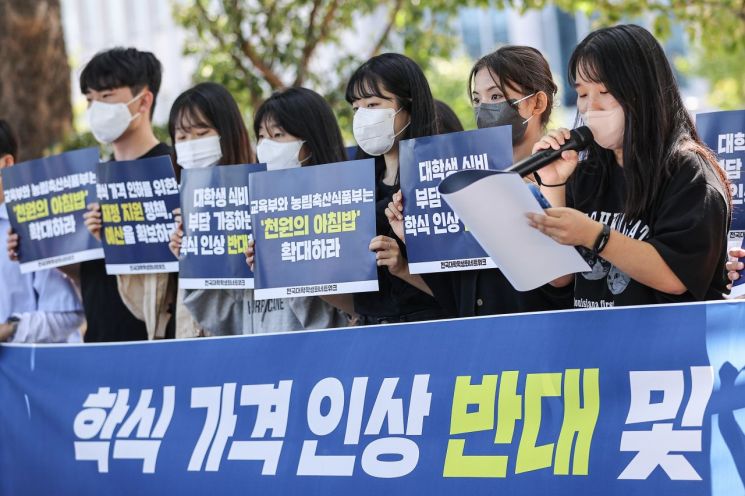 Members of the National University Student Council Network held a press conference on the morning of the 7th near the Presidential Office in Yongsan-gu, Seoul, opposing the increase in school meal prices and urging the expansion of the one-thousand-won breakfast program.
 [Image source=Yonhap News]
In a statement released that day, Jeondaenet said, "With inflation reaching 6%, if school meal prices also rise, food expenses will become a greater burden for university students," pointing out, "Three years ago, even if expensive, school meals were 4,000 KRW, but now they have increased to 7,000 KRW." They added, "School meals are the minimum welfare to reduce students' food expenses and provide nutritious meals. In the current situation of deteriorating university finances, universities, the Ministry of Education, and the Ministry of Agriculture, Food and Rural Affairs must collaborate to address the food expense burden in university districts."
Jeondaenet advocates expanding the "1,000 KRW Breakfast" program as a model for stabilizing school meal prices. First introduced by Chonnam National University in 2015, the program provides breakfast to university students with high breakfast skipping rates and promotes domestic rice consumption. Students pay 1,000 KRW, and the government and school each support 1,000 KRW.
Jeondaenet stated, "Among the 330 universities nationwide, less than 10% implement the '1,000 KRW Breakfast' program," and argued, "The number of universities benefiting from the '1,000 KRW Breakfast' should be expanded, and the program should be extended not only to breakfast but also to lunch."
© The Asia Business Daily(www.asiae.co.kr). All rights reserved.
![Clutching a Stolen Dior Bag, Saying "I Hate Being Poor but Real"... The Grotesque Con of a "Human Knockoff" [Slate]](https://cwcontent.asiae.co.kr/asiaresize/183/2026021902243444107_1771435474.jpg)


















