Applicants for Financial Public Enterprises Halve in 3 Years
Private Sector Salaries Rise While Institutions Stall
Local and Rotational Work, Closed Culture Also Play a Role
"Elite Applicants Will Continue to Decline"

[Asia Economy Reporter Song Seung-seop] Financial public institutions, once called the "divine workplace," seem to be increasingly shunned by the MZ generation (Millennials + Generation Z). While they once boasted higher popularity and competition rates than private banks, both the number of applicants and competition rates are rapidly declining. Analysts attribute this to factors such as rotational and regional assignments, slow salary increases, and conservative corporate cultures.
On the 7th, a review of the recruitment status of seven financial public institutions?Seomin Financial Support Center, Korea Credit Guarantee Fund, Korea Deposit Insurance Corporation, IBK Industrial Bank of Korea, Korea Development Bank, Korea Asset Management Corporation (KAMCO), and Korea Housing Finance Corporation?showed that the competition rate for new employee open recruitment in the first half of this year was 54.56 to 1. They selected a total of 242 people, excluding some specialized positions such as IT, accounting, and regional talent tracks, with 13,204 applicants.
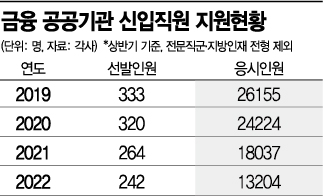
Financial public institutions are experiencing declines in the number of recruits, applicants, and competition rates. In contrast, during the same period last year, 264 people were selected with 18,037 applicants, resulting in a competition rate of 68.32 to 1. The difference is even more pronounced compared to 2019. In 2019, 333 new employees were recruited, with 26,155 applicants. The number of applicants has halved in just three years. The competition rate at that time reached 78.54 to 1.
Employees at financial public institutions cite treatment levels as a major cause. Although salaries remain high compared to other industries, the rate of increase has stagnated for several years. For example, the Seomin Financial Support Center's average annual salary per person last year was about 67.37 million KRW, which only increased by 13.7% (8.15 million KRW) from 59.22 million KRW four years ago. KAMCO, with an average salary of 85.78 million KRW, saw only an 8% (6.7 million KRW) increase over four years.
Work locations change every two years, and corporate culture remains conservative
Meanwhile, private bank salaries have risen sharply. During the same period, KB Kookmin Bank's average salary per employee jumped 23.0% (21 million KRW) from 91 million KRW to 112 million KRW. Shinhan Bank's salary increased by 16 million KRW (17.5%) from 91 million KRW to 107 million KRW. IBK Industrial Bank of Korea, which had an average salary of 99.37 million KRW four years ago, saw its salary reach 107.72 million KRW last year, surpassing private banks for the first time. Considering that employees at financial public institutions generally have longer tenure, the actual salary gap is likely even larger.
For applicants living in the metropolitan area, regional and rotational assignments are also burdensome. Among the seven institutions, Korea Credit Guarantee Fund is located in Daegu, while KAMCO and Korea Housing Finance Corporation are in Busan. Other institutions often require employees to relocate to different regions every two to three years. A representative from a financial public institution complained, "I cannot predict where I will be assigned next year. When the transfer announcement comes out on Wednesday, I have to prepare to start working at the new location by Monday."
Unlike the trend toward a horizontal and free corporate atmosphere, the still closed and conservative practices also reduce applicants' motivation. Another financial public institution official said, "Some department heads require analog methods for tasks that could easily be done digitally," adding, "Dealing with a 'kkondae' (old-fashioned) boss means even having to worry about formalities, which is stressful."
Experts analyze that the number of excellent applicants may continue to decline in the long term. Professor Kim Dae-jong of Sejong University’s Department of Business Administration explained, "Because financial public institutions are dispersed under the name of national balanced development, the so-called elite talent pool is gradually shrinking."
© The Asia Business Daily(www.asiae.co.kr). All rights reserved.
![Clutching a Stolen Dior Bag, Saying "I Hate Being Poor but Real"... The Grotesque Con of a "Human Knockoff" [Slate]](https://cwcontent.asiae.co.kr/asiaresize/183/2026021902243444107_1771435474.jpg)

















