US NASA Announces Delay Due to 'Fuel Leak'
Controversy Expected Over Reliability and Development Efficiency of Super Heavy Launch Vehicle SLS
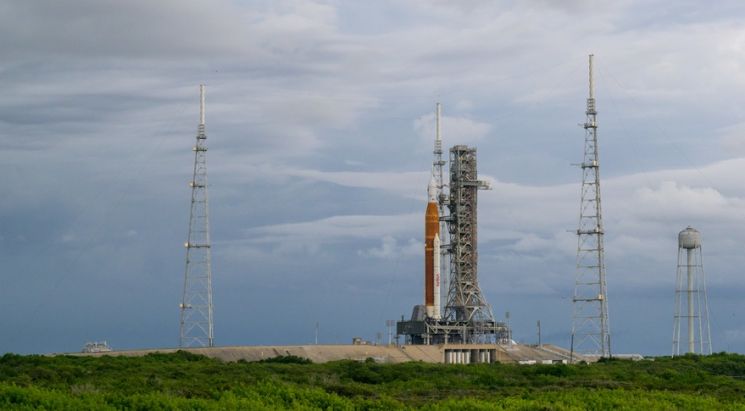
[Asia Economy Reporter Kim Bong-su] The launch of the United States' Artemis 1 mission, prepared to resume lunar exploration after 50 years, has been postponed due to a rocket malfunction.
The National Aeronautics and Space Administration (NASA) announced on the 29th at 8:33 a.m. Eastern Time that the Artemis 1 mission launch, scheduled at the Kennedy Space Center in Florida, was delayed due to an engine issue. NASA is expected to explain the reason in an official briefing soon, but it is currently known that fuel leaked from one of the four RS-25 engines.
NASA plans to attempt the launch again as early as the 2nd of next month. The Artemis 1 mission involves launching the 98-meter-long super heavy-lift launch vehicle Space Launch System (SLS), developed directly by NASA, to send the crew capsule from the private company Orion into lunar orbit and then return it. This is the first phase project of the Artemis program, which aims to return humans to the Moon for the first time in 50 years since Apollo 17 in 1972. The United States will carry a dummy simulating human organs and skeleton on the Artemis 1 mission to orbit the Moon, and next year will conduct the Artemis 2 mission, which will carry humans along the same route. After 2025, the Artemis 3 mission plans to land people of color and women on the lunar surface for exploration for the first time in 53 years.
The SLS, with a total length of 98.1 meters?equivalent to a 32-story building?was developed as the largest and most powerful launch vehicle ever. Although it is about 12 meters shorter than the Saturn V rocket that sent the Apollo spacecraft to the Moon, its maximum thrust is 3,991 tons, approximately 15% stronger. Two booster rockets, responsible for 75% of the thrust at launch, deliver the strongest and highest performance ever. Each booster produces about 1,630 tons of thrust, pushing the SLS, which weighs over 2,600 tons, upward. NASA planned to verify the performance of the SLS through the Artemis 1 mission and test key technologies such as Orion capsule’s lunar orbit transfer, Earth atmospheric re-entry, and parachute landing.
Although NASA has stated its intention to resume the launch soon, this delay is expected to intensify controversy over the development of the SLS within the United States. So far, $20 billion has been invested in the development of the SLS, but reliability concerns have been raised due to repeated issues found during propellant loading tests (WDR) conducted in April and June. Moreover, the private space company SpaceX is developing a super heavy-lift launch vehicle called Starship with similar performance, sparking debates over redundant investment and budget waste. In fact, NASA originally planned to develop the SLS by 2017 with a budget of $10 billion, but the schedule has been delayed and costs have increased exponentially to more than double.
© The Asia Business Daily(www.asiae.co.kr). All rights reserved.
![Clutching a Stolen Dior Bag, Saying "I Hate Being Poor but Real"... The Grotesque Con of a "Human Knockoff" [Slate]](https://cwcontent.asiae.co.kr/asiaresize/183/2026021902243444107_1771435474.jpg)















