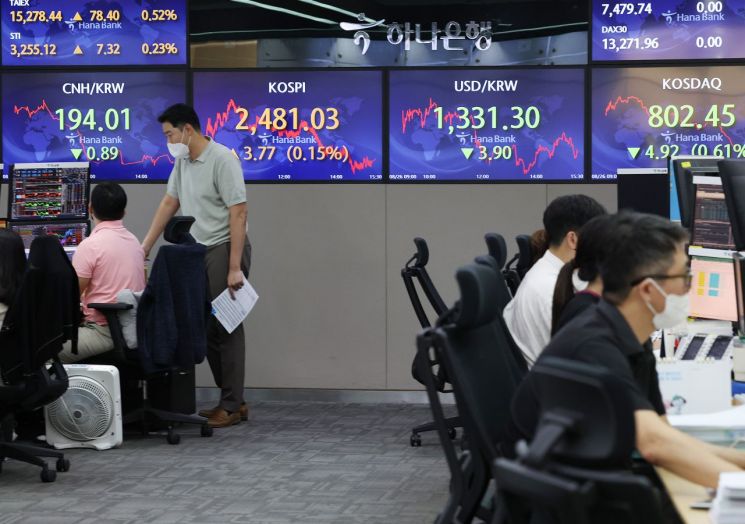
[Asia Economy Reporter Ji Yeon-jin] Foreign investors continued their eight-week consecutive net buying streak in the domestic stock market.
According to the Korea Exchange on the 28th, foreign investors net purchased approximately 613.8 billion KRW worth of domestic stocks from the 22nd to the 26th. They bought about 525.1 billion KRW in the KOSPI market and 66.5 billion KRW in the KOSDAQ market. Following last month's net purchase of over 1.8 trillion KRW in domestic stocks, foreign investors net bought 3.1267 trillion KRW this month.
The stock most purchased by foreign investors last week was Hyundai Motor Company, with net buying worth 92.4 billion KRW. This was followed by LG Energy Solution (83.7 billion KRW), Hyundai Rotem (71.7 billion KRW), Hanjin KAL (71.4 billion KRW), and Samsung SDI (58.4 billion KRW).
On the other hand, L&F was the most sold stock, with net sales of approximately 62 billion KRW. This was followed by KakaoBank (-50.5 billion KRW), Samsung Biologics (-45.5 billion KRW), POSCO Holdings (-45.5 billion KRW), and LG Electronics (-44.2 billion KRW).
Shin Seung-jin, a researcher at Samsung Securities, explained the foreign investors' buying trend in domestic stocks by saying, "Macro uncertainties have already been reflected in market prices," adding, "Due to the weak Korean won, the Korean stock market may appear relatively cheap to foreign investors." Currently, the KOSPI is undervalued with a price-to-earnings ratio of 9 times and a price-to-book ratio of 0.9 times, which explains foreign investors' low-price buying.
Additionally, the U.S. Inflation Reduction Act, which is expected to benefit Korean companies, is also cited as a factor fueling foreign buying. Researcher Shin said, "Korean companies in energy and automotive sectors either have production bases in the U.S. or plan to expand them," adding, "Korea could emerge as a beneficiary country in the U.S.-led supply chain restructuring centered on allied countries, and the momentum for new orders in industries where Korea has strengths, such as nuclear power and defense, is also a basis for foreign investors' buying."
© The Asia Business Daily(www.asiae.co.kr). All rights reserved.
![Clutching a Stolen Dior Bag, Saying "I Hate Being Poor but Real"... The Grotesque Con of a "Human Knockoff" [Slate]](https://cwcontent.asiae.co.kr/asiaresize/183/2026021902243444107_1771435474.jpg)















