Five Chinese Dynasties Collapsed Due to Famine Amid Rapid Water Consumption Growth in Agricultural Expansion
Severe Water Shortage in Major Grain-Producing Huabei Plain... Beijing and Shanghai Also Facing Water Scarcity
2003 Waterway Tunnel Project 'South-to-North Water Diversion' Launched... Uncertain if It Will Solve Water Shortage
[Asia Economy Reporter Park Byung-hee] "China can print money, but it cannot print water."
This was said by British diplomat Charlie Parton in 2018. Parton is a China expert who spent 22 of his 37 years as a diplomat in China, Hong Kong, and Taiwan. He believed that while China could grow its economic power and become a key currency country like the United States, solving the water shortage problem would not be easy.
As the world suffers from heatwaves and droughts, raising awareness of climate change, Foreign Affairs, a U.S. diplomatic magazine, warned that China's water shortage could have a much greater impact on global food and raw material supplies than the shocks caused by COVID-19 and the Ukraine war.
◆ China consumes 10 billion barrels of water daily, 700 times its oil consumption = China has large regional disparities in rainfall, resulting in significant differences in water resources by region. The southwestern region is rich in water resources, while the densely populated northeastern region suffers from water scarcity.
As of 2020, the amount of water available per capita in the northern Hebei Plain region was only 253 cubic meters. Major cities such as Beijing, Shanghai, and Tianjin have similar levels of available water. This is only half the level defined by the United Nations as acute water scarcity. The UN classifies countries as water-scarce if the amount of water available per capita falls below 1,000 cubic meters.
China's daily water consumption is 10 billion barrels, which is 700 times its daily oil consumption. Moreover, the situation has worsened in recent years due to overlapping droughts.
Foreign Affairs explained that China's rapid economic growth over the past 40 years and its food security policy aiming for a 90% self-sufficiency rate have led to enormous water consumption. At least five of the 17 dynasties in China's history collapsed due to famine, and both historical dynasties and the modern Chinese government have encouraged expanding agricultural production to achieve food self-sufficiency. However, increasing agricultural production has resulted in excessive water consumption.
According to NASA's GRACE satellite data, groundwater levels in the Hebei Plain are declining faster than those in the U.S. Great Plains. Most rivers north of the Yangtze River have steadily decreased in water level over the past 15 years. In some parts of northern China, groundwater levels drop by one meter annually.
Furthermore, a significant portion of China's water resources is unusable due to poor water quality. According to a 2018 survey by China's Ministry of Ecology and Environment, 19% of China's water resources are unsuitable for human use, and 7% are unusable for any purpose. Groundwater conditions are worse, with 30% unsuitable for human use and 16% unusable for any purpose. This is due to ongoing soil contamination by chemicals from farms and factories. The situation has worsened because the Chinese government has long ignored environmental issues identified as weaknesses.
Significant investment in facilities to improve water quality is required, and the process of generating electricity to operate these facilities is expected to consume a substantial amount of water.
◆ By 2030, supply may meet only 25% of China's water demand = China's severe water shortage could significantly impact crop production. The Hebei Plain, which suffers from severe water scarcity, produces about 60% of the wheat, 45% of the corn, 35% of the cotton, and 64% of the peanuts consumed in China. Foreign Affairs estimated that if water shortages reduce crop yields in the Hebei Plain by 33%, China would need to import 20% of the world's corn trade volume and 13% of the wheat trade volume, potentially triggering a global food crisis.
Water shortages also significantly disrupt power generation. Ninety percent of China's power production depends on hydropower, coal, and nuclear energy, all of which require substantial water resources. Nuclear power plants need water for cooling, and coal requires water during mining and processing. Most Chinese nuclear plants are located on the eastern coast, allowing the use of seawater for cooling, but coal-fired power plants are inland.
Water shortages could disrupt China's power generation, forcing factories to halt operations. Since many major global companies have factories in China, this could deliver a significant shock to the global economy. The global raw materials market would also be affected. For example, China accounts for 50% of the world's magnesium production, but at the end of last year, power shortages forced smelters in Shanxi Province to reduce operations, causing magnesium prices to soar sevenfold compared to the beginning of the year. Over 65% of the electricity consumed in China is industrial, and China is the world's largest producer of numerous metal minerals and rare earths, including aluminum, lead, manganese, magnesium, and zinc.
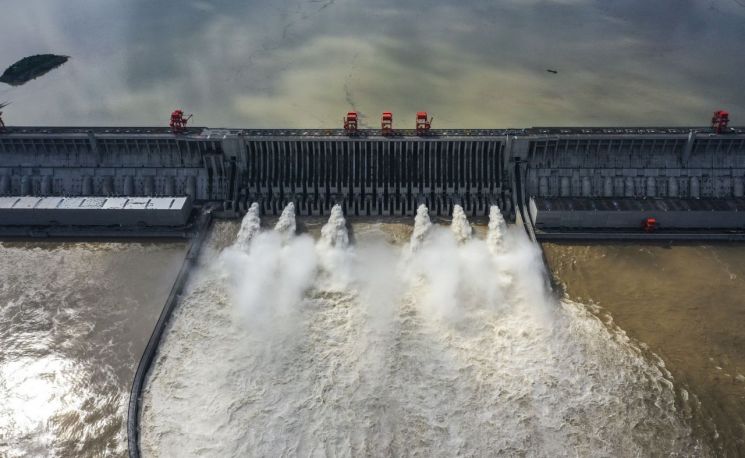
As a solution to the severe water shortage, China launched the South-to-North Water Diversion Project in 2003, aiming to transfer abundant water from the south to the north. This project involves a $60 billion investment to build the world's longest water tunnel.
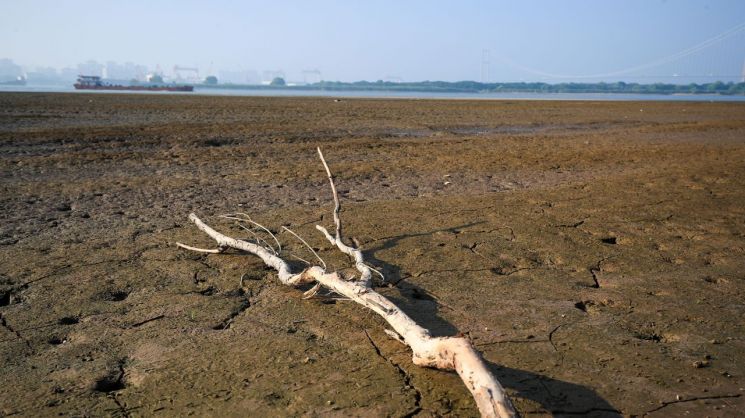
However, some scholars question the effectiveness of the Chinese government's measures and present a grim forecast that by 2030, China's water supply may meet only 25% of demand. This implies that strict water supply controls may be implemented. Recent extreme heatwaves have dried up the Yangtze River, a major water source in China, increasing concerns.
© The Asia Business Daily(www.asiae.co.kr). All rights reserved.
![Clutching a Stolen Dior Bag, Saying "I Hate Being Poor but Real"... The Grotesque Con of a "Human Knockoff" [Slate]](https://cwcontent.asiae.co.kr/asiaresize/183/2026021902243444107_1771435474.jpg)
















