Government Holds Emergency Meeting with Semiconductor, Automobile, and Battery Leaders
"Frustrated as Companies Have Practically Nothing They Can Do"
Industry Calls for Policy-Level Support to Protect Domestic Industries
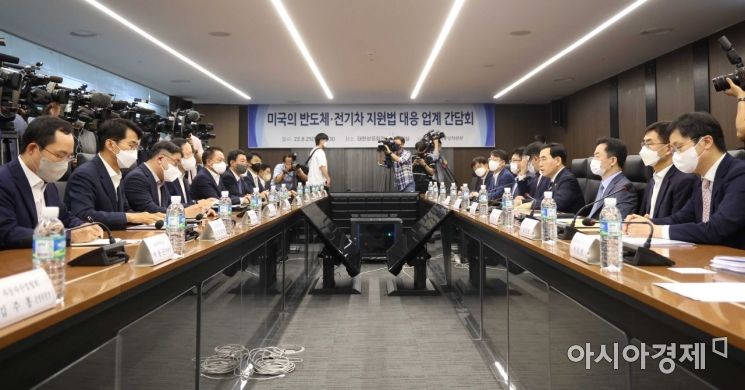 Minister Lee Chang-yang of the Ministry of Trade, Industry and Energy is speaking at the industry meeting on responses to the U.S. Semiconductor and Electric Vehicle Support Act held on the 25th at the Korea Chamber of Commerce and Industry in Jung-gu, Seoul. Photo by Moon Ho-nam munonam@
[Asia Economy Reporters Kiho Sung, Hyungil Oh, Hyunseok Yoo] "There is no solution."
At an emergency meeting held on the 25th at the Korea Chamber of Commerce and Industry with the government and related companies in semiconductors, automobiles, batteries, etc., the CEO of Company A expressed a grim reality about the difficulties in responding to the U.S. Inflation Reduction Act (IRA). Most CEOs and heads of related associations clearly showed concern over the aftershocks of the IRA and the implementation of the Chips and Science Act (CSA). Another CEO expressed frustration, saying, "There is realistically nothing companies can do."
At the meeting with Minister Chang-yang Lee of the Ministry of Trade, Industry and Energy, representatives from the semiconductor, automobile, and battery industries agreed that the public and private sectors must actively respond together to the U.S. government's semiconductor support law and the IRA. Although the laws have been passed, the enforcement decrees and regulations have not yet been established, so they agreed to incorporate Korea’s opinions as much as possible. Despite the government’s leading role in public opinion campaigns, the effectiveness may be limited as the World Trade Organization (WTO) appellate function has been practically paralyzed under the protectionist trend, deepening companies’ concerns.
A participant in the meeting said, "The government must raise objections if the laws violate the national treatment principle of the Korea-U.S. Free Trade Agreement (FTA) and the most-favored-nation principle of the WTO," emphasizing, "Especially for products manufactured in FTA partner countries like us, the same status as those produced in North America should be recognized."
The industry also proposed domestic industrial protection and support measures, including improvements to the electric vehicle subsidy system, temporary corporate tax reductions for electric vehicle exporters, and support for electric vehicle export subsidies.
Experts pointed out that since the laws have just been passed, it is more important than ever for the Korean government to convey its opinions. Professor Pilsoo Kim of Daelim University’s Department of Automotive Engineering explained, "What has currently passed is the parent law, and enforcement decrees and regulations are just being drafted. It is crucial not to miss this timing and strongly communicate our opinions."
The Korea Automobile Industry Association also raised four major issues in a statement that day: ▲ violation of WTO subsidy regulations ▲ breach of the national treatment principle of the Korea-U.S. FTA ▲ violation of the vision of the Indo-Pacific Economic Framework (IPEF) promoted by the U.S. for supply chain cooperation ▲ and violation of the spirit of strengthening the Korea-U.S. economic security alliance emphasized during President Biden’s visit to Korea this year. They also requested the U.S. Congress and government to provide tax benefits equal to those for North American electric vehicles for electric vehicles produced in Korea, an FTA partner and economic security ally.
The battery industry expressed the need for the government to relax requirements for locally produced batteries. An industry official said, "Battery companies have already secured or planned local production facilities, but the issues lie with parts and minerals," adding, "Government support is needed to secure competitiveness that can replace China, which has been a strength so far."
Experts also suggested preparing for changes after the U.S. midterm elections scheduled for November this year.
Research Fellow Hanggu Lee of the Korea Automotive Technology Institute advised, "Currently, the law requires batteries to be produced in North America, but depending on the midterm election results, the scope could expand. If North American production requirements extend to automotive parts and tires, it will inevitably cause significant damage to domestic industries, so preparations must be made."
© The Asia Business Daily(www.asiae.co.kr). All rights reserved.
![Clutching a Stolen Dior Bag, Saying "I Hate Being Poor but Real"... The Grotesque Con of a "Human Knockoff" [Slate]](https://cwcontent.asiae.co.kr/asiaresize/183/2026021902243444107_1771435474.jpg)















