Concerns Over Rising Import Prices Due to Strong US Dollar... Russia-Linked Energy Crisis Also a Variable
[Asia Economy Sejong=Reporter Kwon Haeyoung] As the won-dollar exchange rate soars, there is an analysis that the timing of the price peak-out (passing the peak) may be delayed beyond the government's initial prediction of September to October. Additionally, concerns about an energy crisis originating from Russia are growing, making it premature to conclude the price peak.
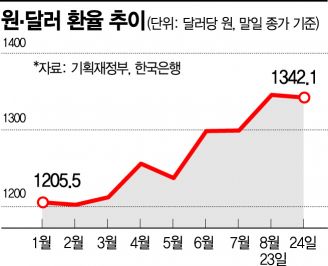
According to the Bank of Korea on the 25th, the won-dollar exchange rate closed at 1,345.5 won on the 23rd, marking the highest level since April 2009 during the financial crisis, and is currently moving around 1,340 won. At the beginning of the year, it was below 1,200 won (1,187.3 won on January 14), but it has continued to rise due to the impact of U.S. interest rate hikes and other factors.
This high exchange rate pushes up import prices, which are reflected in producer and consumer prices with a time lag, thereby raising overall inflation. The Korea Economic Research Institute analyzed that the exchange rate increase contributed 0.7 percentage points to the 3.8% domestic consumer price inflation rate in the first quarter. If the dollar's strength continues due to the possibility of economic contraction in Europe and China, there is a possibility that domestic prices will rise further. Although international oil and grain prices are falling, the effect diminishes if the won's value declines.
The European energy crisis is another variable. Russia has announced a temporary suspension of gas supply to Europe at the end of this month, causing global gas prices to surge. If Russia weaponizes resources during the winter season when energy demand spikes, there is also a possibility that other energy prices, such as crude oil, which had eased, will rise again.
It is also difficult to judge that overseas prices have passed their peak. Although the U.S. consumer price inflation rate slowed to 9.1% in June and 8.5% in July, the core inflation rate, which excludes food and energy prices that are heavily affected by supply and demand and shows the underlying trend, recorded 5.9% for two consecutive months, showing no sign of a decline in the inflation rate. In the UK, the inflation rate in July rose to 10.1%, reaching double digits for the first time in 40 years.
Deputy Prime Minister and Minister of Economy and Finance Choo Kyung-ho repeatedly stated that "the end of September to early October will be the price peak," but despite the expected inflation rate dropping to 4.3% last month for the first time in eight months, there is cautious skepticism about confidently concluding that the price peak has passed.
Professor Sung Tae-yoon of Yonsei University's Department of Economics said, "Although the inflation rate may decline after Chuseok, it is difficult to see it as a potential stabilization of prices," adding, "Overseas inflationary pressures remain strong, and the exchange rate is also stimulating prices, so it cannot be asserted that September to October is the price peak."
© The Asia Business Daily(www.asiae.co.kr). All rights reserved.
![Clutching a Stolen Dior Bag, Saying "I Hate Being Poor but Real"... The Grotesque Con of a "Human Knockoff" [Slate]](https://cwcontent.asiae.co.kr/asiaresize/183/2026021902243444107_1771435474.jpg)















