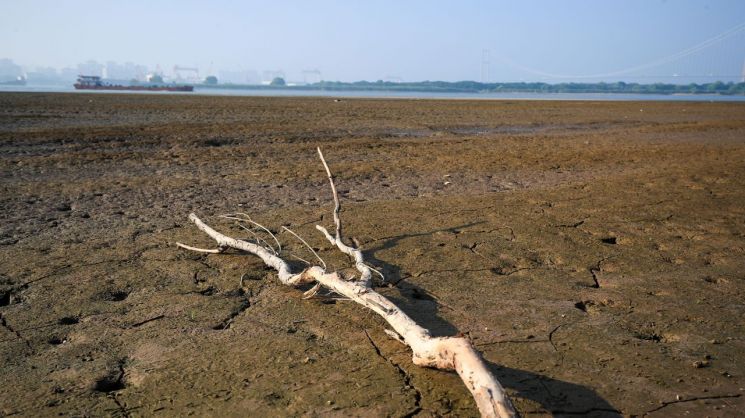
[Asia Economy Reporter Park Byung-hee] Bloomberg News reported on the 24th (local time) that the water level of the Yangtze River, the longest river in Asia located in China, has dropped to the lowest level since records began in 1865 due to severe drought.
Bloomberg stated that the Yangtze River supplies a significant amount of water needed for agriculture and hydropower generation, and expressed concerns that the decrease in the Yangtze River's water level could cause substantial economic damage to China. However, it is expected that this year's power shortage will not be as severe as last year's, which was caused by a coal supply shortage. This is because the Chinese government decided to increase coal power generation after experiencing a nationwide power supply crisis last year, and coal production has increased by 11% this year in response to government demands.
Nevertheless, concerns are rising that this will add to the burden on the Chinese economy, which is already struggling due to COVID-19 lockdown measures and a real estate market downturn. Especially with the 20th Party Congress approaching, which will confirm President Xi Jinping's third term, the leadership finds itself in a difficult situation.
There are also worries that this could become an obstacle to China's transition to eco-friendly energy. Doubts about the effectiveness of hydropower, which holds the largest share among eco-friendly energy sources in China, may increase.
According to an analysis by Bloomberg New Energy Finance (NEF), hydropower accounted for 18% of China's electricity production as of 2020.
China has the world's largest solar panel and wind turbine installations and is increasing investments in eco-friendly energy to reduce dependence on fossil fuels. In the first half of this year, China's investment in eco-friendly energy reached $98 billion, more than double that of the first half of last year.
Concerns are growing that Sichuan Province, which accounts for 5% of China's GDP, will suffer significant damage. In Sichuan, hydropower accounts for 80% of electricity generation, so expanding coal supply is expected to provide little relief.
Due to the heatwave, Sichuan's electricity demand has increased by about 25% this year, while electricity production from hydropower has been halved. The Sichuan provincial government is actively responding by extending power supply cuts to industrial complexes from the original 20th to the 25th.
Major automobile companies such as Toyota, Volkswagen, Hyundai, and the Chinese electric vehicle battery manufacturer CATL, which supplies batteries to Tesla, have factories in Sichuan. Tesla previously requested the Chinese government to ensure that parts suppliers in Sichuan receive sufficient power. Tesla had to shut down its Shanghai factory for several weeks due to COVID-19 lockdowns, and now faces a situation where it must halt operations at the Shanghai factory because parts cannot be supplied due to the shutdown of the Sichuan factory.
Shanghai is reducing the use of lighting, elevators, and air conditioners. Wuhan in Hubei Province has suspended the famous Yangtze River light show. A well-known shopping mall in Wuhan operates only the elevators going up, while elevators going down have been shut off.
© The Asia Business Daily(www.asiae.co.kr). All rights reserved.
![Clutching a Stolen Dior Bag, Saying "I Hate Being Poor but Real"... The Grotesque Con of a "Human Knockoff" [Slate]](https://cwcontent.asiae.co.kr/asiaresize/183/2026021902243444107_1771435474.jpg)















