August Overall Industry BSI Rises 1p MoM
Consumption Recovers Despite High Inflation and Economic Uncertainty
Improvement in Non-metallic Minerals, Automotive, and Other Sectors
September Outlook Shows Increase in Both Manufacturing and Non-manufacturing Industries
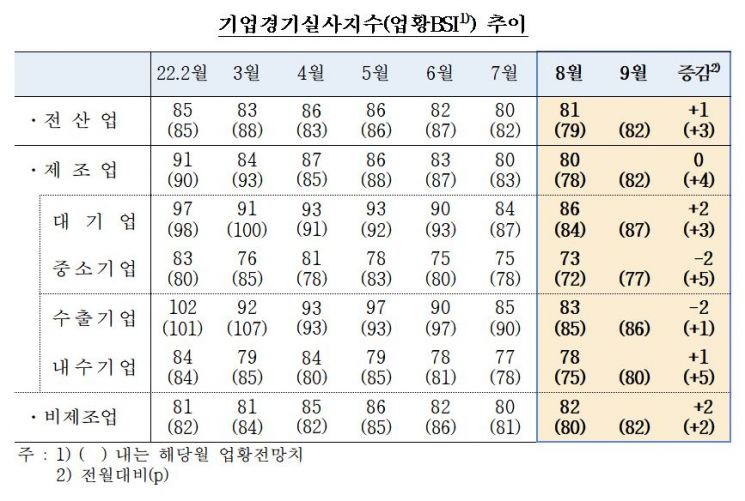
Despite high inflation rates and economic uncertainties, the perceived business conditions of domestic companies have shown slight improvement. Recently, with the automotive industry picking up and consumer sentiment improving following the lifting of COVID-19 social distancing measures, business conditions for next month are also expected to improve.
According to the "August Business Survey Index (BSI) and Economic Sentiment Index (ESI)" released by the Bank of Korea on the 24th, the BSI for all industries this month was recorded at 80, up 1 point from the previous month.
The BSI is a statistic that surveys companies' assessments and outlooks on current business conditions; if negative responses outnumber positive ones, the index falls below 100.
The overall industry BSI had declined for two consecutive months since May (86) due to raw material supply instability caused by the Ukraine crisis and interest rate hikes in major countries such as the U.S., but it turned upward again this month.
The manufacturing sector's business condition BSI remained unchanged at 80 from the previous month, while the non-manufacturing sector rose 2 points to 82.
Within manufacturing, the chemical substances and products sector (-3 points) and the electronics, video, and communication equipment sector (-1 point) experienced downturns due to decreased global demand for chemical products and a slowdown in semiconductor demand, but non-metallic minerals (up 8 points) and the automotive sector showed improvement.
Kim Dae-jin, head of the Bank of Korea's Corporate Statistics Team, said, "The automotive sector had been struggling due to semiconductor parts supply issues, but business conditions improved as semiconductor supply stabilized. Although chemical substances and products declined, the gains and losses across sectors offset each other, resulting in manufacturing remaining steady compared to the previous month."
By company size and type, large enterprises (up 2 points) and domestic market-oriented companies (up 1 point) saw increases, whereas export-oriented companies (-2 points) and small and medium-sized enterprises (-2 points) experienced declines.
The manufacturing business outlook BSI for next month rose 4 points to 82, led by the automotive sector (up 23 points) and non-metallic minerals (up 22 points). Large enterprises (up 3 points), small and medium-sized enterprises (up 5 points), export-oriented companies (up 1 point), and domestic market-oriented companies (up 5 points) all showed increases.
Domestic manufacturing companies cited rising raw material prices (27.6%), uncertain economic conditions (20.2%), and labor shortages and wage increases (10.1%) as their main difficulties. However, with recent international oil prices stabilizing, the proportion citing raw material price increases fell by 4.6 percentage points from the previous month, while the share citing uncertain economic conditions rose by 2.8 percentage points.
The non-manufacturing business condition BSI showed recovery centered on electricity, gas, and steam (up 10 points), construction (up 4 points), and wholesale and retail trade (up 4 points). The non-manufacturing business outlook BSI for next month also rose 2 points to 82, led by wholesale and retail trade (up 4 points) and construction (up 3 points).
The August Economic Sentiment Index (ESI), which incorporates the Consumer Sentiment Index (CSI) into the BSI, rose 1.5 points from the previous month to 99.3. An ESI below 100 indicates that the economic sentiment of all private economic agents, including companies and households, is worse than the historical average.
© The Asia Business Daily(www.asiae.co.kr). All rights reserved.
![Clutching a Stolen Dior Bag, Saying "I Hate Being Poor but Real"... The Grotesque Con of a "Human Knockoff" [Slate]](https://cwcontent.asiae.co.kr/asiaresize/183/2026021902243444107_1771435474.jpg)















