Duty-Free Cigarette Prices Surpass Market Prices Amid 1340 Won Exchange Rate
Foreign Cigarette-Type Tobacco Priced at 45,100 Won... Sales Halted
Similar Trends in Cosmetics and Other Items... Whiskey Less Affected
Duty-Free Industry 'Tense'... High Exchange Rate and Inflation Raise Consumption Concerns
Government to Implement Customs Act Enforcement Rule Amendments Before Chuseok
[Asia Economy Reporter Song Seung-yoon] "There is no reason to buy cigarettes at duty-free shops."
Office worker Kim Hyun-sun (38, pseudonym) recently stopped by a duty-free shop on her way back from a vacation in Jeju Island to buy cigarettes but boarded the plane empty-handed. She intended to purchase a pack of foreign-made heated tobacco sticks but turned away after seeing the price. The price difference was only about 500 won compared to the market price, so she did not feel the need to buy. Kim said, "Carrying extra luggage just for 500 won feels unnecessary," adding, "I heard the exchange rate had risen a lot, but I didn't expect it to be this much."
As the won-dollar exchange rate surpassed 1,340 won for the first time in over 13 years since 2009, the price of duty-free cigarettes, which had been catching up to the market price, has now exceeded it. From the consumer's perspective, there is no reason to buy duty-free cigarettes, which were considered essential purchases at duty-free shops. When applying the won-dollar exchange rate, a price reversal occurs where the duty-free price becomes more expensive than the market price. Some foreign cigarette brands have temporarily suspended sales at duty-free shops due to this ironic situation where duty-free prices have become higher.
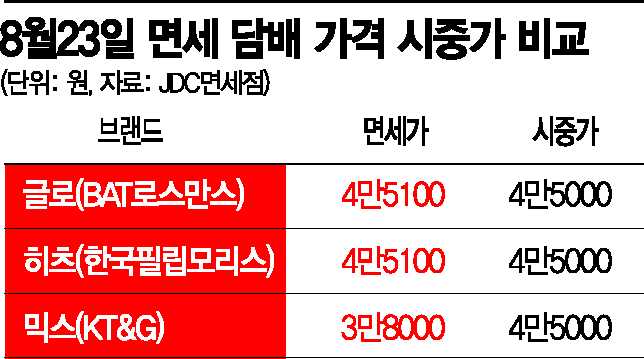
According to the duty-free industry on the 23rd, as of 4 p.m., the won-dollar exchange rate reached 1,345 won, breaking the 1,340 won mark for the first time since the 2009 financial crisis. The price of a pack of 'Heets,' a foreign-made tobacco stick exclusive to the IQOS heated tobacco device sold at duty-free shops, is $34. Applying this exchange rate, the purchase price at duty-free shops amounts to about 45,730 won, which is actually more expensive than the market price of 45,000 won. As of this date, the JDC duty-free shop has set the price at 45,100 won, but due to the high exchange rate making it more expensive than the market price, sales at the duty-free shop have been temporarily suspended. The same applies to BAT Korea's foreign-made heated tobacco sticks, Glo. Domestic cigarettes are priced in won and are sold at 38,000 won.
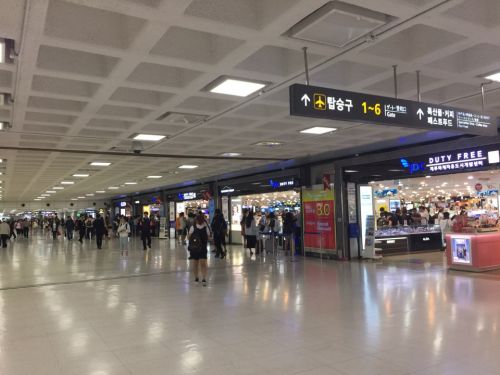
An official from a duty-free shop said, "Due to the loss of price merit, products with reversed prices are temporarily not being sold," adding, "If the exchange rate drops and prices become lower than the market price again, sales will resume."
This issue is not limited to cigarettes. Luxury goods and cosmetics are experiencing similar situations. Due to the nature of duty-free prices being set in dollars, even excluding taxes, prices are as high as or higher than domestic retail prices, eliminating the price advantage.
However, the situation is expected to be somewhat different for whiskey. It is generally considered a relatively competitive item even in high exchange rate conditions. When purchasing whiskey domestically, about 160% in taxes including liquor tax and education tax are added on top of customs and VAT, but buying at duty-free shops is much cheaper. Currently, the duty-free purchase price of Ballantine's 30-year-old whiskey is about 476,400 won, while even with discounts at liquor shops, it sells in the high 500,000 won range. Even if the price advantage is small, some brands are experiencing scarcity, making whiskey difficult to obtain, so purchases are expected to continue. Moreover, with the implementation of the revised Customs Act Enforcement Rules before Chuseok, the duty-free limit for alcohol will increase from one bottle to two, which is expected to further stimulate alcohol consumption.
In fact, looking at the sales status of the Jeju International Free City Development Center (JDC) and Jeju Tourism Organization (JTO) designated duty-free shops, the proportion of alcohol sales is very high. Among JDC duty-free shop's sales of 351.949 billion won in the first half of this year, the best-selling item was Ballantine's 30-year-old whiskey, amounting to 12.9258 billion won. Similarly, alcohol held the top sales position at the JTO designated duty-free shop with 9.06724 billion won.
Meanwhile, the government recently announced a legislative notice for the revision of the Customs Act Enforcement Rules, including raising the duty-free limit before Chuseok. The duty-free industry plans to continue promotions aimed at increasing benefits for domestic customers. However, with the high exchange rate continuing, the effectiveness remains uncertain. Some express concerns that the rapid rise in exchange rates combined with high inflation could lead to a contraction in consumption.
© The Asia Business Daily(www.asiae.co.kr). All rights reserved.
![Clutching a Stolen Dior Bag, Saying "I Hate Being Poor but Real"... The Grotesque Con of a "Human Knockoff" [Slate]](https://cwcontent.asiae.co.kr/asiaresize/183/2026021902243444107_1771435474.jpg)
















