"Must Be Comparable to US and Other Overseas Policies"
Expectations for Job Creation and Export Increase with Tax Credits
Content Industry Also Points Out Sunset Clause Every 3 Years
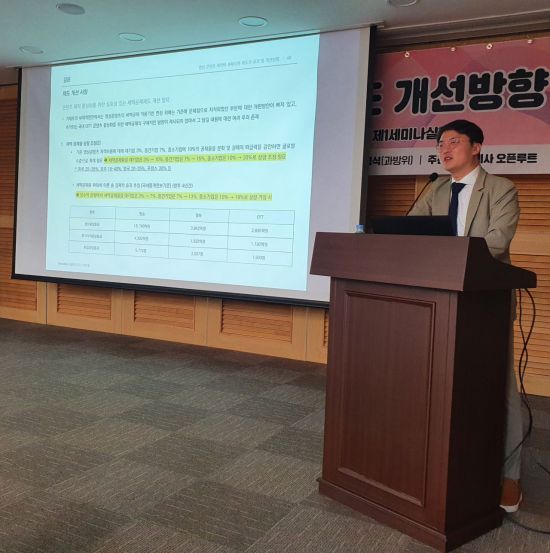 Professor Kim Yong-hee of Dongguk University Graduate School of Film is presenting a paper at the seminar on "Improvement Directions for Tax Support Systems for Video Content" held at the National Assembly Members' Office Building on the 22nd.
[Asia Economy Reporter Cha Min-young] While major countries such as the United States and Europe provide tax credits of up to 30% for content production costs, South Korea’s tax credit rates are only 3% for large corporations, 7% for medium-sized enterprises, and 10% for small and medium-sized enterprises, prompting calls for an increase. Despite the global popularity of K-content, the actual production conditions are poor compared to major countries, highlighting the urgent need for institutional policies to encourage this industry domestically.
81% of Major Content Companies Say "Current Tax Credit Rates for Production Costs Are Not Appropriate"
Professor Kim Yong-hee of Dongguk University Graduate School of Film and Digital Media presented at the "Seminar on Improving Tax Support Systems for Video Content" held at the National Assembly Members’ Office Building on the 22nd, stating, "Through improvements in the tax support system, we expect activation of content production through increased investment, expansion of overseas exports of domestic content and the spread of Hallyu, strengthening of the content industry base leading to job creation, revitalization of related industries such as IT and fashion due to increased content exports, and the establishment of a virtuous cycle ecosystem in the content industry."
Earlier, the Ministry of Economy and Finance extended the sunset clause for tax credits on video content production costs for three years through the 2022 tax reform plan and included online video services (OTT) as eligible for tax support. However, the tax credit rates are still criticized as being low compared to overseas standards. The structure of the sunset clause, which expires every three years, is also considered problematic.
According to a survey conducted by Professor Kim targeting 62 domestic content companies, 81.3% of respondents said the current tax credit rates of "3% for large corporations, 7% for medium-sized enterprises, and 10% for small and medium-sized enterprises" are not appropriate. When asked about the desired tax credit rates, 10% for large corporations, 22.5% for medium-sized enterprises, and 23.8% for small and medium-sized enterprises were considered appropriate. All respondents (100%) said they would actively use the system if the tax credit rates were expanded, and 82% of those companies said they would reinvest the tax savings into the content industry.
Disney’s "WandaVision" Receives 60 Billion KRW Tax Credit, Only 8 Billion KRW if Made in Korea
According to Professor Kim, advanced countries such as the United States, the United Kingdom, France, Australia, and Canada encourage the activation of the content industry by providing tax credits of 20-30% or more of production costs. For example, the American content "WandaVision," which spent 266.4 billion KRW on production costs, is estimated to receive about 60 billion KRW or more through domestic tax credit systems that provide around 20%. Professor Kim pointed out, "If this work had been produced domestically, the total tax credit amount would be only about 8 billion KRW."
From a conservative perspective, when the tax credit rates are raised to 7% for large corporations, 13% for medium-sized enterprises, and 18% for small and medium-sized enterprises, the estimated production inducement effect over the next four years is expected to be ▲Broadcasting 1.079 trillion KRW ▲Film 384.2 billion KRW ▲OTT 283.5 billion KRW. The value-added inducement effect is estimated at ▲Broadcasting 430.2 billion KRW ▲Film 153.2 billion KRW ▲OTT 113 billion KRW. The expected employment inducement effect is ▲Broadcasting 5,772 people ▲Film 2,037 people ▲OTT 1,503 people.
Professor Kim said, "The economic inducement effects resulting from tax support for the video content industry have been proven," adding, "In the UK, economic effects appeared in areas such as production expenditure, value creation, and job creation, and especially tax reduction benefits led to increased tax revenue through future industry activation and sales growth."
Baek Seung-il, Secretary General of the Korea Broadcasting Channel Promotion Association, said, "As K-content globalization progresses, we must compete with global companies with works that meet the standards of global viewers, but the funding structure makes it difficult to bear soaring production costs," adding, "If the tax credit rate for video content production costs is raised and leads to reinvestment in new works or next seasons, it will serve as a catalyst for revitalizing the Korean content industry."
National Assembly Also Agrees: "Government Should Expand Tax Support to Serve as a Catalyst"
The National Assembly also expressed consensus. Park Dae-chul, Chair of the National Assembly Planning and Finance Committee, said, "The media content industry is at the center of Hallyu culture," emphasizing, "The first step is to increase resources that serve as a catalyst for content production, and the most effective policy the government can implement is to expand tax support for this."
Hong Ik-pyo, Chair of the National Assembly Culture, Sports and Tourism Committee, said, "The tax credit for domestic content production costs is up to 10%, but in the US, which leads the OTT sector, refunds go up to 30%," adding, "Our domestic production companies have relatively small corporate tax bases and low credit rates, so there are still shortcomings in feeling actual support."
Meanwhile, the event was hosted by Park Dae-chul, Chair of the Planning and Finance Committee; Hong Ik-pyo, Chair of the Culture, Sports and Tourism Committee; Cho Seung-rae, Secretary of the Science, Technology, Information and Broadcasting Committee; and Kim Young-sik, member of the Science, Technology, Information and Broadcasting Committee, and organized by Open Route. Small and medium-sized production companies such as the Korea Drama Producers Association, Korea Film Producers Association, Korea Animation Producers Association, Korea Broadcasting Channel Promotion Association, and Korea Broadcasting Association also attended.
© The Asia Business Daily(www.asiae.co.kr). All rights reserved.
![Clutching a Stolen Dior Bag, Saying "I Hate Being Poor but Real"... The Grotesque Con of a "Human Knockoff" [Slate]](https://cwcontent.asiae.co.kr/asiaresize/183/2026021902243444107_1771435474.jpg)















