Camping Gains Huge Popularity Amid COVID-19
Camping Industry Size Grows 2.5 Times in 4 Years
Some Brands Face Tent Shortages
Trend Diversifies Mainly Among MZ Generation
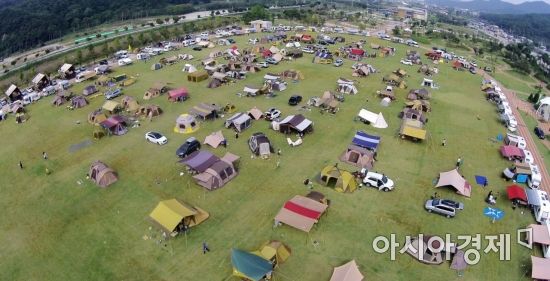
[Asia Economy Reporter Song Seung-yoon] Camping is rapidly emerging as a mainstream hobby. As indoor activities became restricted due to COVID-19, camping, which allows for hobby activities while minimizing contact with others, has gained popularity. The related market is also growing significantly every year.
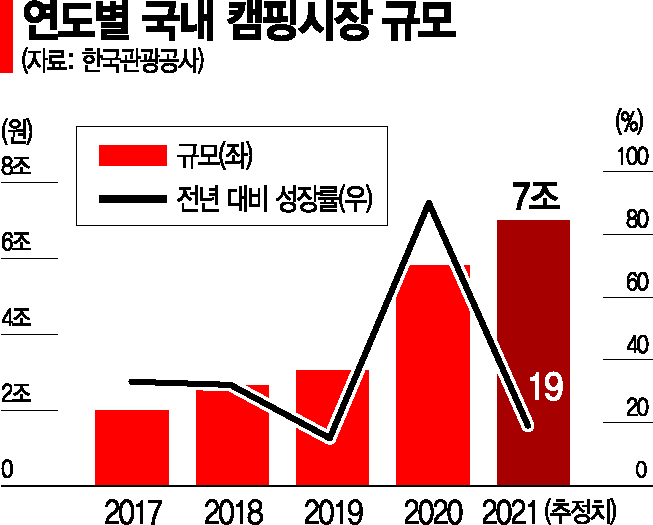
According to the Korea Tourism Organization on the 22nd, the domestic camping industry size last year is estimated to have reached about 7 trillion KRW. This represents approximately 20% growth compared to the previous year (5.8336 trillion KRW). The camping market, which was around 2 trillion KRW in 2017, expanded to 2.6474 trillion KRW in 2018 and grew to 3.0689 trillion KRW in 2019 before the COVID-19 pandemic. In the first year of the pandemic, 2020, it grew to 5.8336 trillion KRW, increasing about 2.5 times in four years.
This is analyzed to be due to the sharp decline in travel demand such as overseas trips and the contraction of indoor activities caused by COVID-19. The popularity factor was that people could enjoy hobbies while avoiding face-to-face contact, and since camping is an outdoor activity, it had relatively fewer restrictions compared to indoor hobbies.
Over the past three years during the COVID-19 situation, the camping market has undergone significant changes. As camping surged as a hobby, domestic small and medium-sized companies experienced a boom. Tent shortages occurred mainly around popular brands such as Northpeak, Campingkan, Retros, and Helinox. People had to meet certain qualification conditions to participate in group purchases through online communities, or they had to win a lottery or make reservations up to a year in advance to buy tents or products. Naturally, premiums were added, and at its peak last year, tent prices reached the 1 million KRW range with premiums matching the product price, intensifying the shortage phenomenon.
Booking campsites also became as difficult as catching stars in the sky. For some popular campsites, all zones are fully booked within minutes of the reservation window opening, resembling the scene of university course registration.
The age group of campers is also getting younger. According to the 2020 camping user survey by the Korea Tourism Organization, the age distribution of campers in 2020 was 18.3% for ages 19-29, 33.1% for those in their 30s, 28.7% for their 40s, 15.2% for their 50s, and 4.7% for those 60 and older, with those in their teens to 30s making up the majority. As the MZ generation (Millennials + Generation Z) emerges as the main consumer group in the camping market, there is an increasing tendency to pursue camping that reflects individuality and preferences.
Since 2019, so-called ‘emotional camping’ featuring canvas materials and wooden camping gear became popular, followed by ‘minimal camping,’ which focuses on packing light with fewer people. Car camping also gained momentum. Recently, trends have shifted quickly, including decorating tents and gear with a military feel. New camping-related terms have emerged, such as ‘Meokping’ (eating and drinking camping), where people bring lots of food, and ‘Campnic’ (camping + picnic), which is enjoyed lightly like a picnic.
This phenomenon is a global trend. The global market research firm Global Business Research Company projected that the global camping market, which was $62 billion last year, will grow 11.2% to $68.9 billion this year and exceed $100.6 billion by 2026, growing more than 45%. According to a survey conducted by the global market research firm Mintel targeting consumers aged 18 and older in North America, 58% of the 1,865 respondents said they enjoyed outdoor activities more during the COVID-19 pandemic. The proportion of U.S. consumers who reported cooking outdoors increased by 51% compared to the previous year in 2020, and outdoor product company sales increased by 20% overall during this period, indicating a significant rise in camping-related consumption activities.
Professor Lee Eun-hee of Inha University’s Department of Consumer Studies said, "Since the COVID-19 outbreak, travel trends avoiding face-to-face contact have emerged, making camping popular. Also, among the MZ generation, camping is perfect for taking photos for social media (SNS). I expect that as various camping know-how is shared, camping will continue to develop in more enjoyable and accessible ways."
© The Asia Business Daily(www.asiae.co.kr). All rights reserved.
![Clutching a Stolen Dior Bag, Saying "I Hate Being Poor but Real"... The Grotesque Con of a "Human Knockoff" [Slate]](https://cwcontent.asiae.co.kr/asiaresize/183/2026021902243444107_1771435474.jpg)















