Aftermath of US 'Inflation Reduction Act' Passage
Subsidies Effectively Limited to US-Made Cars
"Domestic Subsidies and Tax Support Needed"
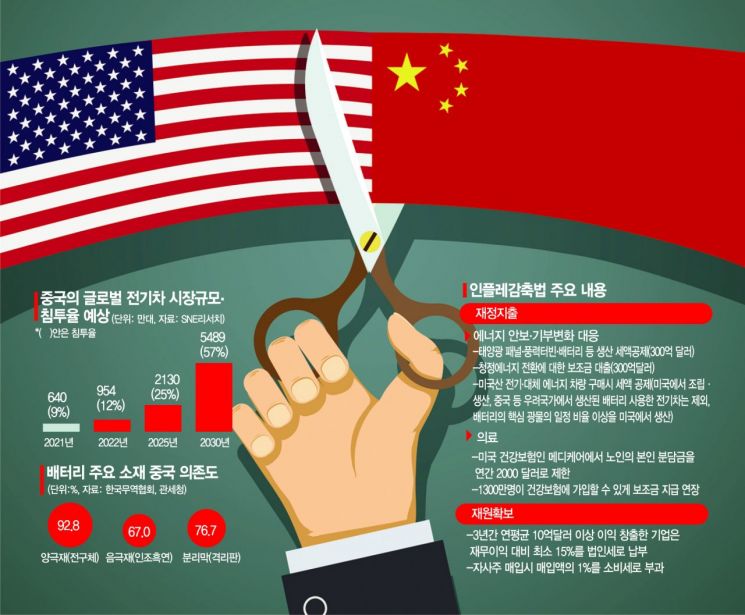
[Asia Economy Reporter Sung Ki-ho] The United States has ignited a crisis for Hyundai Motor Group as it implements the 'Inflation Reduction Act,' which provides subsidies only for electric vehicles produced domestically. This immediately results in an approximate 10 million KRW price increase for Hyundai's electric vehicles. If Hyundai loses price competitiveness, its North American market strategy will inevitably face setbacks. Although the government is working on countermeasures, no clear solution has emerged, leading to a bleak outlook that Hyundai may struggle in the U.S. market for the next three years.
Hyundai Motor Group's Electric Vehicles Face Immediate 10 Million KRW Price Increase in the U.S.
According to the automotive industry on the 20th, the U.S. Internal Revenue Service (IRS) recently announced the list of eco-friendly vehicles eligible for subsidies under the Inflation Reduction Act in the U.S. market. The main point is that consumers receive a $7,500 (approximately 9.8 million KRW) tax credit when purchasing new electric vehicles. Previously, a total of 72 models were eligible, but with the implementation of the Inflation Reduction Act, the number has drastically dropped to 21 models, with only 15 pure electric vehicles qualifying.
By brand, Tesla has four electric vehicle models (Model 3, Model S, Model X, Model Y) produced locally that all qualify for subsidies. General Motors (GM) has three models (Chevrolet Bolt EV, Bolt EUV, Cadillac Lyriq) eligible. Additionally, Rivian has three models, Ford one model, and Lucid one model receiving subsidies. Outside U.S. companies, only Japan's Nissan (Leaf) and Germany's Mercedes-Benz (EQS) have one model each eligible for tax credits. Essentially, the benefits are limited to American companies.
The Inflation Reduction Act stipulates that subsidies are granted only to electric vehicles 'assembled in North America and sourcing a certain percentage of battery materials or parts from the U.S. or countries with Free Trade Agreements (FTA).' The recent announcement selected subsidy-eligible electric vehicles based solely on the 'final assembly in North America' condition. The U.S. plans to release a new list in January next year, which will require a North American manufacturing ratio for battery parts and minerals installed in electric vehicles.
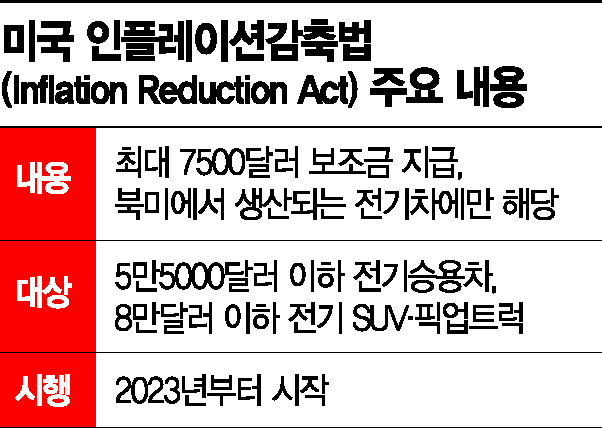
Effectively Only U.S.-Made Vehicles Supported... Hyundai's Local Factory to Complete in 2025
Immediate attention is focused on Hyundai Motor Group, a leading domestic automaker. Currently, Hyundai sells five models locally?IONIQ 5, Kona EV, Genesis GV60, EV6, and Niro EV?but since these are produced outside the U.S., they are excluded from the tax credit. Moreover, if domestic battery companies fail to reduce their reliance on Chinese raw materials next year, sales could suffer serious damage. Both the automotive and battery sectors are under urgent pressure.
If this situation continues, unless Hyundai Motor Group independently offers marketing discounts, U.S. consumers will face an approximately 10 million KRW increase in the vehicle's final price. Hyundai has been targeting the North American electrification market with competitive pricing, so this means losing its biggest advantage compared to other companies.
Hyundai's flagship eco-friendly vehicle, the IONIQ 5, has a local U.S. price of about $40,000. Previously, with the tax credit, it could be purchased for around $32,500, but now consumers must pay the full $40,000. In contrast, Tesla's entry-level Model 3 starts at about $46,990, and with the tax credit, the price difference with the IONIQ 5 becomes negligible.
If Hyundai continues to be excluded from subsidy eligibility, its plan to sell approximately 840,000 electric vehicles in the North American market by 2030 will inevitably face obstacles. Hyundai's electric vehicle market share in the U.S. for the first half of this year was second at about 9%, following Tesla's 70%. Although Tesla dominates, Hyundai had exported about 40,000 electric vehicles to the U.S. by last month, securing second place.
Currently, Hyundai plans to produce the GV70 electrified model locally within this year and the EV9 in 2024, but there are no local production plans for the popular IONIQ 5 and EV6 in North America. The electric vehicle-only factory Hyundai is building in Georgia, U.S., will not be completed until 2025.
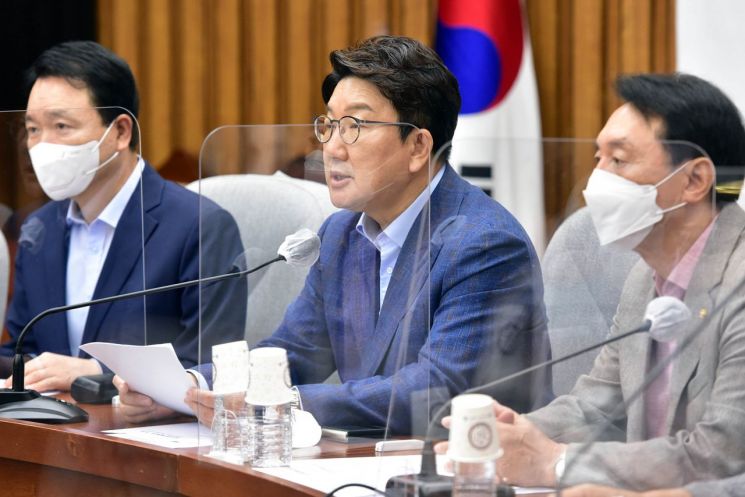 Kwon Seong-dong, floor leader of the People Power Party (center), is giving an opening remark at the party's strategy meeting held at the National Assembly on the morning of the 19th. [Image source=Yonhap News]
Government Response Effectiveness Uncertain... "Need to Consider Additional Domestic Subsidies"
Our government is responding to the situation, but overcoming it appears challenging.
On the 19th, Kwon Seong-dong, floor leader of the People Power Party, stated at a party meeting, "Under the national treatment principle of the Free Trade Agreement (FTA), Korean electric vehicles should receive the same tax benefits as North American products," and criticized, "The U.S. tax discrimination measures contradict the spirit of strengthening the economic and security alliance between Korea and the U.S." He demanded, "The government should immediately start negotiations with the U.S. government to ensure Korean electric vehicles receive equal treatment as North American ones."
Foreign Minister Park Jin also appeared before the National Assembly that day and said regarding the Inflation Reduction Act, "There is a possibility of violating the national treatment principle of the Korea-U.S. FTA and the most-favored-nation principle under World Trade Organization (WTO) rules," adding, "We have conveyed concerns to the U.S. through multiple channels." Trade Negotiations Director An Deok-geun of the Ministry of Trade, Industry and Energy is expected to deliver the government's concerns during a visit to the U.S. early next month for IPEF consultations.
However, it is uncertain whether these government moves can directly pressure the U.S. Therefore, there are calls for the Korean government to reconsider its subsidy policy for the domestic electric vehicle market. Since subsidies are not received in the U.S., domestic subsidies should be significantly increased. Floor leader Kwon emphasized, "We must actively consider temporary subsidies or corporate tax reductions for automakers and related companies expected to suffer damage."
He added, "Currently, Korean electric vehicles exported to China receive no subsidies from China, while Chinese electric vehicles receive subsidies from the Korean government. Our government should either demand subsidies for Korean electric vehicles from the Chinese government or abolish subsidies for Chinese electric vehicles."
© The Asia Business Daily(www.asiae.co.kr). All rights reserved.
![Clutching a Stolen Dior Bag, Saying "I Hate Being Poor but Real"... The Grotesque Con of a "Human Knockoff" [Slate]](https://cwcontent.asiae.co.kr/asiaresize/183/2026021902243444107_1771435474.jpg)

















