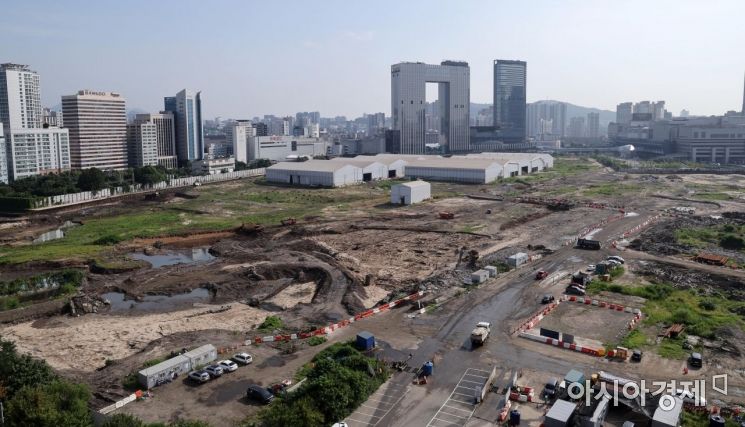
 The site of the railway maintenance depot in Hangangno 3-ga, Yongsan-gu, Seoul. The Seoul Metropolitan Government announced the development plan for the Yongsan International Business District. Photo by Hyunmin Kim kimhyun81@
[Asia Economy Reporter Chawan-yong] The phrase ‘Mayongseong (Mapo, Yongsan, Seongdong)’, which used to lead the rise in housing prices in northern Seoul, is expected to become a thing of the past. While housing prices in Mapo-gu and Seongdong-gu have stagnated due to the recent real estate market transaction slowdown, prices in Yongsan, where large-scale development was announced, have risen sharply, widening the gap significantly. It is now time to refer to ‘Maseong’ and ‘Yongsan’ separately.
According to the KB Real Estate Housing Price Trend Survey on the 19th, the average sale price per square meter of apartments in Yongsan in July was 18.49 million KRW. Mapo was 15.43 million KRW, and Seongdong was 16.23 million KRW, with the gap from Yongsan reaching 3.06 million KRW and 2.26 million KRW per square meter, respectively.
Until December last year, the average sale price per square meter of apartments in Mayongseong did not show a significant difference. Yongsan was 17.64 million KRW, Mapo 15.24 million KRW, and Seongdong 16.01 million KRW. The same was true at the end of 2020, with Yongsan at 14.93 million KRW, Mapo at 12.95 million KRW, and Seongdong at 13.59 million KRW, showing similar differences.
However, despite the real estate market transaction slowdown, Yongsan’s housing prices continued to rise due to the relocation of the presidential office and Seoul Mayor Oh Se-hoon’s announcement of the ‘Yongsan International Business District Development Plan’. It is now threatening Songpa (18.63 million KRW), which is grouped with the Gangnam 3 districts.
Yongsan is also seeing a surge in record-high priced complexes this year. Among the top 10 apartment transactions in Seoul in the first half of the year, seven were apartments located in Hannam-dong. According to the apartment transaction big data site Asil, the most expensive apartment in Seoul in the first half of this year was ‘PH129 (exclusive area 273.96㎡)’ in Cheongdam-dong, Gangnam-gu, which was traded for 14.5 billion KRW in April. The next most expensive apartment was ‘Park Hannam (exclusive area 268.67㎡)’ in Hannam-dong, Yongsan-gu, traded for 13.5 billion KRW in the same month.
‘Hannam The Hill (exclusive area 240.30㎡)’, which was traded for 11 billion KRW on May 30, set a record high price. Compared to the same exclusive area traded for 7.75 billion KRW in May last year, it rose by 3.25 billion KRW (41.9%) in just one year.
The upward trend in Yongsan’s housing prices is expected to continue. Last month, Seoul City announced a development plan for the Yongsan Maintenance Depot site, which is expected to strengthen the momentum for reconstruction and redevelopment in the Yongsan area.
Currently, about 40 districts in Yongsan are pursuing redevelopment projects, including Jungsan Apartment, Bukhangang Seongwon Apartment, Daerim Apartment, Hangang Samik Apartment, Ichon Prototype Apartment, the entire Maintenance Depot Zones 1, 2, and 3, Yongsan Station Zones 1 and 3, North side of Sinyongsan Station Zones 1 and 2, and Cheongpa Zone 1.
Reconstruction and remodeling projects are also in full swing by complex. ‘Hangang Mansion’, known as the ‘leader of Yongsan reconstruction’, along with Ichon Zone 1, Jungsan Apartment, Gangbyeon Gangseo Apartment, Gangchon Apartment, Miju Apartment Building B, Jumbo Apartment, Kolon Apartment, Shindonga Apartment, and Wanggung Apartment are all moving forward with their own development plans.
Experts predict that Yongsan’s upward trend will continue, but the sluggish transaction market due to interest rate hikes is expected to undergo some adjustment.
Park Won-gap, Senior Real Estate Specialist at Kookmin Bank, said, “Yongsan is expected to rise alone due to mammoth-scale development benefits, but the continuous rise in interest rates will limit the increase in Yongsan’s housing prices.”
© The Asia Business Daily(www.asiae.co.kr). All rights reserved.
![Clutching a Stolen Dior Bag, Saying "I Hate Being Poor but Real"... The Grotesque Con of a "Human Knockoff" [Slate]](https://cwcontent.asiae.co.kr/asiaresize/183/2026021902243444107_1771435474.jpg)















