The Financial Services Commission (FSC) presented detailed alternatives to alleviate the concerns of the secondary financial sector regarding the New Start Fund, but did not hide its discomfort. It referred to the ‘history’ of injecting public funds to prevent past savings bank insolvency crises and emphasized that "the soundness of savings banks is being monitored." It also pressured the secondary financial sector to establish debt adjustment and consulting programs for vulnerable borrowers, stating that “an autonomous debt restructuring program by financial companies is necessary.”
At the New Start Fund briefing on the 18th, the FSC partially accepted the concerns raised mainly by the secondary financial sector and provided a kind of ‘feedback.’ The secondary financial sector had been worried about being forced to sell their major customers’ loan receivables to the New Start Fund at a low price.
Accepting some of the secondary financial sector’s criticism that "customers defined by authorities as at risk of default are normal customers from the perspective of savings banks," the FSC proposed a plan (consent-type debt adjustment) allowing banks to adjust the receivables themselves instead of unconditionally transferring them to the New Start Fund. It also presented a plan to reflect the secondary financial sector’s funding costs in the adjusted interest rates to prevent the possibility of negative margins. Additionally, it emphasized that the fund would sufficiently recognize market prices for purchasing non-performing loans.
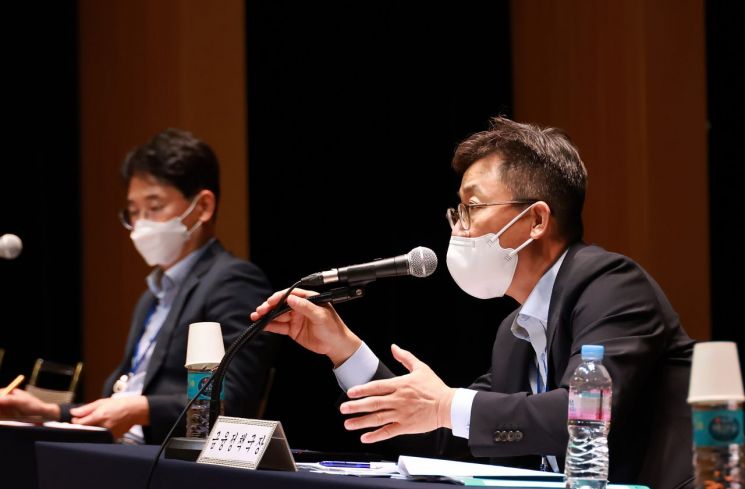
Nonetheless, the FSC did not hide its discomfort toward the secondary financial sector that day. Referring to the ‘history of debt restructuring,’ the FSC emphasized that financial companies had also benefited from government support in the past. Kwon Daeyoung, Director of the Financial Policy Bureau at the FSC, said, “Over the past 20 years, financial companies have been ‘covered’ by the state through public funds during crises,” adding, “During the 1997 foreign exchange crisis, 160 trillion won of public funds were injected, and the state intervened in the 2012 savings bank crisis as well, which was also funded by ‘public taxes.’” He suggested that debt adjustment programs should be approached from a social responsibility perspective toward self-employed individuals.
The FSC also called on financial companies to implement autonomous debt restructuring programs. Director Kwon stated, “I believe autonomous debt restructuring programs by financial companies are necessary before state intervention,” adding, “Financial companies should assist self-employed borrowers in repaying their debts well, and if repayment is difficult, they should strengthen programs that provide ‘customized consulting programs.’” The customized consulting program is a system that utilizes accumulated data in the financial sector to offer preferential interest rate limits to self-employed borrowers or provide multifaceted consulting analyzing commercial districts or sales.
On that day, the FSC also mentioned that the introduction of the New Start Fund should be seen as an opportunity for savings banks, which led the concerns, to restore their ‘soundness.’ Director Kwon said, “During the COVID-19 period, financial authorities classified many borrowers as ‘normal borrowers’ through maturity extensions and repayment deferrals, but during that time, the secondary financial sector rapidly increased loans,” adding, “The savings banks themselves need to carefully consider whether they can endure such a situation and maintain their own soundness.” He continued, “Along with the ongoing debt restructuring system, savings banks should proactively restore their soundness,” and noted, “Financial authorities are also monitoring the loan growth rate and soundness of the secondary financial sector.”
© The Asia Business Daily(www.asiae.co.kr). All rights reserved.
![Clutching a Stolen Dior Bag, Saying "I Hate Being Poor but Real"... The Grotesque Con of a "Human Knockoff" [Slate]](https://cwcontent.asiae.co.kr/asiaresize/183/2026021902243444107_1771435474.jpg)















