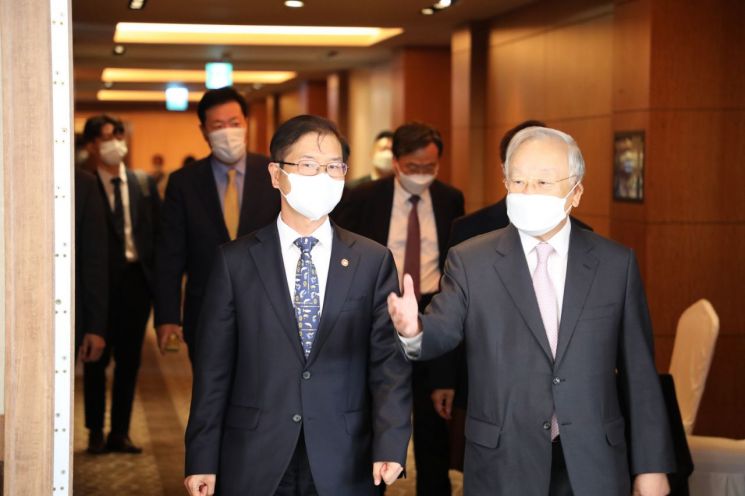
 Minister of Employment and Labor Lee Jeong-sik (left) is entering the CHO meeting held at Lotte Hotel on the 17th, guided by Chairman Sohn Kyung-shik of the Korea Employers Federation.
 [Asia Economy Reporter Choi Dae-yeol] Sohn Kyung-shik, Chairman of the Korea Employers Federation, requested the government to change the 52-hour workweek system from a weekly basis to a monthly basis and to lift the restrictions on dispatched labor, which are currently limited to 32 industries.
On the 17th, the Korea Employers Federation held a meeting with Chief Human Resources Officers (CHOs) of major companies at Lotte Hotel in Seoul, inviting Lee Jeong-sik, Minister of Employment and Labor.
In his greeting, Chairman Sohn said, "Since the new government took office, the President has emphasized labor reform as an important national agenda, and companies have high expectations." He anticipated that flexible working hours and the expansion of job- and performance-based pay systems would have a positive impact at the frontline workplaces.
He emphasized the need to resolve the issue of employment rigidity, which lowers national competitiveness and negatively affects job creation. He stated, "Our courts have increasingly ruled in favor of illegal dispatch by applying the Dispatch Act as a standard to in-house subcontracting, threatening our industrial ecosystem composed of numerous original-subcontractor relationships." He added, "To fundamentally solve this, the current restrictions on dispatched labor, limited to 32 industries, must be lifted."
He explained that specializing and dividing production or work methods is widely used worldwide, so there is little need to restrict it. According to the Korea Employers Federation, dispatched labor is only allowed in 32 industries in Korea, and other dispatched labor is considered illegal. In contrast, the United States, the United Kingdom, and France allow dispatched labor across all industries, while Japan and Germany permit it except for a very few industries.
He also pointed out the need to balance the power between labor and management. Chairman Sohn said, "In the previous government, while the ratification of the ILO core conventions and amendments to the Trade Union Act greatly strengthened the union's right to organize, the employer's countermeasures were not supplemented, increasing the imbalance of power between labor and management." He requested, "Employer countermeasures such as allowing replacement labor and prohibiting workplace occupation should also be supplemented to meet global standards."
Minister Lee Jeong-sik stated, "We will improve systems and practices that do not fit the changed environment to protect workers' rights and interests while enhancing corporate vitality." He added, "We intend to prioritize efforts on reforming working hours and wage systems, which affect the lives of the majority of the people." He further said, "The government will strictly respond to illegal acts in the field based on laws and principles and support changes in the workplace through continuous communication with labor and management."
© The Asia Business Daily(www.asiae.co.kr). All rights reserved.
![Clutching a Stolen Dior Bag, Saying "I Hate Being Poor but Real"... The Grotesque Con of a "Human Knockoff" [Slate]](https://cwcontent.asiae.co.kr/asiaresize/183/2026021902243444107_1771435474.jpg)















