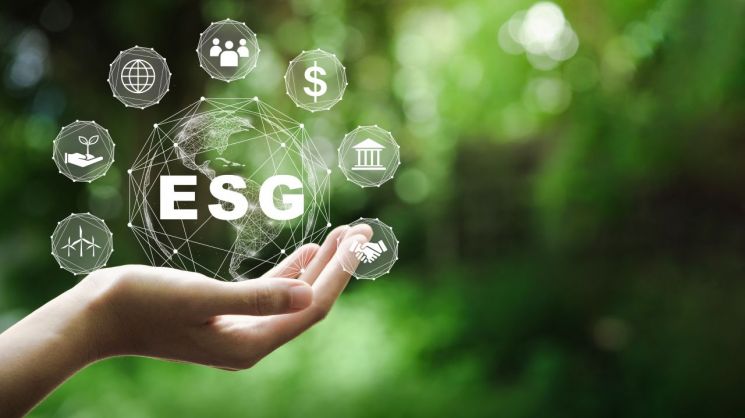
[Asia Economy Reporter Eunju Lee] Recently, unique eco-friendly activities have been unfolding mainly among major banks. They are stepping up to provide “support fire” to help small and medium-sized enterprise (SME) customers solve their ESG concerns, or considering reducing the issuance of physical cards, which have been regarded as a “necessity” in banking services. They also take on the role of “bee protectors” by creating various spaces and supporting infrastructure for bees. Through these notable eco-friendly activities, they are seeking to stand out in ESG management.
According to KakaoBank on the 14th, the bank is promoting ESG activities aimed at minimizing environmental impact by reducing excess resource generation during service operations. First, they plan to implement a “Cardless Project” with the intention of gradually reducing the issuance of plastic cards. KakaoBank issues more than 2 million cards annually, and since these cards are made of plastic, they intend to consider the environmental impact. Once the project is in full swing, customers will be able to choose a “cardless option” that does not use a physical card when issuing a card.
KakaoBank is also making efforts to reduce environmental pollution caused by data through operating “virtual servers.” Virtual servers refer to an approach where high-performance servers are built and data is intensively stored in that space, minimizing the need to install additional physical servers.
For example, computer users who only use simple word processing programs utilize only a very small portion of CPU resources. By applying virtual server technology, multiple users can share the CPU resources of a single computer. A KakaoBank official explained, “We currently operate 2,000 virtual servers,” adding, “Virtualizing servers consumes about one-seventh of the power compared to operating traditional physical servers.”
NH Nonghyup Bank provides free consulting services to help SME borrowers solve their ESG concerns. Recently, SMEs are also required to meet certain ESG standards to establish business partnerships with the government and large corporations. Accordingly, Nonghyup Bank plans to “connect” borrowers who need professional ESG management advice with consulting services. Nonghyup Bank covers all the connection “fees.” A Nonghyup Bank official said, “In this context, we signed a business agreement with the credit rating agency NICE D&B on the 10th,” and explained, “We believe it is a ‘win-win’ for Nonghyup Bank to help borrowers actively respond to the changing industrial environment due to strengthened carbon neutrality regulations and supply chain ESG management demands.”
KB Kookmin Bank is engaging in eco-friendly activities to protect the disappearing “bees.” Since May, they have launched the K-Bee Project and embarked on efforts to save bees. They established an apiary on the rooftop of their headquarters and installed a “Bee Hotel” at the Seoul Botanical Garden. Over the next four years, they plan to plant 100,000 “miryonsu” (nectar-producing trees) in areas including Gangwon Province, which serve as food sources for bees. A KB Kookmin Bank official explained the purpose of their ESG management, saying, “Bees are important pollinators responsible for 70% of the pollination of the top 100 crops cultivated for human food, but we focused on the issue of bees disappearing in Korea.”
© The Asia Business Daily(www.asiae.co.kr). All rights reserved.
![Clutching a Stolen Dior Bag, Saying "I Hate Being Poor but Real"... The Grotesque Con of a "Human Knockoff" [Slate]](https://cwcontent.asiae.co.kr/asiaresize/183/2026021902243444107_1771435474.jpg)















