[Asia Economy Reporter Yoo Hyun-seok] Opinions have emerged that tax benefits are needed for hydrogen electric cargo vehicles to reduce greenhouse gases and revitalize the hydrogen industry.
On the 10th, the Korea Automobile Manufacturers Association (KAMA) released a report titled "The Need to Strengthen Support for Expanding the Supply of Hydrogen Electric Cargo Vehicles," stating, "The acquisition tax reduction limit set based on hydrogen electric passenger cars should have separate requirements for hydrogen cargo vehicles, and the vehicle price limit should be expanded."
According to the report, as of 2019, greenhouse gas emissions from the transportation sector amounted to 100.989 million tons, accounting for 14.4% of the total national emissions. Among these, the road transportation sector accounted for 13.9%, which is 96.5% of the transportation sector emissions.
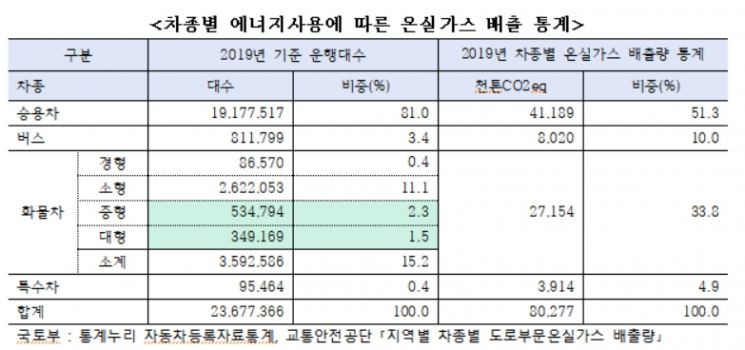
In particular, the number of medium and large cargo trucks is only 883,963 units, which is 3.8% of the total 23,677,366 vehicles. However, their fine dust emissions account for 49.7% of the total. Additionally, CO2 emissions are up to 12.3 times higher compared to 1-ton trucks, and fine dust emissions are more than 17 times higher. Furthermore, commercial cargo trucks have an average driving distance of 121.4 km, which is more than three times higher than non-commercial vehicles at 39.6 km and passenger cars at 37.2 km. The report explains that as the load capacity increases, the driving distance tends to be longer, highlighting the urgency of reducing pollution from medium and large logistics cargo trucks.
KAMA stated, "Cargo trucks have characteristics of long driving distances and a high proportion of diesel vehicles," adding, "As of 2019, although they accounted for 15.2% of the total number of vehicles, their share of carbon dioxide (CO2) emissions was 33.8%, and fine dust (PM10) accounted for 75.5% of total emissions."
Along with this, to enhance the competitiveness of the domestic automobile industry, policies to expand hydrogen electric cargo vehicles are necessary. One of the main means of achieving zero emissions in the transportation sector, electric vehicles, has a high dependence on China for key parts, battery raw materials, and intermediate goods, posing potential supply chain risks.
In the first half of this year, the domestic share of electric vehicles in the automobile market was 78.4%, which is 3.9 percentage points lower than the overall automobile market. Especially in the electric bus market, the share of imports surged from 26% in 2019 to 48.7% in the first half of 2022 due to intensified competition from importers.
KAMA said, "Domestic production cannot rapidly increase in the short term, so the supply increase of domestic electric commercial vehicles is limited, while the number of electric cargo vehicles planned to be launched by importers is considerable, raising concerns about the future encroachment of imported vehicles in the commercial vehicle market."
The report also emphasized the need to promote the hydrogen economy by expanding the supply of hydrogen cargo vehicles. Hydrogen cargo vehicles have advantages such as lighter hydrogen tanks compared to batteries, refueling times similar to conventional internal combustion vehicles at 8 to 20 minutes, and driving ranges about 100 km longer than currently released electric vehicles, at around 400 km. Additionally, they do not burden the national power grid, making them suitable for commercial vehicles that require long-distance driving.
Jung Man-ki, chairman of KAMA, said, "In the case of electric vehicles, countries around the world such as the United States and China are implementing country-centered policies by introducing differentiated subsidies to expand domestic industrial infrastructure, including batteries, rare earths, and parts," adding, "South Korea also needs to introduce drastic measures such as significantly expanding acquisition tax reductions for hydrogen cargo vehicles, which can greatly contribute to building domestic industrial infrastructure and achieving carbon neutrality."
© The Asia Business Daily(www.asiae.co.kr). All rights reserved.
![Clutching a Stolen Dior Bag, Saying "I Hate Being Poor but Real"... The Grotesque Con of a "Human Knockoff" [Slate]](https://cwcontent.asiae.co.kr/asiaresize/183/2026021902243444107_1771435474.jpg)















