Close contact and masks soaked in water... Vulnerable to COVID-19
Experts "If reinfections or hidden infections increase, infections among the elderly will also rise"
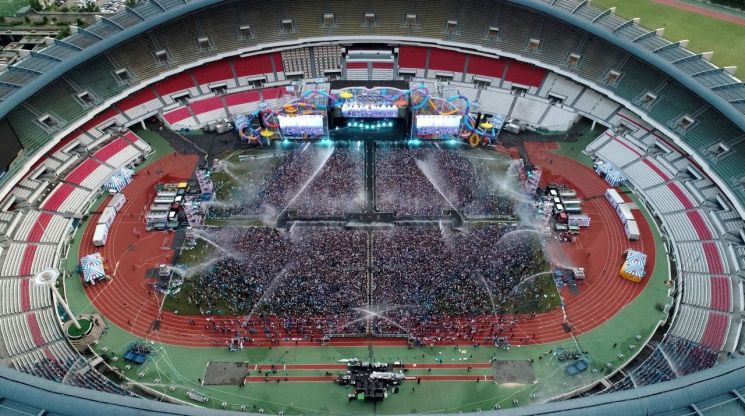 Large-scale water play performances, which were suspended due to COVID-19, have resumed after three years and are being pointed out as a cause of the resurgence.
 [Image source=Yonhap News]
[Asia Economy Culture Young Intern Reporter] Recently, large-scale water play performances have been identified as one of the causes of COVID-19 transmission. These festivals involve unavoidable close contact, and masks soaked in water become ineffective, raising concerns about vulnerability to COVID-19 infection. Some critics point out that health authorities are taking a passive approach under the pretext of 'self-regulation.'
Summer signature events such as singer Psy's 'Heumbok Show' tour, which was halted due to the COVID-19 crisis, and 'Waterbomb,' a water gun fight event, have resumed after three years, sparking concerns about COVID-19 infections. These events have high participation rates among people in their 20s and 30s, and infections have recently surged mainly among young people. The number of confirmed cases among people in their 20s increased from 23,445 in the first week of July to 44,118 in the second week and 78,125 in the third week. Cases among people in their 30s also rose from 17,730 in the first week to 35,480 in the second week and 63,670 in the third week of July.
On the 31st, numerous reports appeared on online communities and social networking services (SNS) stating, "I got infected after attending a large-scale water play performance." Posts such as "If you went to the Heumbok Show, please get tested for COVID" and "I got reinfected after going" were posted.
The reason for the surge in infections after water play performances is the vulnerable environment for infection. Outdoor mask mandates have been lifted, allowing attendees to remove masks during the performance. Even if masks are worn, they quickly become wet due to continuous water splashes. Spectators gathered to watch the performance cannot avoid close contact, and droplets easily spread as people shout or respond.
Experts warn that if reinfections among people in their 20s and 30s and 'hidden infections' from those avoiding testing increase, the number of infections among the elderly, who have a higher fatality rate, could rise ahead of the Chuseok holiday.
However, the government has stated that it will not apply additional quarantine measures to water play performances. The government’s position is that such measures could be perceived as 'regulation.' Health authorities said, "There will be no regulations that shake the recovery of daily life," and emphasized the need to maintain a self-regulation quarantine policy.
Meanwhile, on the 26th of last month, Park Young-jun, head of the epidemiological investigation team at the Central Disease Control Headquarters (CDCH), said at a regular briefing regarding reports of "testing positive after attending large-scale water-spraying performances," "We are aware of the situation" and "We are investigating the details."
Experts advise that considering the increasing reinfection rate, people in their 20s and 30s should actively get tested for COVID-19. Professor Cheon Eun-mi of the Department of Respiratory Medicine at Ewha Mokdong Hospital said, "According to recent studies, even if antibodies are formed through infection or vaccination, the effect lasts only up to three months, and reinfection rates increase significantly from the fourth month. The age groups with the highest reinfection rates are those aged 18 to 29 and those in their 30s, who are highly active."
© The Asia Business Daily(www.asiae.co.kr). All rights reserved.
![Clutching a Stolen Dior Bag, Saying "I Hate Being Poor but Real"... The Grotesque Con of a "Human Knockoff" [Slate]](https://cwcontent.asiae.co.kr/asiaresize/183/2026021902243444107_1771435474.jpg)















