Urging the Conversion of Incheon New Port Hinterland to Public Development
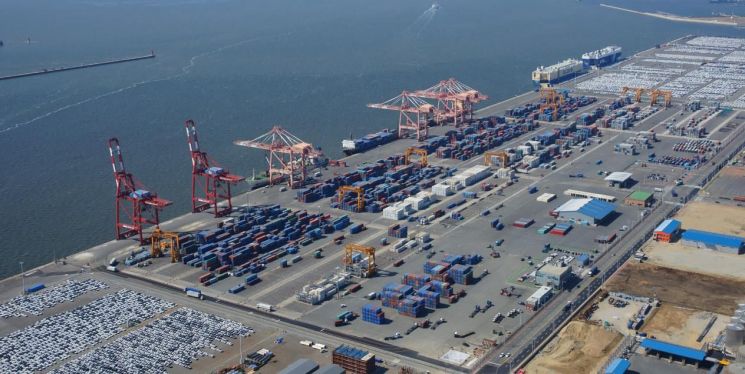
[Asia Economy Reporter Park Hyesook] Civic groups are raising their voices to revert the private development and sale method of Type 1 port hinterland complexes to a public development and sale method from the perspective of the public nature of ports.
Incheon Gyeonggi Federation of Trade Unions and Gyeonggi Federation of Trade Unions issued a joint statement on the 3rd, stating that "'Pyeongtaek-Dangjin Port East Pier Hinterland Land Sale Project' has turned into a real estate speculation ground without regulatory measures," and urged thorough investigations by the authorities and legislative amendments by the political circles.
The Federation claimed, "During the land sale process of the hinterland, companies or chaebols without bidding qualifications unrelated to ports and logistics, as well as special interest parties, were registered en masse as land registrants," adding, "Among them were land transactions that recorded returns approaching 1000% compared to actual investment amounts."
The Federation criticized that although the port hinterland developed as a national project has turned into a 'battleground for speculation,' related agencies have consistently shown a passive attitude.
The Federation stated, "The Ministry of Oceans and Fisheries and Pyeongtaek City are consistently ignoring the issue, claiming it is 'beyond their authority,' despite the fact that the East Pier hinterland land sale project is clearly real estate speculation that betrays public interest," and "We urge thorough investigation and prosecution by the authorities regarding the poor management and supervision by the relevant agencies."
The government developed three berths of 'Pyeongtaek-Dangjin Port Inner Port East Pier' in Manho-ri, Poseung-eup, Pyeongtaek City, from 2003 to 2010 through private investment. This project was promoted to create a logistics hub in response to the expanding functions of Pyeongtaek-Dangjin Port, which opened in 1986, and the increasing trade with China.
The project, implemented by the Hyundai Development Company consortium (HDC consortium) using a BTO (Build-Transfer-Operate) private investment method, consisted of three 2000 TEU (1 TEU equals one container) class berths (places where ships dock at the port), container yards, bonded warehouses, and auxiliary facilities.
A total of 168 billion KRW was invested, including 35 billion KRW from the government budget and 133 billion KRW from private capital. 'Pyeongtaek Dongbang I-Port Co., Ltd.,' the operator of Pyeongtaek Container Terminal, operates this pier.
The government divided the 121,299㎡ hinterland land directly behind the three berths of the East Pier of Pyeongtaek-Dangjin Port into three zones, A, B, and C, and sold them to the private sector.
The problem is that most of this land ended up owned by shareholders of Pyeongtaek Dongbang I-Port, the pier operator, or individuals completely unrelated to the project.
The Federation judged that the loose regulatory measures were a major factor in the port hinterland turning into a speculation ground.
The Federation argued, "The Ministry of Oceans and Fisheries promoted the development of Pyeongtaek-Dangjin Port in 2003 as a 'private investment project' based on the 'Private Investment in Social Overhead Capital Act,' resulting in the East Pier hinterland (auxiliary business site) being excluded from the 'port area,' and the hinterland land sale project ultimately turned into a 'real estate speculation ground without regulatory measures.'"
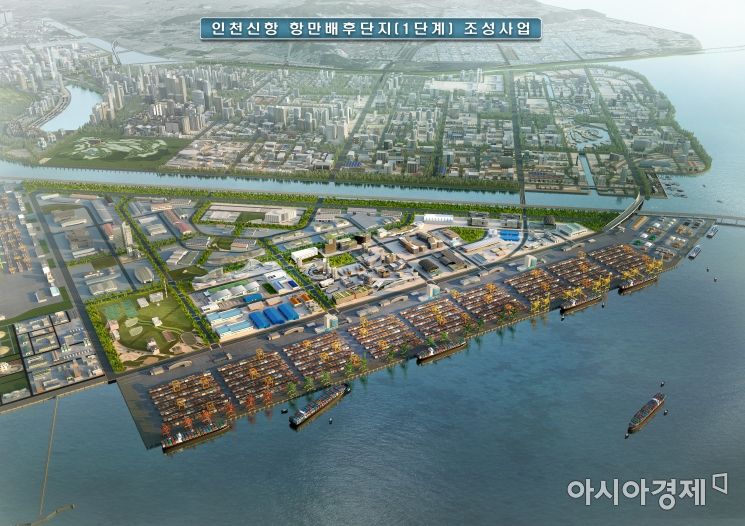
The private development of the Incheon New Port hinterland is also causing great concern among the port industry and civic groups.
The Ministry of Oceans and Fisheries is pushing for private development led by large construction companies for the 1-1 Phase 3 Zone (540,000㎡) and 1-2 Phase Zone (410,000㎡) following the 1-1 Phase 2 Zone (940,000㎡) of the Incheon New Port hinterland, sparking controversy over 'port privatization.'
Until now, port hinterlands were developed by the government and port corporations and leased to the private sector for up to 50 years under a 'public development and lease' method. However, the government introduced the private development and sale method abruptly, citing difficulties in securing large-scale investment funds promptly and the long development period of hinterlands.
The private development and sale method allows the project implementer to acquire the land created within the total project cost range (guaranteeing private ownership) and, upon request, to have the right of first refusal to purchase the remaining land.
Twenty organizations, including Incheon Gyeonggi Federation of Trade Unions, Incheon Port Development Council, Incheon Port Logistics Association, and Incheon Port Labor Union, criticized in a recent statement that "once the 'transfer prohibition' period on land created by non-managing port development projects ends, individual sales for real estate speculation by the private sector will lead to indiscriminate development and rent increases, resulting in the loss of the port's public nature."
They further stated, "The Incheon New Port hinterland should be actively supported by the government and political circles so that Incheon Port Authority can carry out stable acquisition work for public development, including purchasing existing private development project sites."
Park Chandae, a member of the Democratic Party of Korea (Incheon Yeonsu Gap), also released a statement on the 3rd, saying, "(The Pyeongtaek-Dangjin Port East Pier hinterland land sale project) was intended to supplement the insufficient national budget and harmoniously develop ports with the private and public sectors, but it is turning into a tool for speculation," and criticized, "The biggest fault lies in the overall poor management and supervision by related agencies such as the Ministry of Oceans and Fisheries."
He also expressed concern about the Incheon New Port hinterland being promoted under the private development and sale method, stating, "The public nature of national infrastructure facilities such as ports must be maintained, and privatization disguised as economic efficiency should be approached cautiously," and "A comprehensive review of the port and airport privatization attempts by the Yoon Suk-yeol administration is necessary."
Park co-proposed a partial amendment bill to the Port Act and Port Corporation Act for public development of port hinterlands in June.
© The Asia Business Daily(www.asiae.co.kr). All rights reserved.
![Clutching a Stolen Dior Bag, Saying "I Hate Being Poor but Real"... The Grotesque Con of a "Human Knockoff" [Slate]](https://cwcontent.asiae.co.kr/asiaresize/183/2026021902243444107_1771435474.jpg)
















