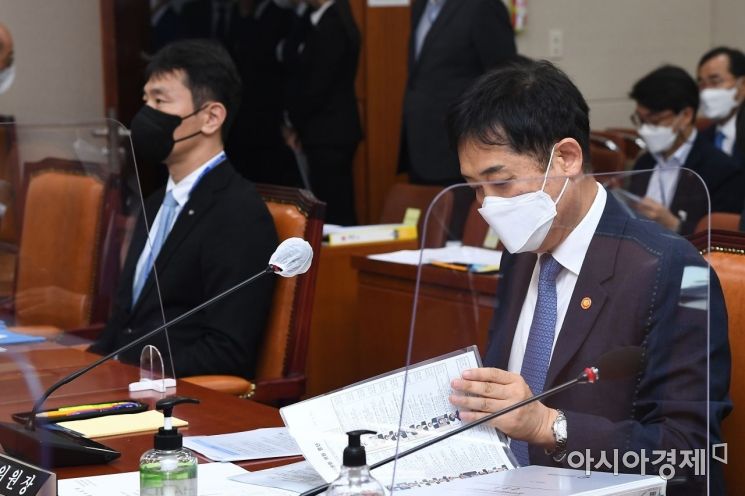
 Financial Services Commission Chairman Kim Ju-hyun attended the full meeting of the Political Affairs Committee held at the National Assembly on the 28th and reviewed materials before the meeting started. Photo by Yoon Dong-joo doso7@
[Asia Economy Reporter Lee Jung-yoon] Financial authorities have announced plans to establish a regulatory framework and strengthen risk management for the coin market. Unlike former Financial Services Commission Chairman Eun Sung-soo's remark that "(young people) should be guided by adults if they go down the wrong path" regarding cryptocurrency investment, they intend to create a basic law and accelerate investor protection.
On the morning of the 28th, the Financial Services Commission (FSC) explained during a report to the National Assembly's Political Affairs Committee, "We will establish a regulatory framework, including the enactment of a Digital Asset Basic Act, to create an environment where the virtual asset market can grow responsibly based on investor trust."
The FSC plans to first create market conditions and manage the issuance of security-type virtual assets under the Capital Markets Act system, which includes investor protection measures. For non-security types, the plan is to enact a Digital Asset Basic Act centered on bills currently pending in the National Assembly to prevent coin issuance, listing, and unfair trading.
However, until the system is established, the FSC urges the industry to make self-regulatory efforts and promotes supervision of virtual asset service providers and consumer protection through the Act on Reporting and Using Specified Financial Transaction Information (Special Act on Reporting) and investigations by prosecutors and police. The Financial Intelligence Unit (FIU) will strengthen inspections to prevent money laundering and cooperate with the Ministry of Justice, investigative agencies, and the Financial Supervisory Service (FSS) to respond to illegal transactions.
The FSS is also stepping up risk management in the cryptocurrency market in line with the FSC. To diagnose risk factors, the FSS formed the "Virtual Asset Risk Council" and held its first meeting on the 28th of last month. Through this, they plan to encourage virtual asset service providers to strengthen internal controls and consumer protection capabilities and devise measures to manage potential risks. Additionally, an expert roundtable was organized on the same day to discuss accounting supervision measures related to virtual asset holdings, and a close cooperation system with international supervisory organizations and overseas supervisory authorities has been established.
The reason financial authorities are actively establishing and managing a system for the virtual asset market is due to the emergence of several risk factors. During the Luna incident, cryptocurrency exchanges did not delist the coin, leading to claims that they were collecting fees. The Seoul Southern District Prosecutors' Office's Joint Financial and Securities Crime Investigation Team received complaints from investors who suffered losses in the Luna incident against Terraform Labs CEO Kwon Do-hyung and others, and conducted raids on exchanges including Upbit.
Recently, suspicious fund movements through exchanges have also been detected. Most of the abnormal foreign exchange transactions amounting to 4.1 trillion KRW at Woori Bank and Shinhan Bank were found to have been transferred from domestic exchanges to trade company accounts and then sent overseas. However, the FSS stated that it is difficult to confirm whether these abnormal remittances were transactions aimed at exploiting the "Kimchi Premium," where domestic coin prices are higher than overseas prices. Earlier in May, Hana Bank was fined 50 million KRW by the FSS for violating foreign exchange transaction laws involving transactions worth around 200 billion KRW, and its Jeongneung branch was suspended from some operations for four months. The problematic foreign exchange transactions at that time were arbitrage trades targeting the Kimchi Premium.
Professor Park Sun-young of Dongguk University's Department of Economics said, "If the Digital Asset Basic Act is enacted, it should include provisions on disclosure and prevention of unfair trading to protect investors," adding, "In fact, there were no regulatory measures on behavior in the cryptocurrency market until now, so although it is late, the financial authorities' move seems to be a desirable direction."
© The Asia Business Daily(www.asiae.co.kr). All rights reserved.
![Clutching a Stolen Dior Bag, Saying "I Hate Being Poor but Real"... The Grotesque Con of a "Human Knockoff" [Slate]](https://cwcontent.asiae.co.kr/asiaresize/183/2026021902243444107_1771435474.jpg)















