If South Korea's base interest rate rises by 1.4%p, annual household interest burden increases by 2.92 million won
[Asia Economy Reporter Park Sun-mi] As the United States continues to raise its benchmark interest rate to stabilize inflation, an analysis suggests that the appropriate benchmark interest rate is around 3.12%, and if South Korea follows this pace, its rate could rise to as high as 3.65%. If the value of the Korean won declines, the increase in South Korea's benchmark interest rate could be even higher, making efforts to stabilize the won’s value?such as maintaining a trade surplus?urgent.
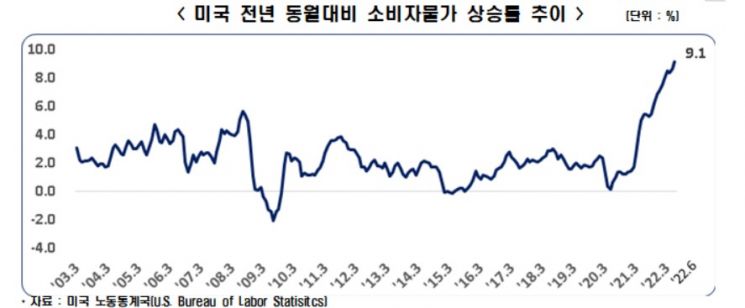
On the 28th, the Korea Economic Research Institute (KERI) estimated the appropriate U.S. benchmark interest rate at 3.12% through its analysis titled “Estimation of Appropriate Benchmark Interest Rates in the U.S. and South Korea and Its Implications.” The estimation was based on a model explaining the U.S. benchmark rate using economic variables such as the inflation rate (consumer price index increase), base money growth rate, and short-term (6-month) government bond yields, as well as the Federal Reserve’s interest rate decision rules. It analyzed that despite the possibility of a recession, the U.S. aggressively raised rates by 0.75 percentage points in June with a giant step and continued to raise the benchmark rate aggressively in July due to the excessively rapid pace of inflation.
KERI forecasted, “Since the U.S. Federal Reserve has decided to aggressively raise the benchmark interest rate even at the risk of a recession, the rate hike trend will continue until it reaches an appropriate level.”
KERI estimated South Korea’s appropriate benchmark interest rate at 3.65% in response to the U.S. rate hikes. This estimate considered that since January 2002, the minimum appropriate benchmark interest rate differential between South Korea and the U.S. has been 0.53 percentage points. To secure this appropriate rate differential of 0.53 percentage points, South Korea could raise its benchmark interest rate by 1.4 percentage points from the current 2.25%.
KERI estimated that if the benchmark interest rate rises by an additional 1.4 percentage points, household loan interest rates would increase by 1.65 percentage points, and the annual increase in household loan interest burden due to the rate hike would amount to 34.1 trillion KRW. The interest burden per household could increase by 2.92 million KRW, raising concerns.
Choo Kwang-ho, Director of Economic Policy at KERI, stated, “Although South Korea’s benchmark interest rate hike is inevitable due to the U.S.’s aggressive rate increases, it is necessary to minimize the increase considering the vulnerable financial resilience of households and the private sector.” He added, “While the U.S. benchmark interest rate level is the most important variable affecting the appropriate rate hike in South Korea, stabilizing the won’s value is also crucial. Therefore, efforts to enhance corporate competitiveness, stabilize raw material supply, and create an environment where dollar supply in the foreign exchange market can increase through a trade surplus turnaround are necessary.”
© The Asia Business Daily(www.asiae.co.kr). All rights reserved.
![Clutching a Stolen Dior Bag, Saying "I Hate Being Poor but Real"... The Grotesque Con of a "Human Knockoff" [Slate]](https://cwcontent.asiae.co.kr/asiaresize/183/2026021902243444107_1771435474.jpg)















