Turkiye Presidential Office Announces Agreement... Oath Ceremony Expected on 22nd
[Asia Economy Reporter Park Byung-hee] Expectations are rising for the resolution of the global food crisis as Russia and Ukraine have reportedly agreed to resume grain exports, including wheat and corn, which had been stuck at Black Sea ports. With the decline in futures prices of wheat and corn, food-driven inflation is also expected to ease somewhat.
According to the New York Times on the 21st (local time), the Turkish presidential office announced that Russia and Ukraine agreed to resume grain exports and that a signing ceremony for the agreement would be held on the 22nd. It added that UN Secretary-General Ant?nio Guterres and Turkish President Recep Tayyip Erdo?an, who mediated the negotiations, are expected to attend the signing ceremony.
However, Russia and Ukraine have not officially confirmed the agreement and stated that negotiations will continue on the 22nd. Russian Deputy Foreign Minister Andrey Rudenko said it is true that they are close to an agreement. In an interview with Interfax news agency, he said, "The negotiations are progressing very dynamically and constructively," and "We expect to reach an agreement soon."
The Ukrainian side is more cautious. A Ukrainian official said, "Everyone recognizes that something could go wrong." Although the agreement includes a clause that Russia will not attack Ukrainian ports or cargo ships, Ukraine still doubts whether Russia will properly implement the agreement.
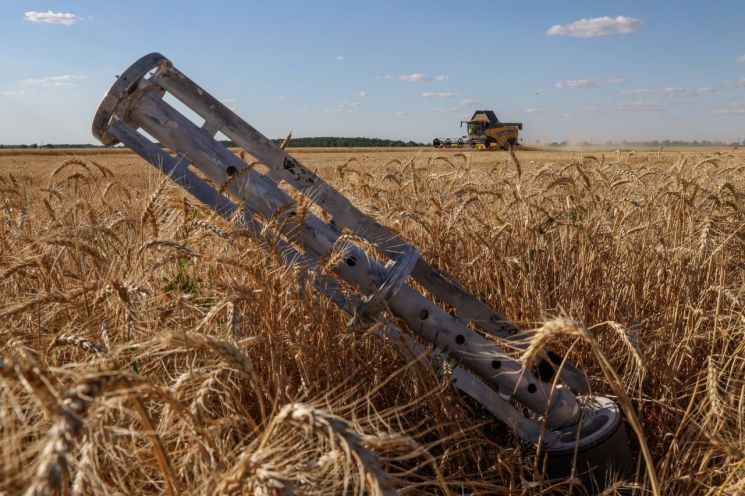 On the 21st (local time), farmers are harvesting wheat with combines in the Kherson region of southern Ukraine.
 Photo by TASS Yonhap News
One of the obstacles in the negotiations so far was the mines installed by Ukraine to block Russian warships' access to the Black Sea. According to Secretary-General Guterres, Ukraine agreed to remove some of the mines to allow ship movement. Ship movements in the Black Sea will be managed by the Ukrainian Navy and Coast Guard, and after ships move into international waters, they will be handed over to shipowners responsible for transportation. Shipowners must stop at Istanbul, the capital of Turkey, for inspection before transporting cargo to their destinations. The control center to be established in Istanbul is known to be for verifying that ships are not used for transporting weapons. Russia has expressed concerns that ships transporting grain might also carry weapons.
On the same day, the European Union (EU) announced legal measures clarifying that there will be no sanctions on Russian grain and fertilizer exports. Russia had claimed difficulties in exporting its grain due to EU sanctions. The EU refuted Russia's claims by stating that grain is not subject to EU sanctions but recently acknowledged that some impact might occur due to complex sanctions. In exchange for allowing Ukrainian grain exports, the EU took measures to enable Russia to export grain more smoothly.
Ukraine, the world's fifth-largest wheat exporter, mainly exported grain through six port cities on the Black Sea. After Russia invaded Ukraine on February 24, Ukraine's exports dropped to one-sixth of pre-war levels due to the blockade of the Black Sea. With the blockade lifted, it is estimated that over 22 million tons of Ukrainian grain will have export routes reopened.
Following the prospect of resuming Ukrainian grain exports, futures prices for wheat and corn fell. On the same day at the New York Commodity Exchange (COMEX), wheat futures prices dropped by 1.6%, and corn futures by 2.8%.
© The Asia Business Daily(www.asiae.co.kr). All rights reserved.
![Clutching a Stolen Dior Bag, Saying "I Hate Being Poor but Real"... The Grotesque Con of a "Human Knockoff" [Slate]](https://cwcontent.asiae.co.kr/asiaresize/183/2026021902243444107_1771435474.jpg)















