Special Lecture on 'Industry and Workforce Development Plans' by Semiconductor Special Committee on the 19th
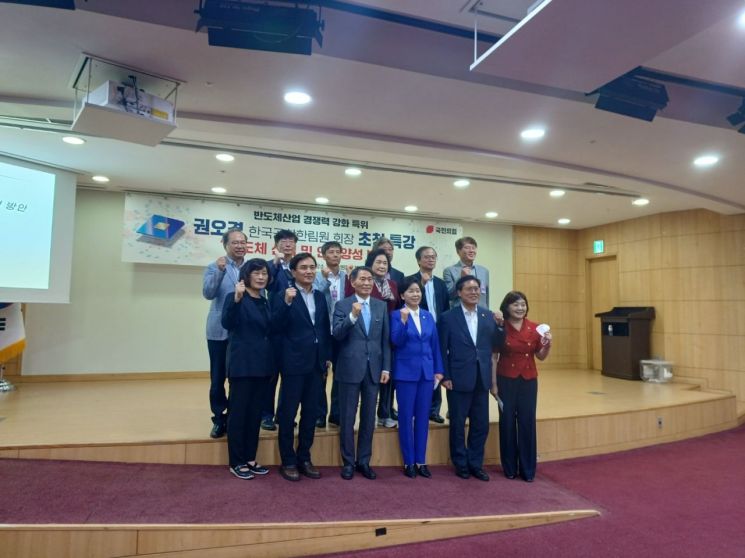 On the afternoon of the 19th at 2 PM, members of the Special Committee on Strengthening Semiconductor Industry Competitiveness are seen taking a photo before the special lecture on "Semiconductor Industry and Workforce Development Measures" held in the 2nd Conference Room of the National Assembly Members' Office Building in Yeouido, Seoul. The fourth person from the left in the front row is Yang Hyang-ja, an independent member and the committee chair, and to his left is Kwon Oh-kyung, president of the Korean Academy of Engineering, who gave the lecture.
 (Photo by Moon Chae-seok)
[Asia Economy Reporter Moon Chaeseok]
"I told President Yoon Seok-yeol to join the 'Chip 4 Alliance,' but I don't know what he thinks about it. From 2020 over two years, Samsung Electronics' market capitalization increased from 339 trillion won to 377 trillion won, while TSMC's rose from 348 trillion won to 518 trillion won. If we do not firmly establish a technological alliance with the United States, South Korea will face difficulties in both security and diplomacy." (Yang Hyang-ja, Independent Member of the National Assembly and Chairperson of the Special Committee on Semiconductor Industry Competitiveness Enhancement)
"When I served as president of the Information Display Society in 2010-2011, I operated five courses related to displays and provided employment benefits at Samsung and LG Display to students who earned a B grade or higher in three of those courses. In the long term, Samsung Electronics and SK Hynix should also offer employment benefits to semiconductor majors by creating a system of 15 to 20 semiconductor-related courses, requiring students to complete more than 10. Of course, this should not involve legislation or administrative regulations." (Kwon Oh-kyung, President of the National Academy of Engineering of Korea)
There have been calls for South Korea to promptly join the 'Chip 4 Alliance' demanded by the United States and to establish a system of more than 15 'semiconductor departments' at universities to activate the hiring of excellent engineers by Samsung Electronics and SK Hynix.
On the 19th, Yang Hyang-ja, an independent lawmaker and chairperson of the National Assembly's Special Committee on Semiconductor Industry, and Kwon Oh-kyung, president of the National Academy of Engineering of Korea, made these claims during a special lecture on 'Semiconductor Industry and Workforce Development Measures.' The lecture was held at 2 p.m. in the 2nd Small Conference Room of the National Assembly Members' Office Building in Yeouido, Seoul. Attendees included Vice Chairman Song Seok-jun (People Power Party lawmaker), Kim Jeong-ho (Professor of Electrical and Electronic Engineering at KAIST), Hwang Cheol-seong (Distinguished Professor of Materials Science and Engineering at Seoul National University), Kim Yong-seok (Professor of Electrical and Electronic Engineering at Sungkyunkwan University), Park In-cheol (Professor of Electrical and Electronic Engineering at KAIST), Park Dong-moon (Advisor at Samsung Display), and Ahn Ki-hyun (Executive Director of the Semiconductor Industry Association), among others.
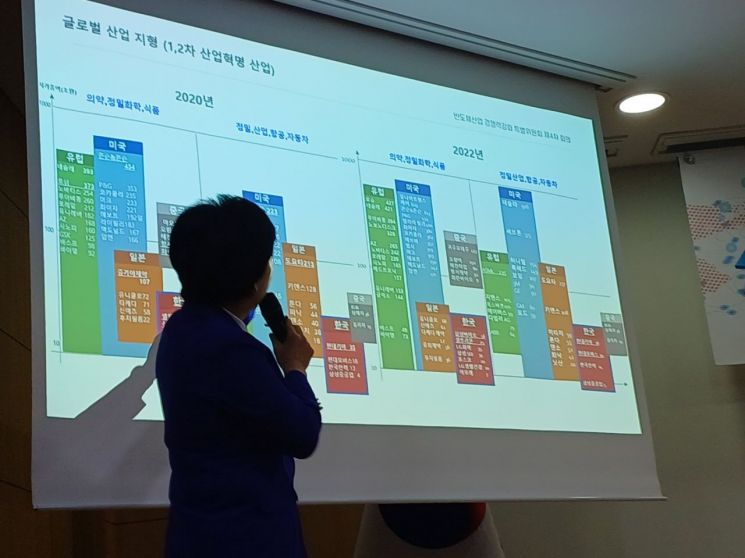 On the afternoon of the 19th at 2 PM, at the 2nd Conference Room of the National Assembly Members' Office Building in Yeouido, Seoul, Yang Hyang-ja, Chairperson of the Special Committee for Strengthening Semiconductor Industry Competitiveness, explained the status of Nasdaq listings of companies valued over 100 trillion won in major countries such as Korea, the United States, and Japan during a special lecture on "Semiconductor Industry and Workforce Development Measures." (Photo by Moon Chae-seok)
Chairman Yang argued in the lecture that South Korea must promptly join the 'Chip 4 Alliance.' He said this is essential not only for competition among individual companies such as Samsung Electronics, SK Hynix, Taiwan's TSMC, and the U.S. Intel but also to prevent national security isolation. On the same day, The Wall Street Journal reported that the U.S. Congress is considering a bill that provides $52 billion (about 69 trillion won) in subsidies to foreign companies building semiconductor factories in the U.S., including provisions that would prohibit these countries from investing in China for ten years. The U.S. has demanded that South Korea, Taiwan, and Japan join the 'Chip 4 Alliance' by the end of next month.
In response, Chairman Yang explained, "Samsung Electronics is the only company listed on Nasdaq with a market capitalization exceeding 100 trillion won in Korea. From 2020 to this year, Samsung Electronics' market cap increased from 339 trillion won to 377 trillion won, while TSMC's rose from 348 trillion won to 518 trillion won, and Apple's from 1,906 trillion won to about 2,500 trillion won." He added, "The power of the Fourth Industrial Revolution comes from semiconductors, and the U.S. holds hegemony over both memory and non-memory semiconductors. From the U.S. perspective, relying solely on TSMC is risky due to blackouts and earthquakes, so Samsung Electronics' foundry can be an alternative."
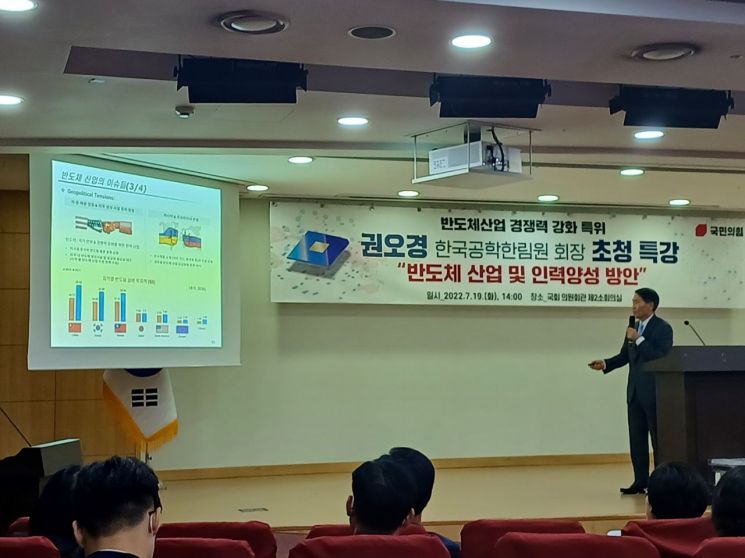 Kwon Oh-kyung, President of the Korean Academy of Engineering, giving a special lecture on "Semiconductor Industry and Workforce Development Plans" at 2 p.m. on the 19th in the 2nd Conference Room of the National Assembly Members' Office Building in Yeouido, Seoul. The scene shows him explaining the investment amounts of major countries, describing the order as China, Korea, Taiwan, and Japan.
 (Photo by Moon Chae-seok)
President Kwon presented strategies for both new workforce development and preventing talent drain. First, he said universities should create 15 to 20 semiconductor-related courses and establish a system that awards a 'Semiconductor Department Completion Certificate' to students who complete more than 10 courses. This would allow semiconductor companies like Samsung Electronics and SK Hynix to provide incentives when hiring these graduates. He introduced that this method was applied in the display industry in the past, where completing three major courses with a B grade or higher granted employment benefits at LG Display and Samsung Display.
Kwon said, "According to the Ministry of Trade, Industry and Energy, Korea is expected to need at least 5,500 master's and doctoral graduates in the semiconductor industry by next year. In the short term, we need to increase semiconductor department enrollment, expand budgets for equipment, and support education in materials, parts, and equipment. In the mid to long term, from elementary to high school, essential physics, mathematics, and calculus related to semiconductors should be taught, and 15 to 20 semiconductor courses should be offered, with a 'completion certificate' given to students who take more than 10 of these courses."
As a solution to prevent talent drain, he proposed encouraging companies to prohibit the disclosure of salaries of outstanding engineers. Realistically, there is no other way besides salary increases, but companies should voluntarily consider improvement measures, while the government and political circles should also collaborate. Kwon said, "Looking at doctoral students who moved to Silicon Valley in the U.S., many left because Korean companies assign master's level work even to Ph.D. holders and believe senior researchers have little chance of becoming executives, prompting them to leave for the U.S. It is difficult to attract talented individuals with a corporate personnel system that allows their salaries to be publicly disclosed."
© The Asia Business Daily(www.asiae.co.kr). All rights reserved.
![Clutching a Stolen Dior Bag, Saying "I Hate Being Poor but Real"... The Grotesque Con of a "Human Knockoff" [Slate]](https://cwcontent.asiae.co.kr/asiaresize/183/2026021902243444107_1771435474.jpg)


















