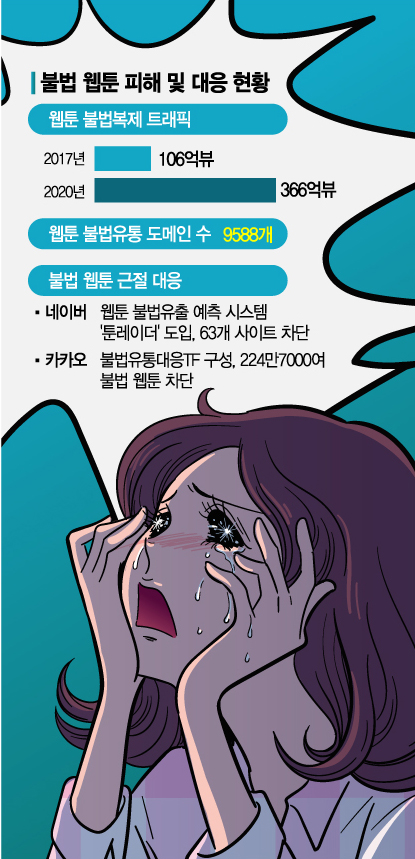
2020 Illegal Duplication Traffic Reaches 3.36 Billion Views
9,588 Illegal Domains Counted as of Early This Month
Distributors Use Deceptive Keywords and Alternative Titles
Undetected Illegal Sites Estimated to Exceed 100 Million
Naver Employs AI "Toon Radar" Since 2017
Kakao Entertainment Also Operates Illegal Distribution Response Task Force
[Asia Economy, reporter Lee Seungjin] The domestic webtoon industry is struggling with the proliferation of illegal overseas webtoon sites. As the influence of K-webtoons expands across the world-including Japan, North America, and Europe-the illegal distribution of webtoons is also increasing. Although companies are pursuing lawsuits, even when they win, it is difficult to receive proper compensation for damages. As a result, eradicating illegal webtoon distribution has become the industry's top priority.
K-Webtoons: 100 Million Illegal Sites
According to content data specialist Conist on July 19, 2022, illegal webtoon duplication traffic reached 33.6 billion views as of 2020. This figure has more than tripled compared to 10.6 billion views in 2017. As of early July, the number of domains distributing illegal webtoons was counted at 9,588. However, considering domains that use deceptive keywords and are not included in the tally, as well as domains that are increasing even at this very moment, the total is estimated to exceed 100 million.
In English-speaking regions, illegal distributors often use alternative titles to make it harder to identify the official English title. For example, Kakao Webtoon's popular series "Solo Leveling" is distributed illegally under the title "Only I Level Up." English-speaking regions are relatively easier to monitor. In contrast, in Chinese-speaking regions, instead of directly translating the Korean title, illegal distributors use the plot or the protagonist's name to evade detection.
Naver and Kakao: The War Against Illegal Webtoons
Since 2017, Naver has been utilizing its AI technology "Toon Radar," which detects illegal users by reading user identification information embedded in webtoons. In 2019, Naver introduced an additional "Illegal Webtoon Distribution Prediction System" to preemptively block users suspected of illegal sharing. As of May 2022, the number of paid works illegally uploaded to overseas sites decreased by 30% compared to the beginning of the year. From July 2017 to the first half of 2022, Toon Radar has halted uploads or blocked servers of 64 illegal sites both domestically and internationally.
Kakao Entertainment operates an Illegal Distribution Response Task Force (TF). From November 2021 to April 2022, over a five-month period, the TF succeeded in blocking 2,247,664 cases of illegal webtoon distribution. The estimated amount of damage prevented is approximately 260 billion KRW. The TF has strengthened monitoring by deploying staff fluent in local languages such as Chinese and English. With the rising popularity of webtoons in Europe following Kakao's entry into France earlier this year, the company also plans to reinforce personnel to block illegal distribution within Europe.
There are growing calls for the government to step in, strengthen damage monitoring, and promote international cooperation through joining international agreements. At a forum on eradicating illegal webtoon sharing held at the National Assembly Members' Office Building on July 15, Lee Wonsang, a professor at Chosun University Law School, emphasized, "Relevant organizations such as the Ministry of Culture, Sports and Tourism must not limit their efforts to one-off projects, but should continuously monitor the damage situation."
© The Asia Business Daily(www.asiae.co.kr). All rights reserved.
![Clutching a Stolen Dior Bag, Saying "I Hate Being Poor but Real"... The Grotesque Con of a "Human Knockoff" [Slate]](https://cwcontent.asiae.co.kr/asiaresize/183/2026021902243444107_1771435474.jpg)















