Government Establishes 'Youth Special Program'
Reducing Debt Burden for 2030s
"Investment Is Personal Choice" vs "Mental Shock and Pain Are Significant"
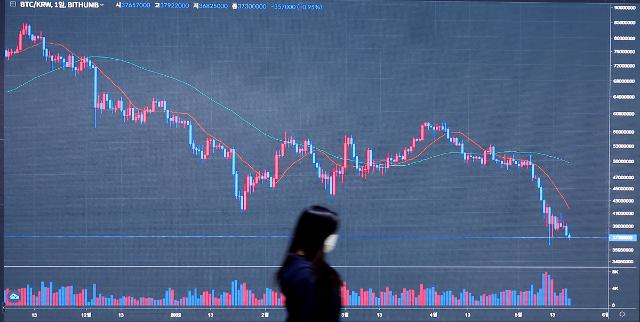 The government’s measures to support young people burdened with debt from investments have sparked mixed opinions among citizens. The photo shows Bitcoin plummeting sharply in May following the decline in the U.S. stock market.
 [Image source=Yonhap News]
[Asia Economy Reporter Yoon Seul-gi] As global inflation has emerged recently and a full-scale interest rate hike period has begun, the government announced that it will ease the interest burden on the youth. However, there are criticisms that government support is inappropriate since investment responsibility lies with individuals.
On the other hand, some argue that the reasons why young people had no choice but to engage in 'Yeongkkeul' (investment by borrowing to the limit) should be considered in light of the uncertainty that increased during the COVID-19 pandemic.
On the 14th, the government announced financial livelihood stabilization measures at the 2nd Emergency Economic and Livelihood Meeting chaired by President Yoon Seok-yeol at the Integrated Support Center for Low-Income Finance in Jung-gu, Seoul. The core of the plan is to promote refinancing at low interest rates, debt adjustment, and new financial support to reduce the burden on vulnerable sectors such as small business owners, households, youth, and low-income groups due to rising interest rates.
To alleviate the debt burden on the relatively economically vulnerable youth, a 'Youth Special Program' will be newly established at the Credit Recovery Committee. Interest reduction and repayment deferral will be temporarily supported for one year even for youth who previously did not meet the eligibility criteria.
If selected for the debt adjustment program, interest can be reduced by 30-50% depending on the degree of debt overload considering income and assets. The interest rate, which is around 10% per annum, will be lowered to about 5-7%. Additionally, principal repayment can be deferred for up to three years, during which a low interest rate of 3.25% per annum will be applied. Eligible individuals are low-credit youth aged 34 or younger with credit scores in the bottom 20% (NICE 744 points, KCB 700 points).
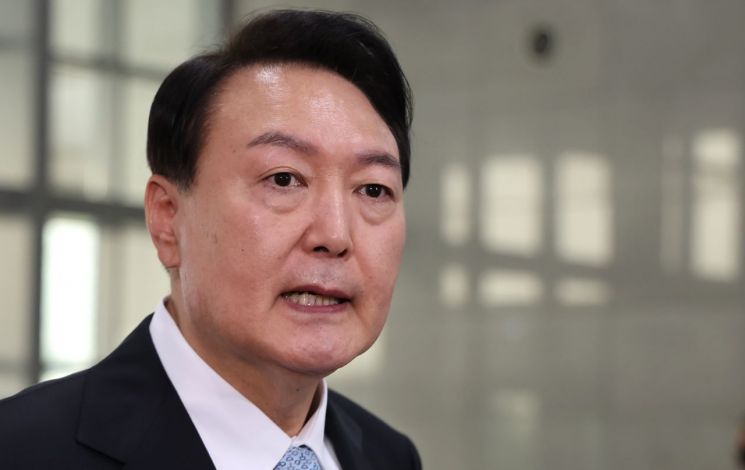 President Yoon Suk-yeol is answering reporters' questions as he arrives at the Yongsan Presidential Office Building in Seoul on the morning of the 4th.
 [Image source=Yonhap News]
President Yoon said on the day, "Self-employed and small business owners who inevitably had to increase loans due to COVID-19, low-income people who purchased homes by taking 'Yeongkkeul' loans amid anxiety over soaring real estate prices, and young people who borrowed to invest in stocks due to future uncertainties are all struggling to repay principal and interest," emphasizing, "If the government does not proactively support them, the social costs that our society will ultimately have to bear will increase."
Earlier, the court also presented relief measures for those who failed after investing in stocks or virtual currencies. The Seoul Rehabilitation Court newly established a practical guideline clause related to 'stock or virtual currency investment losses' in personal rehabilitation procedures last month, and from the 1st, decided not to reflect losses incurred from stock or virtual asset investments when calculating repayment amounts. Personal rehabilitation is a system that helps debtors who have gone bankrupt due to debt burdens but are expected to have continuous income in the future; if they repay part of the debt over a certain period, the remaining debt is forgiven.
However, opinions are divided over the state stepping in to support the economic recovery of young people. There are criticisms that it is inappropriate and unfair for other members of society who work diligently to bear the debts incurred by 'Yeongkkeul' and 'debt investment' groups. Office worker A (25) said, "Isn't investment judgment an individual's responsibility? No one forced them to invest; they used the low-interest environment to invest and ended up in debt, so this policy seems to deviate from the principle of personal responsibility."
On the other hand, considering the uncertainty that expanded after the large-scale COVID-19 outbreak, which caused confusion to the extent that 'Yeongkkeul,' debt investment, and 'panic buying' phenomena appeared among the 20s and 30s generation, some believe this should be taken into account. Kim, a 30-year-old office worker, said, "At that time, there was a strong atmosphere that everyone had to catch the 'last train.' Since people suffer mental shocks and hardships when investment fails, it seems reasonable to delay principal repayment to some extent."
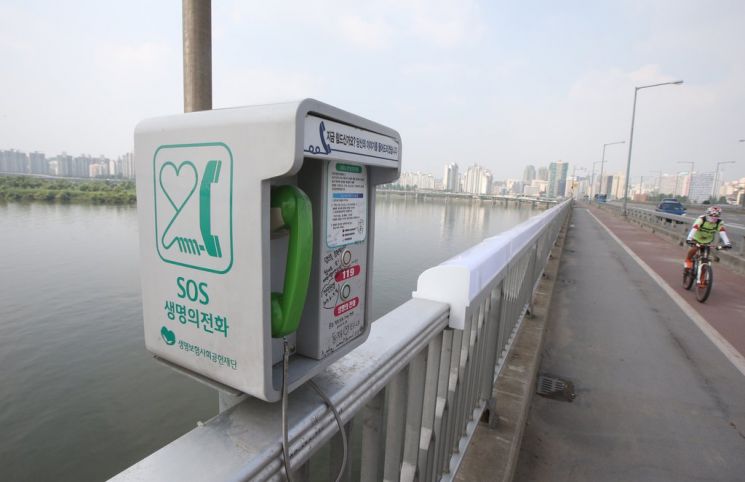
Recently, as stock and virtual currency values have fallen, the number of calls from the Han River bridges has surged. According to Korea Life Line on the 4th, the number of counseling calls from the MZ generation made from Han River bridges to the 'SOS Life Line' from January to June this year increased by more than 8 percentage points compared to the previous year.
Experts explained that this measure is a response to the previous government's real estate price surge. Kim Tae-gi, emeritus professor of economics at Dankook University, said, "The surge in real estate prices under the previous government forced people into 'Yeongkkeul.' Since a significant portion of the 'Yeongkkeul' group is youth, the current government seems to be increasing support for them."
Professor Kim added, "Currently, with interest rate hikes, an economic recession is expected, and unemployment rates will rise afterward. The problem is that this is also fatal to the youth. In this situation, it is important to systematically establish youth employment measures beyond one-time support to reduce debt burdens."
© The Asia Business Daily(www.asiae.co.kr). All rights reserved.
![Clutching a Stolen Dior Bag, Saying "I Hate Being Poor but Real"... The Grotesque Con of a "Human Knockoff" [Slate]](https://cwcontent.asiae.co.kr/asiaresize/183/2026021902243444107_1771435474.jpg)

















