80% of Domestic Paper Recycling Uses Waste Paper, Only 20% Uses Wood from Domestic and Overseas Plantations as Raw Material
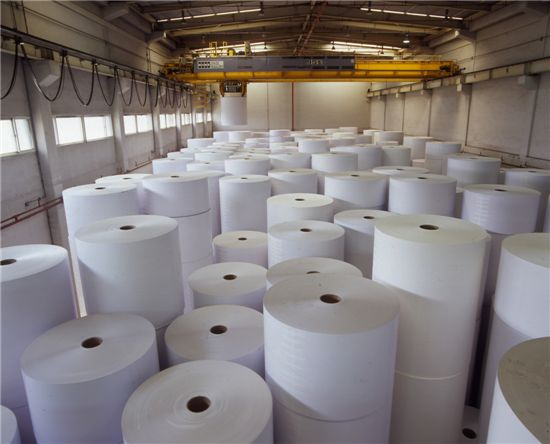 Paper stacked in the warehouse of Hansol Paper factory.
 [Photo by Asia Economy DB]
[Asia Economy Reporter Kim Jong-hwa] "This is a trashy article. Just one precious tree in the Amazon has disappeared."
Sometimes, I hear comments like this from readers or close acquaintances. It is a way of venting dissatisfaction with a particular article onto the newspaper that published it. From the perspective of those who produce newspapers, it can be unpleasant, but I accept it. Just as opinions differ among newspapers and reporters, I consider it a way for readers to express their personal views.
However, there is one expression I really want to correct. The phrase "just one tree in the Amazon has disappeared" needs to be fixed.
In Korea, 80% of all paper produced is made from recycled paper, and only the remaining 20% is made from pulp. Especially newsprint, which is often criticized, is made from 100% recycled paper. Therefore, it is difficult to say it is made from trees. Although the original raw material was wood, after numerous recycling processes, it should be considered that the essence of the wood has been lost.
Recycled paper is used as a major raw material for paper manufacturing along with pulp. It is secondary pulp (recycled pulp) used to replace pulp through resource recycling. This includes waste newsprint, waste corrugated paperboard, waste printing paper, and mixed waste paper.
The remaining 20% pulp is made from wood. However, this wood is not harvested from the Amazon in South America or Southeast Asia. There is an organization called the Forest Stewardship Council (FSC). The FSC implements a forest certification system and awards the FSC certification mark.
The FSC evaluates and verifies organizations and companies through multiple stages such as preliminary review, on-site inspection, and final review based on 10 principles including ▲compliance with laws and regulations ▲workers' rights and employment conditions ▲indigenous peoples' rights ▲community relations ▲environmental, social, and economic benefits from forests ▲forest management planning ▲monitoring and evaluation ▲high conservation value ▲implementation of management activities. Only those with excellent results receive the certification mark. Even after obtaining the certificate, annual maintenance audits are required, making the acquisition process famously stringent. All pulp imported into Korea must bear this 'FSC certification mark.'
Due to these strict conditions, domestic paper companies create 'plantation forests' to produce wood themselves. Like farming, they harvest wood from cultivated land (fields) to make pulp. However, plantations are mainly established in Southeast Asia rather than Korea. It takes 30 years for trees to grow enough to be used as pulp raw material domestically, but in these regions, trees grow sufficiently in just 7 years. The grown trees are either re-imported to Korea or local forests are purchased.
Moorim Paper established a plantation forest in Indonesia in 2011 covering an area the size of Seoul (65,000 hectares), and last year created 'Injerim,' the largest domestic birch forest of about 2,000 hectares (approximately 6 million pyeong) in Inje County, Gangwon Province, receiving the Forest Stewardship Council Forest Management (FSC FM) certification. It is the only and first FSC-certified corporate forest in Korea. Korea Paper Association members such as Hankuk Paper, Hansol Paper, and Yuhan-Kimberly also manage major plantations domestically and abroad.
A Korea Paper Association official stated, "Paper companies in various countries repeatedly plant and harvest trees over 7 years to produce pulp through plantations," emphasizing, "The paper industry does not destroy natural forests. Making paper does not mean eliminating trees."
All forests require cutting down old and decayed trees for new trees to grow well. That is why planting and harvesting trees every 7 years is repeated. The claim that "dozens of 30-year-old natural pine trees are cut down to make 1 ton of paper" is also untrue. Even companies producing particle board (PB), a building material, purchase raw materials produced every 7 years from plantations both domestically and internationally.
A paper industry official said, "Plastic takes 500 years to decompose, but paper is an eco-friendly material that naturally decomposes in 3 months," adding, "If waste paper separation and collection become more efficient, the domestic recycling rate of waste paper will rise to around 90% within a few years."
If reading an article makes you upset, instead of saying "just one tree in the Amazon has disappeared," wouldn't it be more appropriate to say "hurry up and throw it into the recycling bin"? A paper industry official requested, "Please do not contaminate the newspaper you have read; just fold it and put it into the recycling bin."
© The Asia Business Daily(www.asiae.co.kr). All rights reserved.
![Clutching a Stolen Dior Bag, Saying "I Hate Being Poor but Real"... The Grotesque Con of a "Human Knockoff" [Slate]](https://cwcontent.asiae.co.kr/asiaresize/183/2026021902243444107_1771435474.jpg)














