Annual Budget of 3.3 Billion KRW for Presidential Affiliated Committees... "Serious Evaluation of High Cost and Low Efficiency"
[Asia Economy Reporter Ki-min Lee] Following President Yoon Seok-yeol's directive to reduce committees affiliated with the President and the government as part of public sector management innovation, the Presidential Office announced on the 5th that it will abolish up to 70% of the committees under the President's jurisdiction.
On the afternoon of the same day, the Presidential Office held a briefing at the Yongsan Government Complex, revealing plans to reorganize a total of 629 committees: 20 under the President, 60 under the Prime Minister, and 549 under various ministries. The number of committees increased to 631 during the Moon Jae-in administration with the addition of 73 committees, but two committees?the Job Committee and the Policy Planning Committee?have been abolished under the new administration.
A Presidential Office official stated, "We plan to reduce 30 to 50% of committees across all ministries, and the committees under the President will be reduced much more significantly. It seems we will cut about 60 to 70%." Currently, there are 20 committees under the President, so after reorganization, only about six will remain.
Accordingly, the Presidential Office is conducting classification work to decide which committees will be merged or abolished. Regarding the existing National Balanced Development Committee and the Local Autonomy Committee, a Presidential Office official said, "We are preparing to integrate committees with similar functions," adding, "We think it is appropriate to operate these two committees in an integrated manner."
Regarding the Economic, Social, and Labor Committee (Gyeongsanowi), it was evaluated as an institution that should be maintained, but the official explained that "adjustments to roles and functions are necessary." The Low Birthrate and Aging Society Committee was also described as needing role readjustment due to criticisms of lack of achievements. The Library Information Policy Committee was judged by the Presidential Office as not needing to maintain its status as a committee under the President.
The Presidential Office explained that the major reduction of committees under the President is due to "evaluations that the budget is in a state of high cost and low efficiency."
According to the Presidential Office, the average annual budget for committees under the President is estimated at 3.3 billion KRW. Each committee has a separate secretariat, and relatively large committees have a Grade 1 director and 30 to 40 staff members, with maintenance costs reaching 3 to 4 billion KRW annually.
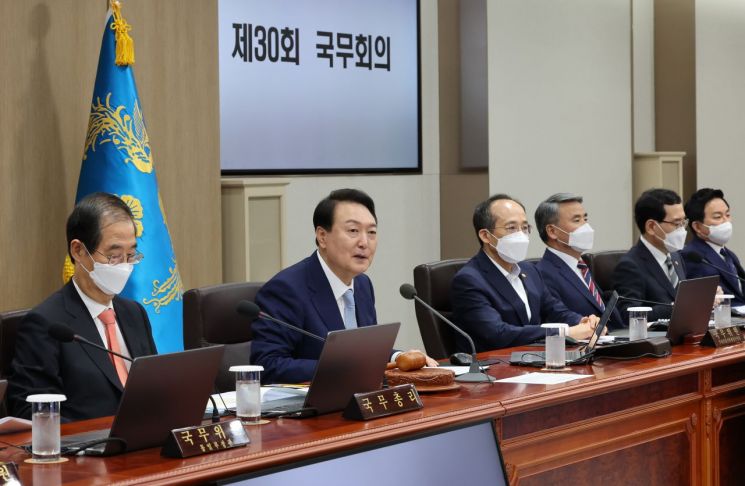
President Yoon emphasized at the Cabinet meeting held that morning, "As many experts have pointed out, the various committees within the government are representative cases that hinder responsible administration and increase administrative inefficiency," adding, "We will first boldly reorganize the committees under the President to save budget, improve administrative efficiency, and establish the foundation for responsible administration. I urge each ministry to actively participate in committee reorganization as well."
Another Presidential Office official pointed out, "Looking at the activities of committees directly under the President from 2019 to 2021 over the past three years, there were almost no meetings chaired directly by the President," adding, "Therefore, many committees existed and operated almost only in form."
Accordingly, the Presidential Office plans to abolish committees that are poorly managed and operated only in form, and committees that perform ministry tasks but are only affiliated with the President will be abolished and redesigned within the ministries. Committees with similar functions and goals or those needing adjustment due to environmental changes will be integrated or converted.
Committees under the President that have inter-ministerial policy coordination functions will be maintained at a minimum, while the rest will be transferred to the Prime Minister's jurisdiction.
Among the 629 committees, about 10% were established by presidential decree, and the rest were created by law. Therefore, once the committees to be reduced are finalized, the Presidential Office plans to propose abolition bills and submit them to the National Assembly.
However, in the current political situation where the opposition holds a majority, there is potential for conflict over committee abolitions. A Presidential Office official explained, "Among the committees under the President, only one has a chairman making abolition difficult," adding, "Others have chairpersons who have resigned or whose terms have ended. One chairman intends to continue, but that needs further resolution. For ministry committees, we also need to consider how to handle members whose terms remain."
The official continued, "Regardless of remaining terms, abolition bills for committees decided to be abolished will be sent to the National Assembly," adding, "Some decisions must be made by the National Assembly. We believe the National Assembly will understand the purpose of committee reorganization and participate accordingly."
© The Asia Business Daily(www.asiae.co.kr). All rights reserved.
![Clutching a Stolen Dior Bag, Saying "I Hate Being Poor but Real"... The Grotesque Con of a "Human Knockoff" [Slate]](https://cwcontent.asiae.co.kr/asiaresize/183/2026021902243444107_1771435474.jpg)















