Announcement of 'New Government Energy Policy Direction'... Moon Targets 'Nuclear Phase-Out'
Nuclear Share Raised to 30% Range... Operating Units Expanded to 28
Early Order for Shin Hanul Units 3 and 4 Within the Year... 12 Billion KRW Scale
Brakes on 'Overspeed Expansion' of Renewable Energy... "Rational Reestablishment"
Establishment of 'Cost-Based Electricity Pricing'... Strengthening Independence and Expertise of Electricity Committee
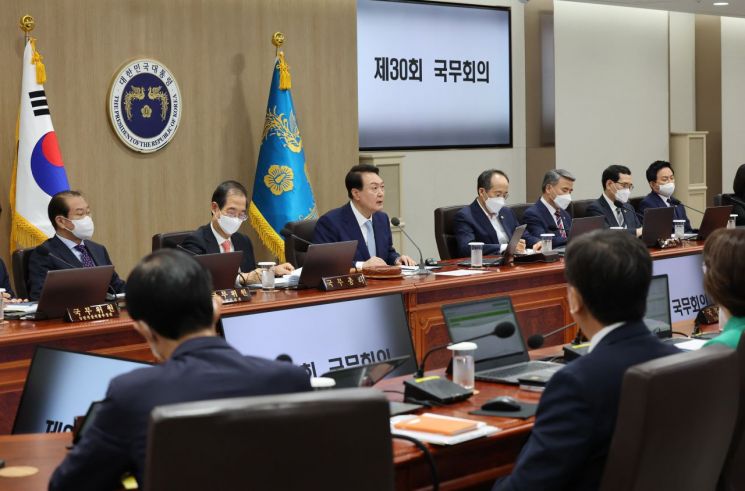 President Yoon Seok-yeol Presiding Over the Cabinet Meeting
(Seoul=Yonhap News) Reporter Seo Myeong-gon = President Yoon Seok-yeol is presiding over the Cabinet meeting held on the morning of the 5th at the Yongsan Presidential Office building in Seoul. 2022.7.5
Photo by Seo Myeong-gon
(End)
<Copyright(c) Yonhap News Agency, Unauthorized reproduction and redistribution prohibited>
[Asia Economy Sejong=Reporter Lee Jun-hyung] The core of the "New Government Energy Policy Direction" announced by the Ministry of Trade, Industry and Energy on the 5th is the "end of nuclear phase-out." The government completely replaced the Moon Jae-in administration's "Energy Transition (Nuclear Phase-out) Roadmap" with the energy policy direction announced that day. Consequently, the 3rd Basic Energy Plan, which was finalized under the nuclear phase-out policy, was officially abolished.
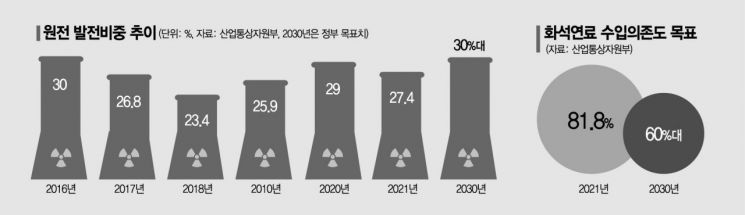
The government has announced a major overhaul of the "energy mix (composition ratio by power source)" in its energy policy direction. Specifically, the share of nuclear power generation will be increased from 27.4% last year to the 30% range by 2030. The previous administration planned to gradually reduce the nuclear power share to 23.9% by 2030 through the "2030 Greenhouse Gas Reduction Target (NDC)." The Yoon Seok-yeol administration plans to complete four nuclear reactors currently under construction?Shin Hanul Units 1 and 2, and Shin Kori Units 5 and 6?by 2025, increasing the number of nuclear reactors from 24 last year to 28 by 2030. The Moon Jae-in administration's 2030 target was 18 units. The government plans to establish the "National Carbon Neutral Green Growth Basic Plan" in March next year and officially revise the previous administration's NDC achievement plan, which included nuclear power reduction.
Shin Hanul Units 3 and 4, whose construction was halted under the Moon Jae-in administration, will resume construction after revising the legal plan. First, the government intends to reflect the resumption of construction of Shin Hanul Units 3 and 4 in the 10th Basic Plan for Electricity Supply and Demand to be established in the fourth quarter. To restore the nuclear ecosystem devastated by the "nuclear phase-out direct hit," the Ministry of Trade, Industry and Energy will place an early order within the year for design work related to Shin Hanul Units 3 and 4, worth 12 billion KRW. Previously, the ministry announced it would inject more than 1 trillion KRW worth of work into the nuclear ecosystem by 2025.
The government will also put the brakes on the "over-speed expansion" of renewable energy. This is based on the judgment that the Moon Jae-in administration excessively expanded renewable energy supply in the process of pursuing the nuclear phase-out policy. When establishing the 10th Basic Plan for Electricity Supply and Demand, the government plans to calculate the appropriate share for each renewable energy source such as wind and solar power. An official from the Ministry of Trade, Industry and Energy explained, "The renewable energy supply targets will be reasonably reestablished considering grid operation conditions, and orderly supply will continue to be promoted based on community acceptance."
Through this energy mix, the import volume of fossil fuels such as coal is also expected to be significantly reduced. The government's target is to lower the dependence on fossil fuel imports from 81.8% last year to the 60% range by 2030. The ministry expects fossil fuel imports in 2030 to decrease by about 40 million TOE (tons of oil equivalent, the energy produced by burning 1 ton of oil) compared to last year. Additionally, the government plans to promote reasonable reduction of coal power generation by considering the power supply and demand situation, such as replacing aging coal power plants with liquefied natural gas (LNG) power plants.
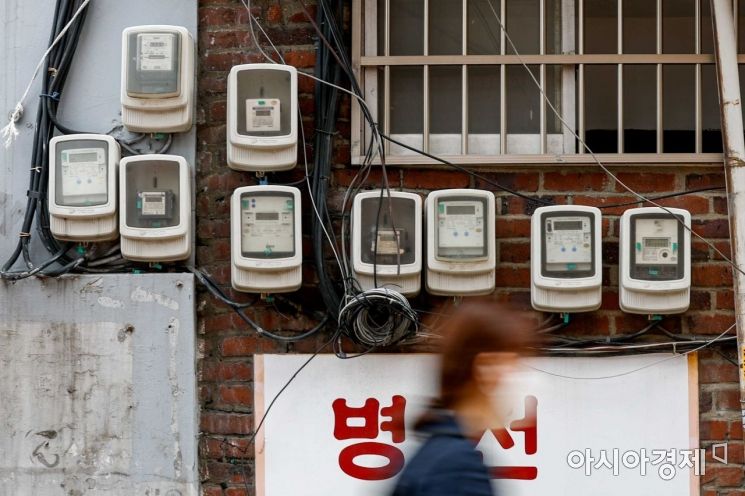 An electricity meter is installed at a commercial building in Seoul on the 27th of last month, when the fuel cost adjustment unit price for the third quarter electricity bill was scheduled to be announced. Photo by Jinhyung Kang aymsdream@
The principle of cost-based electricity pricing has also been established. This is based on the judgment that normalizing the financial structure of Korea Electric Power Corporation (KEPCO), which is mired in deficits, requires the principle of total cost compensation and the activation of cost-linked tariff systems. Initially, the government introduced the "fuel cost linkage system," which reflects fuel costs such as international oil prices in electricity rates last year, but it was evaluated as ineffective due to political considerations. As a result, KEPCO recorded a deficit of 7.8 trillion KRW in the first quarter alone. The government plans to increase the authority of the Electricity Commission, which deliberates and decides on the electricity rate system, and strengthen the secretariat organization to enhance independence and expertise.
The government also presented an ambitious goal to create 100,000 jobs by 2030 by growing the energy industry. It plans to strengthen research and development (R&D) investment focusing on promising energy technologies such as decarbonization and to intensively nurture energy innovation ventures. The government aims to more than double the number of energy innovation ventures from 2,500 in 2020 to 5,000 by 2030.
© The Asia Business Daily(www.asiae.co.kr). All rights reserved.
![Clutching a Stolen Dior Bag, Saying "I Hate Being Poor but Real"... The Grotesque Con of a "Human Knockoff" [Slate]](https://cwcontent.asiae.co.kr/asiaresize/183/2026021902243444107_1771435474.jpg)

















