Pilot Project Starts in 6 Areas Including Jongno, Seoul and Bucheon, Gyeonggi
Includes Self-Employed, Artists, and Special Occupations... Excludes Public Officials and Teachers
Provides Up to 90-120 Days Coverage for Rest or Hospitalization
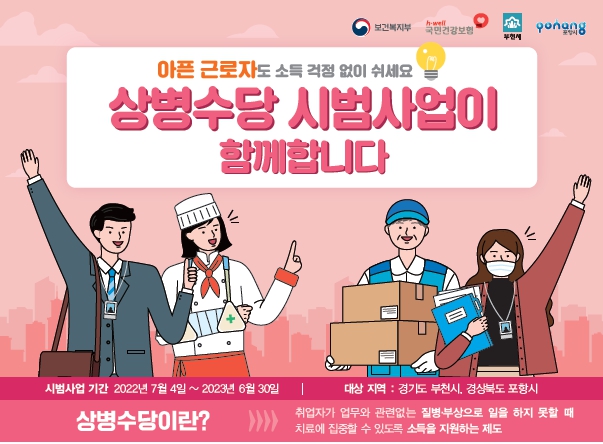
#Delivery worker Mr. A was responsible for supporting a family of five but was unable to work for four months due to sudden knee surgery. As the sole breadwinner of the family, Mr. A initially canceled his savings and borrowed money from those around him to cover living expenses, but as sustaining the household became difficult, he eventually applied for basic living security benefits. However, once the sickness benefit is introduced, Mr. A will be able to partially compensate for living expenses during the four months he cannot work, making it possible to maintain his livelihood without loans or basic living security programs.
A program to provide 'sickness benefits' to allow workers to rest without worrying about their livelihood when they are too sick to work will begin in some regions. Workers unable to work due to illness or injury will receive 43,960 KRW per day as sickness benefits.
The Ministry of Health and Welfare announced on the 3rd that it will implement a pilot project for sickness benefits starting on the 4th in six regions: Bucheon City in Gyeonggi Province, Pohang City in Gyeongbuk Province, Jongno District in Seoul, Cheonan City in Chungnam Province, Changwon City in Gyeongnam Province, and Suncheon City in Jeonnam Province.
Sickness benefits are a system that compensates income so that workers can focus on treatment when they are unable to work due to injuries or illnesses unrelated to their job. The program aims to respond to income loss and poverty risks caused by injury or illness and to flexibly use this system during periodic infectious disease situations such as COVID-19 to prevent the spread of infections through workplaces. The Yoon Seok-yeol administration is promoting the sickness benefit pilot project as one of its major national policy tasks.
Comparison and Analysis of Three Models Setting '60% of Minimum Wage'
The target recipients of sickness benefits are defined as employed Korean nationals aged 15 to under 65 residing in the pilot project regions. Not only wage workers but also self-employed individuals, artists insured under employment insurance, special employment workers such as insurance planners, credit card membership recruiters, private tutors, delivery workers, construction machinery operators, platform workers, and daily workers are included. Foreigners are eligible only if they form a household with a Korean national or are refugees.
Health insurance workplace subscribers or employment insurance subscribers must have maintained their insurance qualification for the previous month, and self-employed individuals must have maintained business registration for the previous three months and have monthly sales of at least 1.91 million KRW to be eligible. Additionally, workers at 'sickness benefit cooperative workplaces' designated by the National Health Insurance Service branch can apply for sickness benefits regardless of their residence if they meet age and employment criteria.
However, those receiving employment insurance unemployment benefits, maternity leave benefits, parental leave benefits, industrial accident insurance leave benefits or sickness compensation pensions, basic living security livelihood benefits, emergency welfare livelihood support, or those who are public officials or teachers are excluded from eligibility.
Sickness benefits are provided when a worker is unable to work for a certain period due to injury or illness unrelated to their job, without restrictions on the type or diagnosis of the injury or illness. Treatments not essential for disease treatment, such as cosmetic surgery, cases with only simple symptoms, or childbirth-related treatments without complications, are excluded. Eligible recipients receive 43,960 KRW per day during the benefit payment period, which is 60% of the 2022 minimum wage.
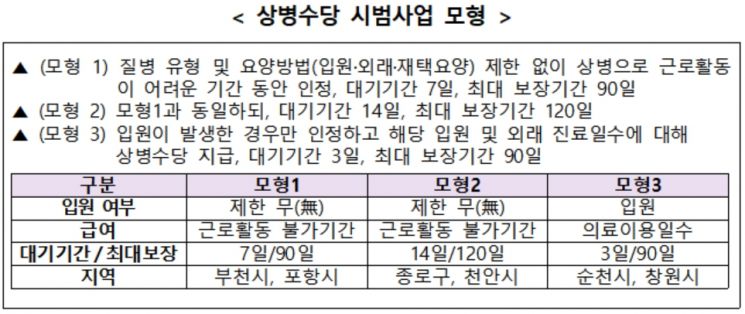
Considering the pilot project's purpose of finding the system best suited to domestic conditions, the government will divide the six local governments into three groups over the next year and apply models with different coverage and benefit standards to compare and analyze their effects. Models 1 (Bucheon, Pohang) and 2 (Jongno, Cheonan), which use 'period of inability to work' as the criterion for sickness benefit payment, provide benefits during the period the worker cannot work due to illness or injury regardless of hospitalization. Model 1 has a waiting period of 7 days and a maximum coverage period of 90 days, while Model 2 has a waiting period of 14 days and a maximum coverage period of 120 days.
On the other hand, Model 3 (Suncheon, Changwon), the 'medical utilization days' model, pays sickness benefits only for the number of days the worker is hospitalized. The waiting period is 3 days, and the coverage period is up to 90 days.
Goal to Introduce After 3 Years of Pilot Project by 2025
When an employed person suffers an injury or illness, they must first visit a medical institution participating in the pilot project in their region to obtain a 'sickness benefit application diagnosis' stating that they are unable to work for eight or more days. Then, they must obtain a 'work suspension plan' from their workplace during the sickness benefit application period, which includes leave plans and whether wages will be paid, and submit the application form via the National Health Insurance Service website or the local branch.
The National Health Insurance Service will verify the applicant's eligibility and review the appropriateness of the sickness benefit application period, i.e., the period of inability to work, and pay sickness benefits for the period excluding the 7-day waiting period from the final confirmed period of inability to work. If the applicant worked during the period of inability to work or received wages from the workplace during paid sick leave or other leave, the corresponding days will be excluded from the sickness benefit payment.
Sickness benefits can be applied for multiple times for different injuries or illnesses and are paid for up to 90 or 120 days per year. For a single injury or illness, applications can be made for up to 4 weeks, and if an extension is needed for the same injury or illness, it can be extended continuously up to 8 weeks per case within the maximum coverage period.
The Ministry of Health and Welfare plans to design a sickness benefit system suitable for Korea's conditions through phased pilot projects and social discussions over the next three years and aims to introduce the full system in 2025.
Choi Jong-gyun, Director of the Health Insurance Policy Bureau at the Ministry of Health and Welfare, said, "The sickness benefit pilot project is a meaningful first step toward creating a society where sick workers can rest without worrying about income," and added, "For the pilot project to be successfully established, the interest of local residents, cooperation from workplaces, and active participation of medical institutions are essential."
© The Asia Business Daily(www.asiae.co.kr). All rights reserved.
![Clutching a Stolen Dior Bag, Saying "I Hate Being Poor but Real"... The Grotesque Con of a "Human Knockoff" [Slate]](https://cwcontent.asiae.co.kr/asiaresize/183/2026021902243444107_1771435474.jpg)

















