Infection Reproduction Number Rises from 0.7 to 1 in 3 Months
Immunity Weakens and Activities Like Overseas Travel Increase
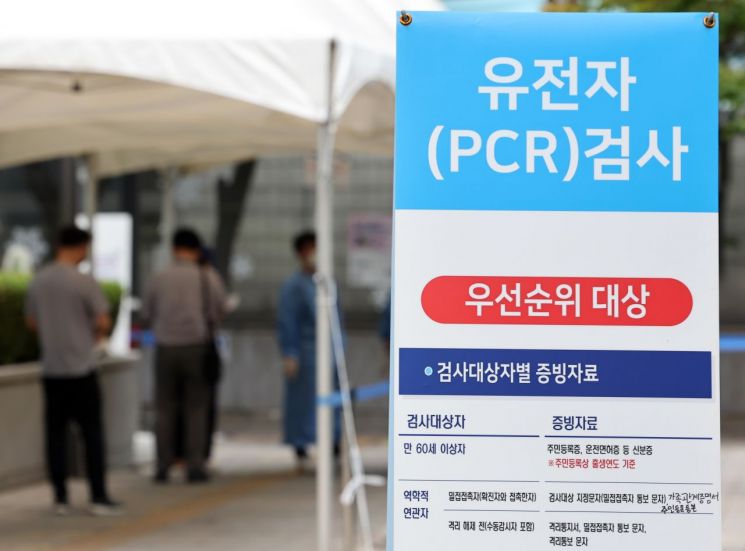
[Asia Economy Reporter Jo In-kyung] The daily number of new COVID-19 cases has exceeded 10,000 again after 20 days, signaling a warning for a resurgence. The infection reproduction number (Rt) has also risen to around 1.0 for the first time in about three months, indicating that the declining trend of the outbreak has shifted to an increasing trend.
According to the Central Disease Control Headquarters on the 30th, as of midnight the previous day, the number of new COVID-19 cases was 10,463, marking over 10,000 for the first time in 20 days since 12,155 cases on the 6th. Compared to the previous day (28th), the number increased by 567, and compared to the same day last week (22nd), it rose by 1,471.
On the 29th, the number of new cases nationwide by 9 p.m. was 9,076, which is 2,023 more than 7,053 on the 22nd a week ago, and 1,463 more than 7,613 on the 15th two weeks ago. Accordingly, the number of new cases to be announced on the morning of the 30th is expected to be around 10,000.
The number of COVID-19 cases had maintained an overall declining trend for some time, but recently this decline appears to have plateaued. The infection reproduction number, an indicator showing how many people one patient infects, rose from 0.7 at the end of April to 1.0 on the 28th of this month. An Rt above 1 indicates outbreak expansion, while below 1 indicates outbreak suppression.
The health authorities interpret that immunity acquired through vaccination or natural infection is waning, and with the lifting of social distancing and increased summer activities, the number of confirmed cases is also rising again. In particular, the increase in imported cases due to the resumption of overseas travel and the clear rise of Omicron variants raise concerns about a possible resurgence.
The number of imported cases recorded 91 on the 23rd, then 110 → 85 → 135 → 114 → 119, and on the 29th rose to 205, surpassing 200 for the first time in five months. Attention should also be paid to the recent spread of BA.4 and BA.5 variant viruses in Europe, including Germany, France, and the United Kingdom, which is causing an increase in COVID-19 cases.
Ki-il Lee, the 1st General Coordinator of the Central Disaster and Safety Countermeasures Headquarters (Vice Minister of Health and Welfare), said, "COVID-19 cases are already increasing in Europe, with the common causes being the spread of BA.4 and BA.5 variant viruses and increased travel during the summer vacation season." He added, "In Korea, variant viruses are spreading and summer travel is increasing, so extra caution is necessary."
Son Young-rae, head of the Social Strategy Division at the Central Accident Response Headquarters, said, "The decline in cases appears to have entered a plateau phase, so it is difficult to judge it as a resurgence yet," and predicted, "It is highly likely that the outbreak will stabilize at a certain level or fluctuate slightly in small-scale increases or decreases."
© The Asia Business Daily(www.asiae.co.kr). All rights reserved.
![Clutching a Stolen Dior Bag, Saying "I Hate Being Poor but Real"... The Grotesque Con of a "Human Knockoff" [Slate]](https://cwcontent.asiae.co.kr/asiaresize/183/2026021902243444107_1771435474.jpg)















