Revision of Operation Standards for Long-term Lease Housing near Stations
Maximum Floor Area Ratio in Semi-Residential Areas Increased from 500% to 700%
Station Area Range Maintained at 350m... Target Areas Expanded Beyond Residential Zones
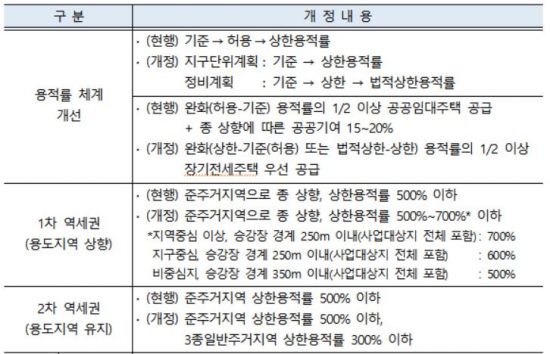
[Asia Economy Reporter Kim Hyemin] The Seoul Metropolitan Government is expanding the maximum floor area ratio (FAR) to 700% to increase the supply of long-term lease housing near subway stations. The uniform 35-floor height restriction will also be removed to encourage high-density development near subway stations. With the increase in FAR and building height, more housing units can be built than originally planned, and the city will secure half of the increased FAR for public rental housing. This plan aims to achieve both housing market stabilization and stability in the monthly rent market through increased supply.
On the 30th, Seoul announced that it has revised the "Operational Standards for the Construction of Long-term Lease Housing near Subway Stations" with these changes.
◆ Comprehensive revision of standards... Expanding FAR near subway stations and removing height restrictions = The long-term lease housing project near subway stations is a method where private developers build housing on sites near subway stations, and the city upgrades the land use designation up to quasi-residential areas to increase the FAR, securing 50% of the increased FAR for long-term lease housing. The subway station area refers to within 350 meters from the subway platform boundary, covering 307 locations including central and non-central areas. Introduced in 2008, it is currently underway in 66 project sites with a scale of 17,572 housing units. Among these, 9 projects (1,375 units) have been completed and occupied.
Seoul is first easing restrictions that have hindered the construction of long-term lease housing near subway stations to dramatically increase supply. A representative example is raising the FAR for quasi-residential areas from 500% or less to a maximum of 700%.
Previously, a uniform FAR of 500% was applied to quasi-residential areas within the primary subway station zone where high-density development was possible. Going forward, the FAR will be applied differentially according to the status of the subway station area as defined in the "2030 Seoul Urban Basic Plan." ▲ For downtown, metropolitan centers, and regional centers within 250 meters of the platform boundary, up to 700% FAR ▲ For district centers within 250 meters, up to 600% FAR ▲ For non-central subway station areas, the previous 500% FAR within 350 meters of the platform boundary will be maintained.
The uniform height restriction of 35 floors has also been abolished. Previously, regardless of the central area or land use zone, a uniform limit of 35 floors was applied, but the restriction has been removed, and height management standards according to the central area and land use zone in the Seoul Urban Basic Plan will be applied.
Along with the relaxation of FAR, the distance between daylight windows and between buildings (indong distance) will also be relaxed up to twice the previous standard. Previously, the daylight window distance in quasi-residential areas was set at one-quarter of the building height, but going forward, it can be relaxed to 1.2 times for FAR between 400-500%, 1.5 times for 500-600%, and up to 2 times for 600-700%. However, to minimize impacts such as sunlight obstruction and urban landscape damage in surrounding areas due to this relaxation, sunlight analysis and landscape simulation must be conducted mandatorily. Whether to allow relaxation will be finally decided after review by the relevant committee.
The temporary relaxation of the primary subway station zone range, which was to be applied only until this year, will be extended for two more years until 2024. In 2020, the city temporarily expanded the primary subway station zone from 250 meters to 350 meters. The subway station zone range is within 500 meters from the platform boundary, but land use upgrades are only permitted within the primary subway station zone.
The project target area has also been expanded from residential areas to semi-industrial areas. Semi-industrial areas were previously excluded from the long-term lease housing project near subway stations, but now projects can be conducted in residential-dense areas where the factory ratio is less than 10%. In residential areas where projects were previously impossible, such as redevelopment promotion districts, projects are now allowed in preservation management zones. Additionally, to increase housing supply and reduce vacancies in commercial areas with low demand depending on location conditions, the mandatory installation ratio of commercial and other non-residential facilities will be lowered from 10% to 5% of the total floor area of the ground floor.
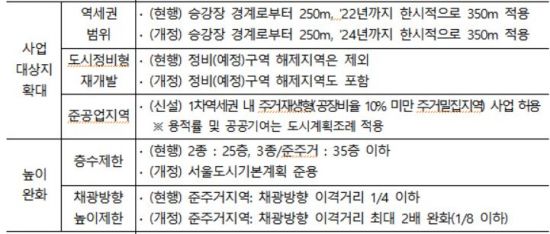
◆ Redevelopment possible even in areas where maintenance zones have been lifted = The city also adjusted systems that were unfavorable to the construction of long-term lease housing near subway stations or unclear in operational standards.
First, in areas where maintenance (or planned maintenance) zones have been lifted, where projects could only be promoted through the housing construction business method under the Housing Act, the "urban maintenance-type redevelopment" method will now be allowed. According to the Urban Maintenance Act, these areas were excluded from redevelopment due to conflicts among residents, but considering that other subway station projects allow projects in areas where maintenance zones have been lifted, the city explained that this change was made for fairness.
Community support facilities have been changed from mandatory to recommended installation. Until now, the city required installation of community support facilities to support community activities and daily life not only for residents but also for local residents. However, considering that these overlap with legally required resident communal facilities and that essential facilities for the local community can be donated as public facilities, this change was made.
In addition, reflecting recent deregulation in the "Seoul City District Unit Plan Establishment Standards," the minimum project site area within special planning zones has been relaxed by 20%, allowing projects to proceed from 2,400㎡ or more. To expand family-unit public housing supply and improve housing quality, the exclusive area for long-term lease housing has been expanded from 60㎡ to up to 85㎡.
The FAR application system has also been improved to align with laws and enhance legal consistency. Previously, all followed the FAR system under the National Land Planning Act, but urban maintenance-type redevelopment projects will follow the FAR system under the Urban Maintenance Act, while housing construction projects will continue with the existing method, creating a dual system.
Kim Seongbo, Director of Housing Policy at Seoul City, said, "We have rationally improved parts that we have been concerned about while promoting the long-term lease housing project near subway stations within the legally permissible scope. We will continue to carefully review policies and systems to sustainably supply long-term lease housing near subway stations and improve them rationally and realistically."
© The Asia Business Daily(www.asiae.co.kr). All rights reserved.
![Clutching a Stolen Dior Bag, Saying "I Hate Being Poor but Real"... The Grotesque Con of a "Human Knockoff" [Slate]](https://cwcontent.asiae.co.kr/asiaresize/183/2026021902243444107_1771435474.jpg)
















