Victims' Second Statements Become Inevitable Following Constitutional Court's Unconstitutionality Ruling
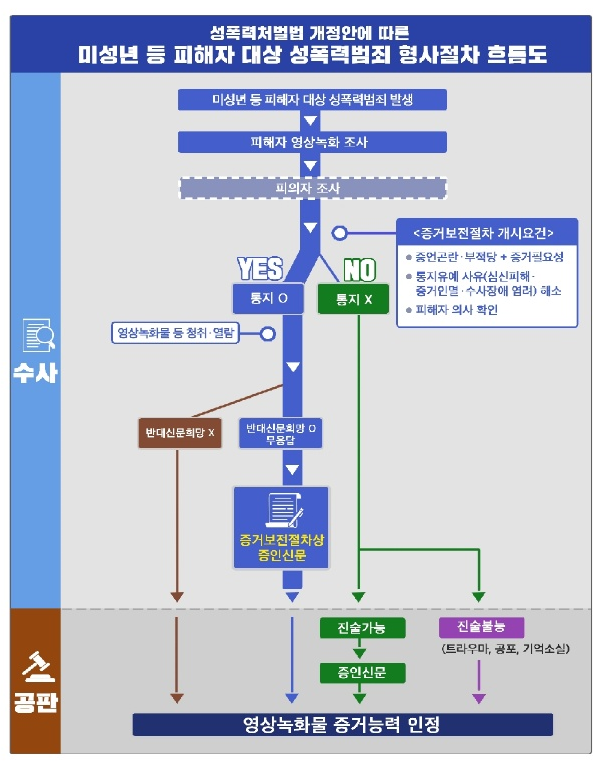 Flowchart of criminal procedures for sexual violence crimes against minors and other victims under the revised Sexual Violence Punishment Act. / Provided by the Ministry of Justice
[Asia Economy Reporter Choi Seok-jin, Legal Affairs Specialist] The Ministry of Justice has prepared a measure allowing video recordings containing the testimony of minor victims of sexual violence to be used as evidence in court without the victims having to testify in person.
In December last year, the Constitutional Court ruled unconstitutional Article 30, Paragraph 6 of the Sexual Violence Punishment Act, which allowed video recordings of testimony from victims under 19 years old to be used as evidence in trials, on the grounds that the defendant's right to cross-examination was not guaranteed.
Due to this ruling, child victims who had previously been freed from criminal procedures after one video-recorded investigation were required to appear again in court as witnesses to testify about the damage suffered and to undergo cross-examination by the defendant's side.
This recent measure by the Ministry of Justice was established to prevent severe emotional distress and the possibility of leading questions by the defendant’s attorney during the secondary testimony process in court. The "Customized Evidence Preservation System for Minor Sexual Violence Victims" is included in the Yoon Seok-yeol administration’s 110 national policy tasks.
On the 29th, the Ministry of Justice announced that the amendment to the Sexual Violence Punishment Act, which introduces customized evidence preservation procedures for minor victims of sexual violence, passed the Cabinet meeting and will soon be submitted to the National Assembly.
The amendment stipulates that when video recordings of testimony from minor victims or victims with mental or physical disabilities due to sexual violence are made during investigations, in principle, the evidence preservation procedure for witness examination before trial will guarantee the defendant’s right to cross-examination, and the video recordings can be used as evidence in court without the victim’s direct testimony.
The evidence preservation procedure is a process where, when it is difficult to use evidence by waiting until the evidence investigation in court, the prosecutor, defendant, or defense attorney can request evidence preservation, and the judge’s approval allows for prior investigation of evidence through witness examination to preserve the results.
However, the amendment allows video recordings of victim testimony to be used as evidence without the evidence preservation procedure in exceptional cases where the defendant waives cross-examination during the investigation stage, or when the minor or mentally or physically impaired victim dies or is unable to testify in court due to illness or other reasons.
The amendment prioritizes the interests of child victims by preventing secondary harm through these procedures, by conducting examinations in child-friendly locations separate from the courtroom (such as Sunflower Centers), with trained professional investigators mediating the questioning of victims, and transmitting the process to the courtroom via video or other relay devices, so that victims do not face the defendant directly or are exposed to aggressive cross-examination.
Additionally, the same investigator will conduct questioning of the victim whenever possible, and irrelevant questions about sexual history or other matters will be prohibited.
Meanwhile, to effectively guarantee the defendant’s right to cross-examination, the amendment allows the defendant or defense attorney to request additional questioning from the court during the examination process, with the judge able to communicate in real time with the professional investigator via electronic devices to incorporate additional questions.
The Ministry of Justice plans to form a working-level consultative body with related agencies such as the Ministry of Gender Equality and Family, the Supreme Prosecutors’ Office, and the National Police Agency to prepare the human and material conditions necessary for the smooth implementation of the evidence preservation procedure, starting with the first meeting held on this day and continuing with regular meetings.
The Ministry of Justice stated, "We will make every effort to ensure that the amendment passes through in-depth discussions in the National Assembly."
© The Asia Business Daily(www.asiae.co.kr). All rights reserved.
![Clutching a Stolen Dior Bag, Saying "I Hate Being Poor but Real"... The Grotesque Con of a "Human Knockoff" [Slate]](https://cwcontent.asiae.co.kr/asiaresize/183/2026021902243444107_1771435474.jpg)















