‘Seoul Digital Sex Crime Citizen Monitoring Group’ of 801 Members Monitors 35 Platforms Including Domestic and International Portals and SNS
339% Removal Actions Taken, 66% No Further Measures... Significant Increase in Citizen Awareness
[Asia Economy Reporter Lim Cheol-young] It has been a year and a half since the so-called 'n번방 방지법' (Nth Room Prevention Act) was enacted to prevent digital sex crimes following the shocking 'Nth Room incident' that shook our society. How much has the internet environment we use daily, such as SNS and portals, changed since the 'Nth Room incident'?
On the 29th, the Seoul Metropolitan Government announced the results of monitoring and analyzing the digital sex crime post reporting systems of 35 online platforms over four months through the 'Digital Sex Crime Citizen Monitoring Group,' consisting of 801 citizens. This is the first case of actually checking how the internet environment, mainly used by citizens in daily life, has changed from the citizens' perspective since the 'Nth Room incident.'
The amendment to the Telecommunications Business Act and the Information and Communications Network Act, which took effect on December 10, 2020, imposes an obligation on all value-added telecommunications service providers to take distribution prevention measures such as deletion and access blocking when there is a report or deletion request for illegal filming materials. Failure to comply with this obligation may result in fines and business suspension.
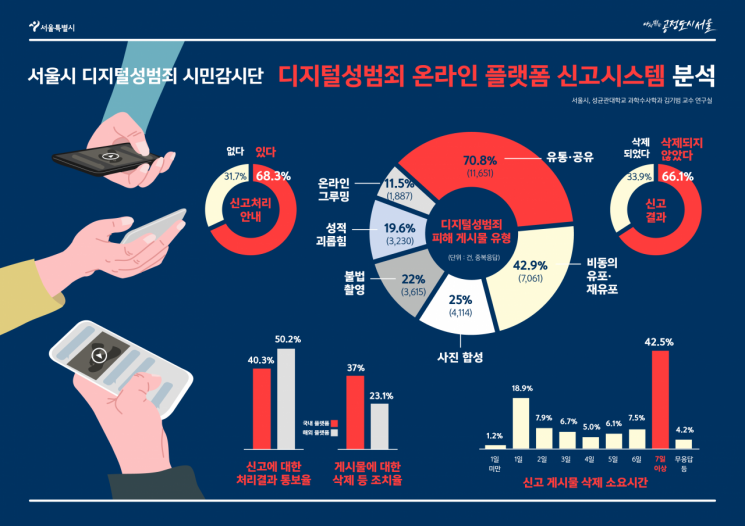
From July to October last year, the 'Digital Sex Crime Citizen Monitoring Group' reported a total of 16,455 digital sex crime posts on 35 online platforms, including domestic and international portals and SNS such as Twitter, Instagram, Facebook, Daum, Naver, and Google. After reporting, 5,584 cases (33.9%) out of the total 16,455 were subject to deletion or other measures, but 10,871 cases (66.1%) saw no action taken. Among the detailed measures, deletion was the most frequent with 3,047 cases (54.6%), followed by temporary restriction with 1,419 cases (25.4%), and temporary suspension with 1,118 cases (20%).
Seoul City analyzed that "the high number of unaddressed reported posts is due to differences in the definition of digital sex crimes across online platforms and unclear criteria on whether reported posts should be considered digital sex crime posts."
However, it was evaluated that deletion and other measures for reported posts have been strengthened compared to before the 'Nth Room incident.' According to the 2019 citizen monitoring group activity results, only 22.8% (592 cases) of reported posts were subject to deletion or other measures, while 77.2% (2,002 cases) were not deleted, meaning only one out of five reported posts was deleted.
The time taken for reported posts on online platforms to be addressed was highest for those taking more than seven days at 42.5%. Posts processed within one day accounted for 20.1%. The time taken for measures such as temporary suspension, temporary restriction, and deletion was 2,374 cases (42.5%) for over seven days, 1,127 cases (20.1%) within one day, and 442 cases (7.9%) within two days. Additionally, the notification rate of processing results after reporting was higher for overseas platforms (50.2%) compared to domestic platforms (40.3%), whereas the deletion and other action rate for reported posts was higher for domestic platforms (37%) than overseas platforms (23.1%).
Furthermore, the gender of victims was predominantly female with 13,429 cases (81.6%) compared to 1,390 cases (8.4%) for males. The age distribution of victims was 9,075 cases (55.2%) adults, 4,680 cases (28.4%) unidentifiable, and 2,700 cases (16.4%) children and adolescents. Looking at the reported posts by crime type: distribution and sharing accounted for 11,651 cases (70.8%), non-consensual distribution and redistribution 7,061 cases (42.9%), photo synthesis and identity theft 4,114 cases (25.0%), illegal filming 3,615 cases (22.0%), sexual harassment 3,230 cases (19.6%), and online grooming 1,887 cases (11.5%).
Awareness of digital sex crimes has also greatly increased. According to a survey of 221 participants in the 'Digital Sex Crime Citizen Monitoring Group' conducted by Seoul City, the response of 'reporting to the platform' when seeing digital sex crime posts increased significantly from 54.5% before the monitoring activities to 91% after. Awareness of the seriousness of digital sex crimes was 94.1%, indicating that most participating citizens recognize its severity.
Citizens identified the top priority action that online platforms should take as "strong regulation (suspension or closure) of accounts posting digital sex crime content" (92 respondents, 41.6%). This was followed by upload blocking (filtering) with 49 respondents (22.2%), improvement of reporting function convenience and accessibility with 36 respondents (16.3%), and prompt deletion and blocking with 29 respondents (13.1%).
Professor Kim Ki-beom of Sungkyunkwan University, who was in charge of analyzing this citizen monitoring group activity, said, "After the 'Nth Room incident,' laws such as the Information and Communications Network Act were amended, and platforms have actively responded, greatly improving the capacity to respond to digital sex crimes," adding, "Going forward, efforts are needed to define the concept of digital sex crimes more specifically and to align platform processing standards similarly."
Kim Seon-soon, Director of the Seoul Metropolitan Government's Women and Family Policy Office, said, "As digital sex crimes are increasing, active deletion measures by platform companies are necessary," and added, "Seoul City will promote integrated support from prevention to victim assistance together with citizens and platform operating companies to create a safer internet environment."
© The Asia Business Daily(www.asiae.co.kr). All rights reserved.
![Clutching a Stolen Dior Bag, Saying "I Hate Being Poor but Real"... The Grotesque Con of a "Human Knockoff" [Slate]](https://cwcontent.asiae.co.kr/asiaresize/183/2026021902243444107_1771435474.jpg)















