[Corporate Insight] Core Component Manufacturing for Military Tactical Communication Systems
Demand for High-Speed X-Band Transmitters Expected to Rise as Satellite Image Transmission Technology Gains Importance
Interest in the space industry has surged like never before following the successful second launch of Nuriho, Korea's independently developed Korean-style launch vehicle. Through the Nuriho launch, Korea has secured independent space transportation capabilities. In terms of the ability to launch practical satellites weighing over 1 ton, Korea has risen to seventh place worldwide. Rapid growth of the domestic space industry is expected in the future. The Ministry of Science and ICT and the Korea Aerospace Research Institute plan to conduct four additional repeated launches by 2027 to improve the reliability of Nuriho. As a mid- to long-term task, the development of a reusable high-performance liquid rocket with a 100-ton-class engine output is also being pursued. From the perspective of export companies, the success of the Nuriho launch has secured a favorable position in overseas exports. Asia Economy analyzed AP Satellite and Zenoco, representative companies related to Nuriho.
[Asia Economy Reporter Park Hyungsoo] With the Korean launch vehicle Nuriho (KSLV-II) successfully reaching orbit, expectations for the growth of the domestic aerospace industry are rising. Satellite communication parts manufacturer Zenoco is growing by successfully domesticating various aerospace parts. With overseas expansion and business diversification bearing fruit, it is expected to achieve record-high sales this year.
Zenoco manufactures non-contact observation cables, a core component of the military tactical information communication network (TICN) project. It is participating in the national space development project and promoting the localization of satellite payloads such as X-band transmitters. It also supplies electronic equipment constituting satellite payloads and satellite operation centers that manage the attitude and relay of the military satellite communication system-II (ANASIS-II) satellite. Furthermore, it participates in the Light Armed Helicopter (LAH) project and Korea’s next-generation fighter project. Its core technologies include ▲ultra-high-speed transmission of satellite payloads ▲modulation and processing technology ▲mechanical design and analysis technology based on 3D modeling of avionics ▲satellite operation and ground data communication technology. Zenoco is a partner company of leading aerospace and defense companies such as Airbus and Lockheed Martin.
As of last year, the sales composition by item consists of 38.0% defense parts including non-contact optical cables, 37.0% launch pad launch control equipment (EGSE) inspection devices, 11.4% avionics, 10.6% satellite terminals and ground stations, and 3.0% satellite payloads.
The Yoon Seok-yeol administration’s policy to foster the space industry combined with active overseas expansion attempts is expected to usher in a full-fledged growth phase. The space industry is a large-scale system industry that integrates various advanced technologies. It requires enormous funds and high technological capabilities. Investments have been made mainly by the government since the early stages of the industry. As technology rapidly advances, the costs of rocket launches and satellite manufacturing have decreased, reaching a level where business feasibility in the space industry is achievable. This is why overseas, especially in the United States, there is a trend of the space industry expanding from government to private sectors.
Companies such as SpaceX, OneWeb, and Amazon are preparing satellite communication businesses using low Earth orbit communication satellites. Satellite companies like Maxar Technologies sell images and video information obtained from observation satellites. Recently, the satellite market has been rapidly growing through satellite miniaturization and low Earth orbit deployment. As the volume of observation videos and photos increases, technology for rapidly transmitting video data to Earth has become important. Demand for Zenoco’s X-band transmitters, which possess the world’s highest transmission speed, is expected to increase.
The domestic space industry began with the 'Mid- to Long-term Basic Plan for Space Development' established in 1996. According to the '3rd Basic Plan for Space Development Promotion' established in 2018, it is progressing in six key areas: ▲self-reliance in space launch vehicle technology ▲advancement of satellite utilization services and development ▲initiation of space exploration ▲establishment of the Korean Positioning System (KPS) ▲creation of a space innovation ecosystem ▲promotion of the space industry and creation of space jobs. According to the plan, the government intends to launch a total of 69 satellites by 2040.
Yoon Chang-bae, a researcher at KB Securities, explained, "Zenoco possesses core technologies for satellite payloads and main bodies, including large-capacity video data transmission components installed on the next-generation medium satellites 1 and 2, and transceivers used in the next-generation small satellite 1." He added, "The development of the S-band repeater is expected to be completed in 2024," and "It is anticipated to be installed on the next-generation medium satellite 5 and multipurpose practical satellite 8."
Zenoco, which plays a significant role in the growth of the domestic space industry, is also pursuing overseas market expansion. It recently signed a satellite ground station supply contract with Airbus, increasing the potential for overseas sales growth.
Based on the technological capabilities accumulated in the satellite communication business, it is pursuing business diversification. It is continuously advancing unmanned aerial vehicle projects and eco-friendly communication businesses. It has succeeded in domesticating avionics and supplies deconfliction devices (DA) for the FA-50 and T-50 aircraft. It has secured core technology by supplying interference prevention units (IBU) for the KF-21 prototype aircraft. It has signed intercom-related contracts with overseas companies and is expected to begin mass production this year. With domestic sales currently dominant, actively supplying satellite ground stations and intercoms overseas could accelerate sales growth.
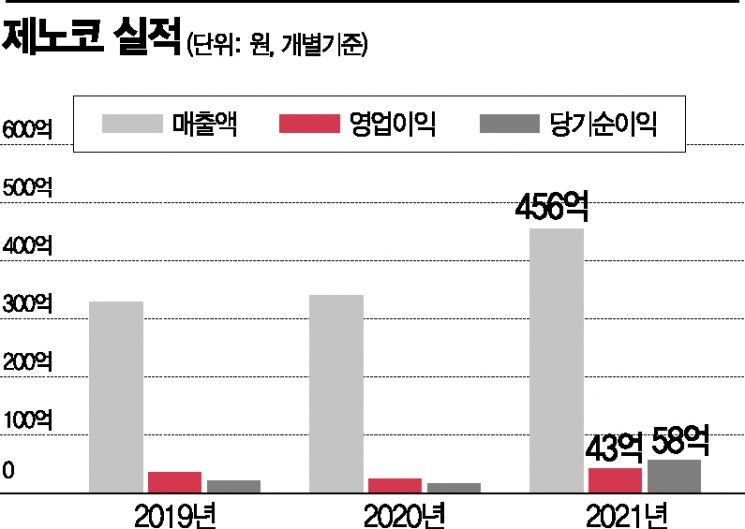
Park Jong-sun, a researcher at Eugene Investment & Securities, estimated that Zenoco will achieve sales of 54.1 billion KRW and operating profit of 6.1 billion KRW this year, increases of 18.5% and 42.7%, respectively, compared to last year. The debt ratio rose from 102% at the end of last year to 118% at the end of the first quarter this year. The company holds 23 billion KRW in cash and cash equivalents.
© The Asia Business Daily(www.asiae.co.kr). All rights reserved.
![Clutching a Stolen Dior Bag, Saying "I Hate Being Poor but Real"... The Grotesque Con of a "Human Knockoff" [Slate]](https://cwcontent.asiae.co.kr/asiaresize/183/2026021902243444107_1771435474.jpg)















