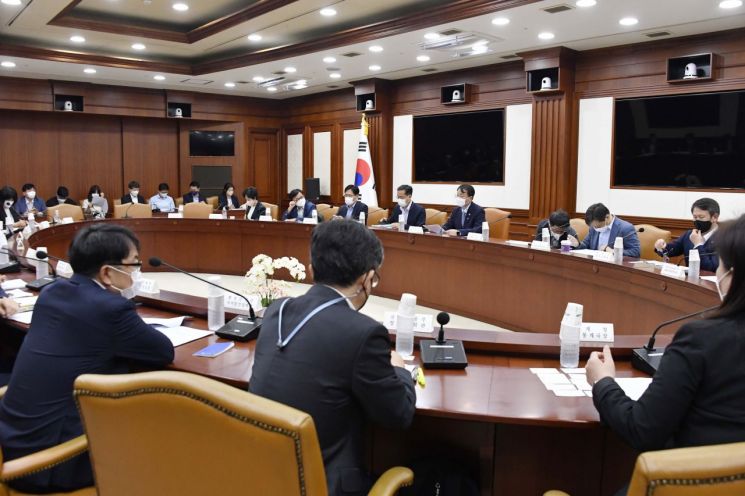
 The 'Population Crisis Response TF' is being held on the morning of the 24th at the Government Seoul Office in Jongno-gu, Seoul, chaired by Bang Gi-seon, the 1st Vice Minister of the Ministry of Economy and Finance. (Photo by Ministry of Economy and Finance)
The government has officially launched the 'Population Crisis Response Task Force (TF)' to address the increasingly severe low birthrate issue. The TF will focus on expanding economic participation among women and the elderly, as well as enhancing incentives for marriage and childbirth.
On the morning of the 24th, Bang Gi-seon, the first vice minister of the Ministry of Economy and Finance, chaired the first meeting of the Population Crisis Response TF at the Government Seoul Office in Jongno-gu, Seoul, the Ministry announced.
Although the government had previously operated a population policy TF, the new TF was established as the population risk worsened due to the impact of COVID-19, with the number of marriages and births falling to historic lows.
In his opening remarks, Vice Minister Bang said, "The total population peaked at 51.84 million in 2020 and is expected to continuously decline, returning to the 1970s level of 37.66 million by 2070." He added, "As the world’s fastest aging population progresses, concerns are growing over the sustainability of pension systems, social insurance, and welfare finances."
During the meeting, the population crisis response promotion plan and key discussion topics from 10 working groups were presented and discussed. Additionally, eight core tasks across four major areas were selected for focused implementation. The four major tasks include expanding the economically active population such as women, the elderly, and foreigners, preparing for a shrinking society due to decreases in school-age and military-age populations, preparing for an aging society, and responding to low birthrates.
Vice Minister Bang stated, "We will sequentially announce population crisis response measures and sector-specific plans after July, and swiftly implement them through next year’s budget allocation and legal and institutional improvements."
The meeting was attended by first-level officials from 18 related ministries including the Ministry of Education, Ministry of Science and ICT, Ministry of Justice, Ministry of National Defense, Ministry of the Interior and Safety, Ministry of Culture, Sports and Tourism, and Ministry of Trade, Industry and Energy, as well as the deputy director of the National Strategy Research Center of the Economic, Social and Humanities Research Council, senior researcher Kang Dong-su of KDI, and Professor Lee Cheol-hee of Seoul National University.
© The Asia Business Daily(www.asiae.co.kr). All rights reserved.
![Clutching a Stolen Dior Bag, Saying "I Hate Being Poor but Real"... The Grotesque Con of a "Human Knockoff" [Slate]](https://cwcontent.asiae.co.kr/asiaresize/183/2026021902243444107_1771435474.jpg)















