Yoon Administration Prioritizes Labor Reform Among 5 Key Sectors
Revamps Working Hours and Wage System to Boost Economy
Labor Unions Oppose... "Not Reform but Deterioration"
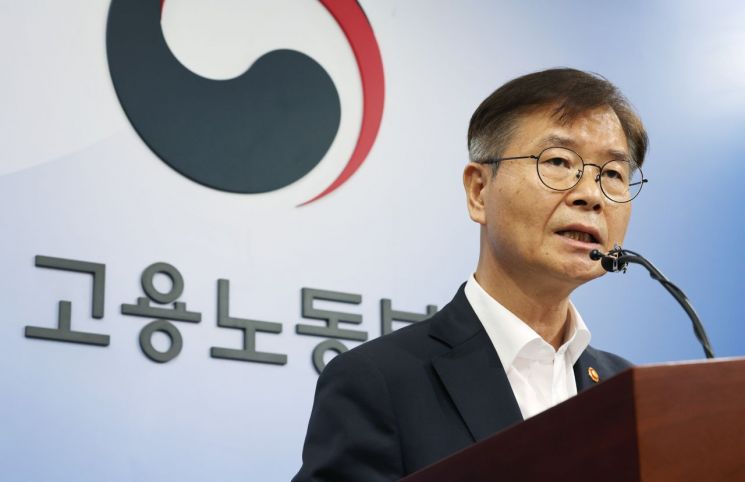 Minister of Employment and Labor Lee Jeong-sik is briefing on the direction of labor market reform promotion at the Government Complex Sejong on the morning of the 23rd.
 [Photo by Yonhap News]
The reason the Yoon Suk-yeol administration set a policy to prioritize ‘labor market reform,’ represented by the restructuring of working hours and wage systems, at the early stage of its launch is due to the severity of issues such as job shortages, declining corporate productivity, and aging population in South Korea. It reflects the sense of crisis that the country’s competitiveness is falling behind because, unlike major advanced countries such as Japan and France, the Moon Jae-in administration’s five years of biased ‘pro-labor policies’ failed to implement reforms suited to the rapidly changing industrial structure.
The government believes that labor reform can revitalize companies and create a sustainable, future-oriented labor market. However, since large labor unions such as the Korean Confederation of Trade Unions (KCTU) define the government’s labor reform as a ‘deterioration,’ significant resistance is expected. Given that it is also difficult to seek cooperation from the Democratic Party of Korea, which holds more than half of the National Assembly seats, the key will be how much public support the government can secure during the labor reform process.
Accelerating Labor Reform Amid Aging and Low Birthrate
On the 23rd, Deputy Prime Minister and Minister of Economy and Finance Choo Kyung-ho said at the Emergency Economic Ministers’ Meeting, "Neglecting the labor market structure that is disconnected from economic realities erodes the nation’s competitiveness and dynamism and, above all, deprives youth and future generations of opportunities," adding, "Labor market reform is an urgent task that cannot be postponed." Earlier, on the 16th, the government announced in the ‘New Government Economic Policy Direction’ that it would pursue structural reforms in five major sectors: public, labor, education, finance, and services, with labor reform being the first agenda item.
This underscores the significant impact of South Korea’s labor market on labor productivity and growth potential. According to the Ministry of Employment and Labor, South Korea is aging at an unprecedentedly rapid pace worldwide and is approaching a super-aged society by 2025. The government judges that under the existing labor market structure, sustainable growth is difficult to guarantee amid the rapidly changing industrial structure following COVID-19.
Unlike major advanced countries, South Korea’s labor reform is relatively delayed. France announced a large-scale labor reform bill in 2017, and Japan also introduced the ‘Work Style Reform Implementation Plan’ that year to restructure its labor market. However, South Korea failed to push forward meaningful labor reforms due to the Park Geun-hye administration’s collapse of the tripartite labor-management-government agreement and the Moon Jae-in administration’s pro-labor policies.
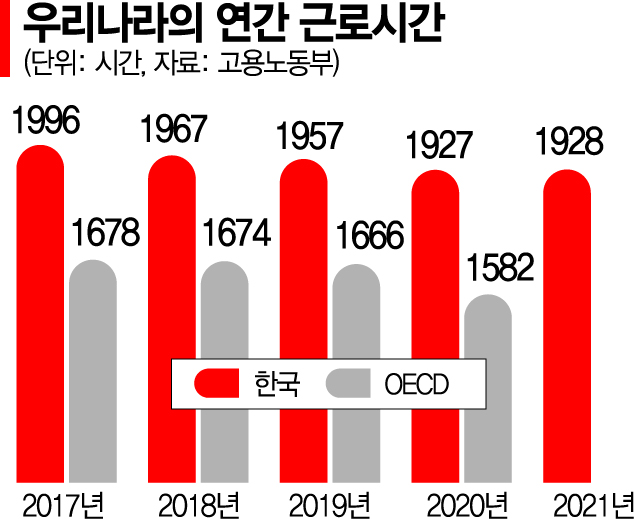
The rigidity of South Korea’s labor structure also strengthens the need for reform. The proportion of seniority-based wage systems in domestic companies is very high: 55.5% in businesses with over 100 employees and 70.3% in those with over 1,000 employees. Notably, the wage gap between workers with less than one year of service and those with over 30 years is 2.87 times, which is higher than Japan’s 2.27 times, a country known for its seniority system. Annual working hours were recorded at 1,928 hours last year, exceeding the OECD average of around 1,500 hours.
The government plans to create legislative and policy tasks through an expert group called the ‘Future Labor Market Research Committee.’ Since restructuring working hours and wage systems are highly contentious issues between labor and management, the committee will develop expert-driven alternatives that both labor, management, and the general public can agree upon. The first meeting will be held next month to discuss and finalize detailed agenda items and specific operational schedules.
The Ministry of Employment and Labor will transparently disclose interim and final discussion results through regular briefings. The expert proposals prepared by the committee will be submitted to the government as ‘recommendations,’ based on which the government will conduct further reviews and gather opinions from labor, management, and the public to prepare the final legislative bill.
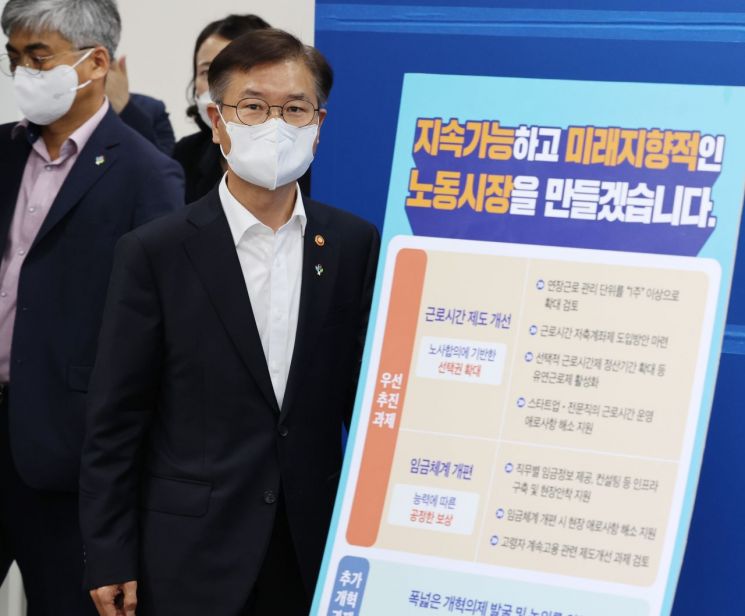 Minister of Employment and Labor Lee Jeong-sik is attending a briefing on the direction of labor market reform held at the Government Complex Sejong on the morning of the 23rd. [Image source=Yonhap News]
Can Opposition from Labor Circles Be Overcome?
Although the government views reform as essential under the current labor market structure, strong opposition from labor circles is expected to make progress difficult. The Korean Confederation of Trade Unions (KCTU) and the Federation of Korean Trade Unions (FKTU) maintain that the government’s wage system restructuring will ultimately harm workers. They argue that, like the wage peak system recently ruled invalid by the Supreme Court, it could lead to wage cuts and forced long working hours for workers.
In particular, the KCTU criticized the government’s labor reform direction as ‘labor deterioration.’ The KCTU-affiliated Labor Research Institute stated, "This policy deepens and expands the neoliberal trend of labor flexibility," adding, "Its essence is to strengthen employers’ discretion over working hours, undermining the regulatory framework on long working hours and seriously threatening workers’ health rights."
They also warned of strong resistance. Lee Jung-hee, Policy Director of the KCTU, said, "The KCTU is a powerful organization that can fight against the Yoon government," and emphasized, "We must broadly organize solidarity groups to expand universal labor rights and strengthen publicness and respond jointly." The KCTU has also announced a ‘National Workers’ Rally to Stop Labor Deterioration and Public Sector Retreat’ scheduled for the 2nd of next month in downtown Seoul.
The FKTU, considered relatively moderate, shares a similar stance. In a statement, the FKTU said, "The Yoon government’s economic policy is a replica of the Lee Myung-bak administration 15 years ago," and argued, "In South Korea, where unionization is only 12%, policies like selective working hours will be used as means to enforce concentrated long working hours." An FKTU official said, "The government claims that selective working hours and flexible working hours will not be abused, but this is the result of abusing the special extended working hours approval system," and added, "Before labor reform, the government must acknowledge its failure in labor policy."
Therefore, there is an analysis inside and outside the government that reform efforts should be based on public support rather than existing large labor unions to achieve results. Minister Choo emphasized, "We will listen to the diverse voices of the people," and "We will promote reform based on public consensus."
© The Asia Business Daily(www.asiae.co.kr). All rights reserved.
![Clutching a Stolen Dior Bag, Saying "I Hate Being Poor but Real"... The Grotesque Con of a "Human Knockoff" [Slate]](https://cwcontent.asiae.co.kr/asiaresize/183/2026021902243444107_1771435474.jpg)

















