Yoo Hee-yeol Admits Similarity in 'Aqua' Plagiarism Controversy, Apologizes
Original Creator Says Similarity Exists but Not 'Plagiarism Category'
Controversy Seemed Settled but 3 More Online Plagiarism Allegations Arise
Expert: "Creators Must Become Their Own 'Supervisors'"
"Post-Management Essential to Avoid K-POP Plagiarism Stigma"
 Composer and singer Yoo Hee-yeol is facing growing controversy as additional plagiarism allegations have been raised following accusations that he plagiarized a song by Ryuichi Sakamoto.
[Asia Economy Reporter Yoon Seul-gi] Composer and singer Yoo Hee-yeol has admitted allegations of plagiarizing a piece by the Japanese film music maestro Ryuichi Sakamoto, amid which additional plagiarism suspicions have been raised one after another, spreading the controversy. As plagiarism controversies persist in the music industry, voices calling for clear standards to quickly determine plagiarism are emerging, but since plagiarism is a crime prosecuted only upon complaint, even this is not easy. Experts emphasize that the conscience of individual creators is most important regarding plagiarism issues and stress the systematization of checks and verification.
Recently, Yoo Hee-yeol, through his agency Antenna's social networking service (SNS), reviewed reports that the second track of the 'Yoo Hee-yeol's Living Music' project, 'A Very Private Night,' and Ryuichi Sakamoto's 'Aqua' are similar, stating "he agreed that the main theme of the song is sufficiently similar," thus acknowledging the plagiarism claim.
Yoo Hee-yeol said, "As a musician I have been most influenced by and respected for a long time, I unconsciously wrote the song with a similar progression that remained in my memory. At the time of release, I thought it was a purely original work, but I had to acknowledge the similarity between the two songs," adding, "I apologize for disappointing many people."
In response, Ryuichi's side stated, "We immediately confirmed the 'similarity,' but after musical analysis, we judged that the melody and chord progression do not meet the criteria for plagiarism," meaning that although there is similarity, it is not at a level requiring legal action.
It seemed the situation was settling as the accused apologized and the original artist denied plagiarism, but the controversy reignited with three additional plagiarism allegations.
These include claims that singer Sung Si-kyung's 2002 release 'Happy Birthday to You' (lyrics, composition, and arrangement by Yoo Hee-yeol) is similar to Tamaki Koji's 1998 song of the same name 'Happy Birthday to You'; 'Please Don't Go My Girl (Feat. Kim Jo-han),' released in 2013 on MBC's variety show 'Infinite Challenge - Jayu-ro Music Festival,' resembles the 1998 song 'Body Bumpin' by the group Announcement; and Yoo Hee-yeol's September 2021 release 'The Time I Turn On' is similar to an inserted track in Ryuichi Sakamoto's '1900,' with these allegations continuously raised online.
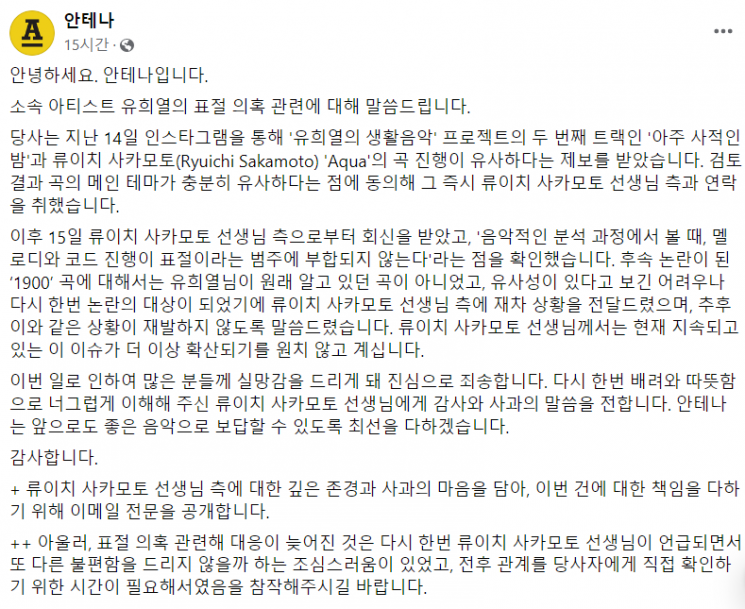 Yoo Hee-yeol's agency Antenna clarified the plagiarism controversy on the 21st through social networking service (SNS).
Photo by Facebook capture
On the 21st, Antenna stated via its official SNS, "Regarding the follow-up controversy over the song '1900,' Yoo Hee-yeol was not originally familiar with the song," adding, "It is difficult to see the similarity, but since it has become a subject of controversy again, we have communicated the situation once more to Mr. Sakamoto's side," but did not comment on the other two songs involved in plagiarism allegations.
◆ Repeated Plagiarism Controversies in the Music Industry... Why?
Although plagiarism controversies have been frequent in the music industry, cases legally recognized as plagiarism are rare. Since plagiarism is a crime prosecuted only upon complaint, legal sanctions cannot be imposed unless the original copyright holder files a complaint, and because the standards for judging plagiarism are ambiguous, even legal battles rarely result in recognition of plagiarism.

In 2011, composer Kim Shin-il, who raised allegations that singer and composer Park Jin-young's song 'Someday' plagiarized his own song 'To My Man,' engaged in a lawsuit for over four years but ultimately accepted the court's recommendation for reconciliation.
The lawsuit was full of twists and turns; the first and second trial courts recognized that the four bars of the chorus in 'Someday' were based on part of the chorus in 'To My Man' and ruled that Park Jin-young pay damages. However, the Supreme Court judged that the chorus of 'To My Man' itself was similar to many previously released works and lacked originality, ruling that Park Jin-young was not liable for damages.
Currently, the legal standards for judging plagiarism in musical works are broadly divided into ▲ originality ▲ derivation ▲ substantial similarity. According to guidelines presented by the Ministry of Culture, Sports and Tourism, to determine similarity between two works, the relationship of derivation (whether the work was based on an existing work) and substantial similarity (whether the works are substantially similar, not just superficially) are examined. In music, melody, rhythm, and harmony are considered. However, since plagiarism is a crime prosecuted only upon complaint, it cannot be established without a complaint from the original copyright holder.
Experts emphasize that as K-POP's global status rises, post-management of plagiarism issues is crucial. Popular music critic Lim Jin-mo said, "Yoo Hee-yeol is a person with significant influence in the music industry, called a 'genius composer.' Since he himself acknowledged the similarity, he cannot be free from plagiarism issues and will face public criticism."
Regarding plagiarism prevention systems, critic Lim said, "Because plagiarism is a crime prosecuted only upon complaint, it is practically impossible to have third-party intervention such as establishing an institution to judge plagiarism disputes," adding, "Creators themselves must act as supervisors. Ultimately, checks and verification must be systematized."
He continued, "Now that attention to K-POP is increasing, to prevent K-POP from suffering negative impacts like being stigmatized with plagiarism, post-management after problems arise is more important," advising, "It should serve as an opportunity to sound an alarm by inspecting K-POP regarding plagiarism issues."
© The Asia Business Daily(www.asiae.co.kr). All rights reserved.
![Clutching a Stolen Dior Bag, Saying "I Hate Being Poor but Real"... The Grotesque Con of a "Human Knockoff" [Slate]](https://cwcontent.asiae.co.kr/asiaresize/183/2026021902243444107_1771435474.jpg)
















