LPR 1-Year at 3.7%, 5-Year at 4.45%, Maintaining Same Level as Previous Month
US Interest Rates and Inflation Considered... Fiscal Policy Likely to Ease Further Considering Economic Growth Rate
[Asia Economy Beijing=Special Correspondent Jo Young-shin] China's monetary policy aimed at stimulating the economy through interest rate cuts has come to a halt.
As the U.S. Federal Reserve Board (Fed) has implemented a strong interest rate hike of 0.75 percentage points to curb inflation, it has become difficult to pursue monetary policy through interest rate cuts. If the interest rate gap between the U.S. and China widens further, the possibility of foreign currencies such as the dollar leaving the Chinese market increases.
Additionally, China may face a situation where it must also manage inflation, leading Chinese authorities to focus on fiscal policy rather than monetary policy for the time being.
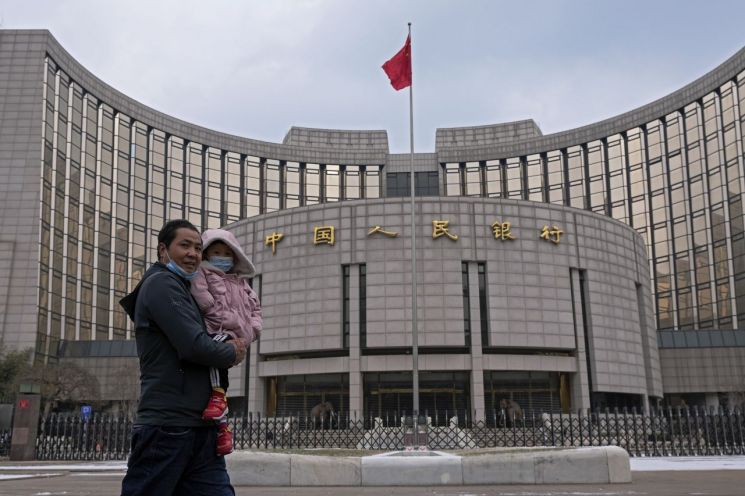
On the 20th, the People's Bank of China, the country's central bank, announced that the one-year Loan Prime Rate (LPR) and the five-year LPR were maintained at 3.7% and 4.45%, respectively, the same as the previous month. The LPR is an average rate compiled from the loan rates offered to the best customers of commercial banks and effectively serves as the benchmark interest rate in China.
The freeze on the LPR had been anticipated. The general view is that it will be difficult for Chinese financial authorities to stimulate the economy through interest rate cuts in the near term.
Primarily, the interest rate gap with the U.S. is expected to be a major obstacle. The narrower the gap between U.S. and Chinese interest rates becomes, the higher the likelihood that foreign currencies will exit the Chinese capital market. The outflow of foreign currencies such as the dollar lowers the value of the yuan. Yuan depreciation stimulates China's import prices.
Moreover, further LPR cuts could lead to unexpected inflationary pressures in China. Last month, China's Consumer Price Index (CPI) reached 2.1%, entering the 2% range, but it remains lower than that of many other countries.
Furthermore, the Chinese government's adherence to the 'Zero COVID' policy also acts as a barrier to using monetary policy. Even if interest rates are cut, the reality is that the entities that would spend money are restricted due to lockdowns. The consensus is that interest rate cuts may only stimulate prices without achieving the expected economic stimulus effect.
In fact, last month, the People's Bank of China took a baby step by freezing the one-year LPR and cutting the five-year LPR by 0.15 percentage points. The cut in the five-year LPR is interpreted as a measure considering the real estate market. It is read as a message from financial authorities that they will not allow the real estate market to deteriorate significantly.
Ultimately, the cards available to Chinese authorities for economic stimulus are limited to fiscal policies such as issuing special bonds, making it somewhat more difficult to achieve this year's economic growth target. Additionally, fiscal policy leads to increased debt for central and local governments, limiting flexibility.
Some voices within China are calling for a revision of the government's fiscal deficit ratio. Considering domestic and international conditions such as rising international commodity prices, the Russia-Ukraine war, delayed supply chain recovery, and unstable employment and industrial environments due to the resurgence of COVID-19, there is a need for a proactive upward adjustment. This year's fiscal deficit target for China is 2.8%, which is 0.4 percentage points lower than last year's target of around 3.2%. This is significantly lower than the 3.6% during the height of COVID-19 in 2020.
Meanwhile, Chinese media are optimistic, stating that domestic demand is reviving through the 6·18 shopping festival period and that the Chinese economy could achieve growth in the 6% range in the third quarter.
© The Asia Business Daily(www.asiae.co.kr). All rights reserved.
![Clutching a Stolen Dior Bag, Saying "I Hate Being Poor but Real"... The Grotesque Con of a "Human Knockoff" [Slate]](https://cwcontent.asiae.co.kr/asiaresize/183/2026021902243444107_1771435474.jpg)















